Federal Litigation Record
Establishes who alleged what, under which legal theories, and what narrative was formally placed before the court.
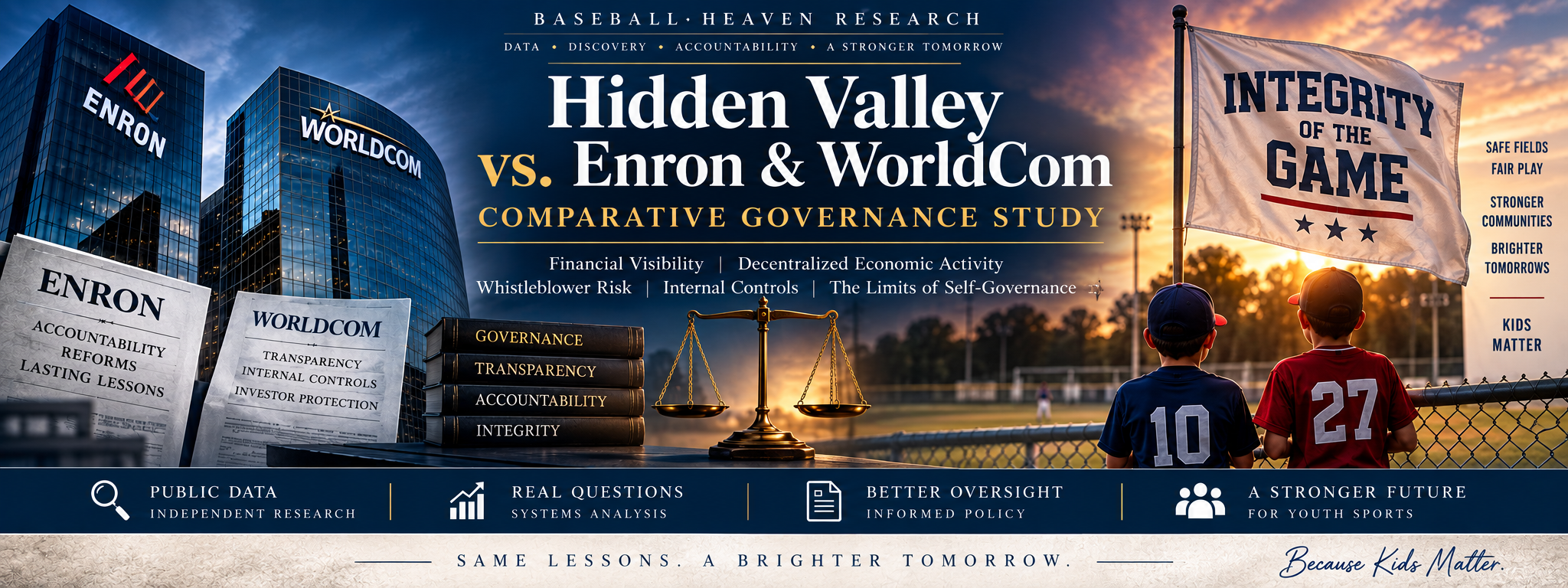
Financial visibility, decentralized economic activity, whistleblower risk, internal controls and the limits of self-governance.
Enron and WorldCom are used as historical control-failure benchmarks. The USSSA federal litigation is a contested governance case. Hidden Valley is an independent public-data reconstruction methodology. The study asks what those different evidence environments teach us about transparency, reporting boundaries, internal controls and external verification.
A public-company governance and financial-reporting failure followed by extensive investigation, prosecution and adjudication.
A public-company accounting and internal-control failure that produced a large authoritative record and regulatory consequences.
A federal complaint alleged serious misconduct, but the core allegations were not comprehensively adjudicated at trial. Hidden Valley separately reconstructs Oklahoma's observable event economy.
Hidden Valley is not an audit of USSSA's books. It is a longitudinal reconstruction of publicly observable Oklahoma USSSA activity from 2001–2026.
Establishes who alleged what, under which legal theories, and what narrative was formally placed before the court.
Establishes observable events, division records, team entries, published prices, director associations, facility associations and modeled relationships.
Courts, IRS, municipalities, auditors and other authorized bodies can examine nonpublic records and make determinations within their jurisdiction.
The central research problem is not simply “where did the money go?” It is determining which economic activity belongs to the national organization, regional/state structures, independent contractors, facilities or other parties - and what records make those boundaries visible.
The complaint describes USSSA as a 501(c)(4) organization with more than four million participants, approximately $20 million in annual organizational revenue, and more than 3,500 state and area directors. It describes directors as generally independent contractors and identifies multiple revenue categories.
A separate Oklahoma event-level reconstruction that allows researchers to test the scale and structure of visible tournament activity without assuming the complaint's contested allegations are true.
| Dimension | Enron | WorldCom | USSSA / Hidden Valley |
|---|---|---|---|
| Institution | Public corporation | Public corporation | 501(c)(4) sports organization plus decentralized event network |
| Disclosure regime | SEC / public-company reporting | SEC / public-company reporting | Form 990 + internal records + state/local event architecture |
| Misconduct status | Extensively investigated and adjudicated | Extensively investigated and adjudicated | Federal complaint alleged serious misconduct; no comprehensive trial adjudication of the core allegations |
| Insider reporting | Important to public understanding and enforcement | Important to detection and investigation | Central to federal complaint and current governance analysis |
| External verification | Auditors, SEC, prosecutors, courts | Auditors, SEC, prosecutors, courts | Tax filings, municipalities, litigation records, event data, contractor records and agency validation |
| Best use in this study | Governance/control-failure benchmark | Accounting/control-failure benchmark | Governance-risk and transparency case study |
The federal complaint alleged that USSSA Midwest operated as a regional layer between national USSSA and state/local operations and specifically identified a component involving Kansas, Missouri and Oklahoma.
Private settlement can resolve litigation without producing the comprehensive public factual record that a trial, regulatory investigation or criminal prosecution may produce. That difference is central to the comparison.
Investigation → discovery → prosecutions/trials → established misconduct → large public record → major regulatory consequences.
Whistleblower allegations → federal litigation → judicial proceedings → settlement → no comprehensive trial verdict resolving all core factual allegations.
Public USSSA data → event reconstruction → director mapping → facility mapping → modeled economic analysis → questions for independent validation.
The federal complaint repeatedly alleged retaliation involving board members, employees and an independent contractor after concerns were raised. For this study, those allegations create governance questions - not findings of retaliation.
Is the reporting channel independent from the people whose conduct may be questioned?
Can an independent contractor report concerns without realistically risking event assignments, territory, facilities or livelihood?
Can parents, coaches, officials or municipal employees escalate serious concerns outside the sanctioning body's own hierarchy?
Are relevant records preserved long enough for independent review by the bodies that possess authority to validate disputed claims?
Publicly displayed events · division records · team entries · published fees · director associations · facility associations · public agreements when obtained · historical activity patterns · transparent calculations and modeled economic relationships.
Actual bank deposits · who ultimately retained funds · individual tax reporting · unreported income · criminal intent · accuracy of nonpublic accounting · RICO liability · truth of contested litigation allegations.
The strongest policy lesson is sanction-neutral: establish reasonable protections where children, families, substantial private commerce and public assets intersect.
Transparent leases, licenses and subleases; identification of operating entities; community-access obligations; periodic review.
Proportionate documentation for high-volume commercial activity on public property and clear economic-impact methodology.
Complaint and escalation pathways for defined child-safety, retaliation, financial and governance concerns.
Payment documentation, workforce standards, training, classification and sustainable compensation.
Meaningful conflict-of-interest disclosure, board oversight and records-retention practices.
Research questions should be routed to the courts, IRS, municipalities, auditors or agencies with lawful access to nonpublic records.
This framing places the project within governance, nonprofit accountability, principal-agent theory, institutional theory, public-private partnerships, public choice, sports economics and municipal recreation administration. A doctoral-quality design can treat Enron and WorldCom as historical control-failure benchmarks, the federal USSSA litigation as a contested governance case, and Hidden Valley as an independent empirical reconstruction methodology.
The documents below are presented so viewers can distinguish the underlying federal litigation record from the independent Hidden Valley research.
Primary federal court pleading. Allegations in this document are allegations unless separately adjudicated or independently verified.
Use alongside the complaint and Hidden Valley reconstruction. The page does not treat contested assertions as adjudicated findings.
Enron and WorldCom demonstrate what extensively documented corporate control failures can look like after investigation and adjudication. The USSSA litigation demonstrates how serious allegations can arise within a large, decentralized sports organization and still end without a comprehensive public trial record. Hidden Valley addresses the remaining research problem from outside the organization by reconstructing the observable Oklahoma event economy.