
TULSA HILTI PARK
USSSA Facility Activity Profile | Oklahoma Baseball Research | 2001–2026
Integrity of the Game vs Economic Impact (Politics): The Oklahoma Business Plan
Tulsa, Oklahoma
Public-source venue designation used in the USSSA records analyzed for this profile.
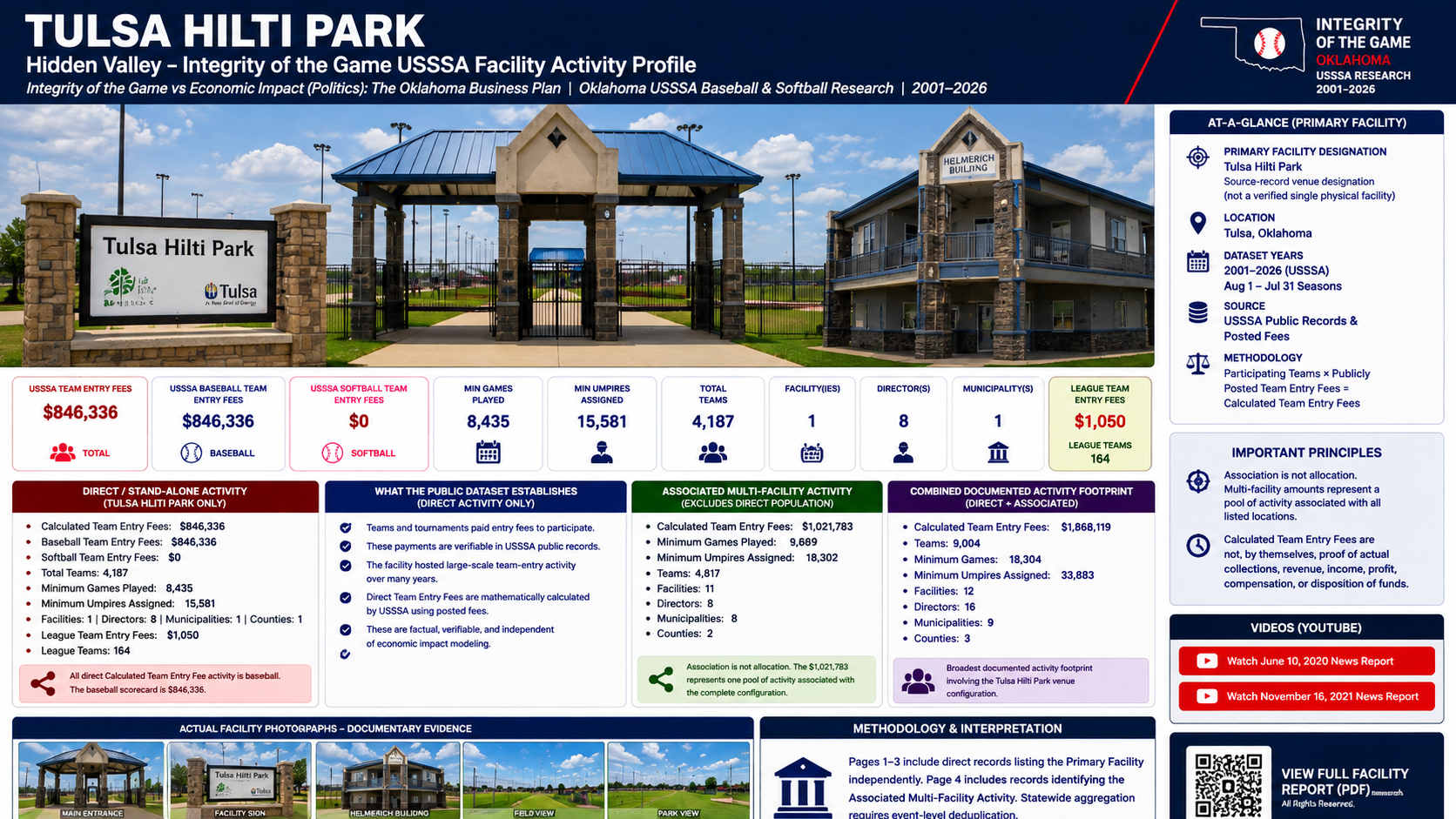
Direct / stand-alone Tulsa Hilti Park activity
Pages 1–2 of the Facility Report represent records listing Tulsa Hilti Park independently and exclude the associated multi-facility combinations shown on Page 3.
Direct activity, municipality and director concentration
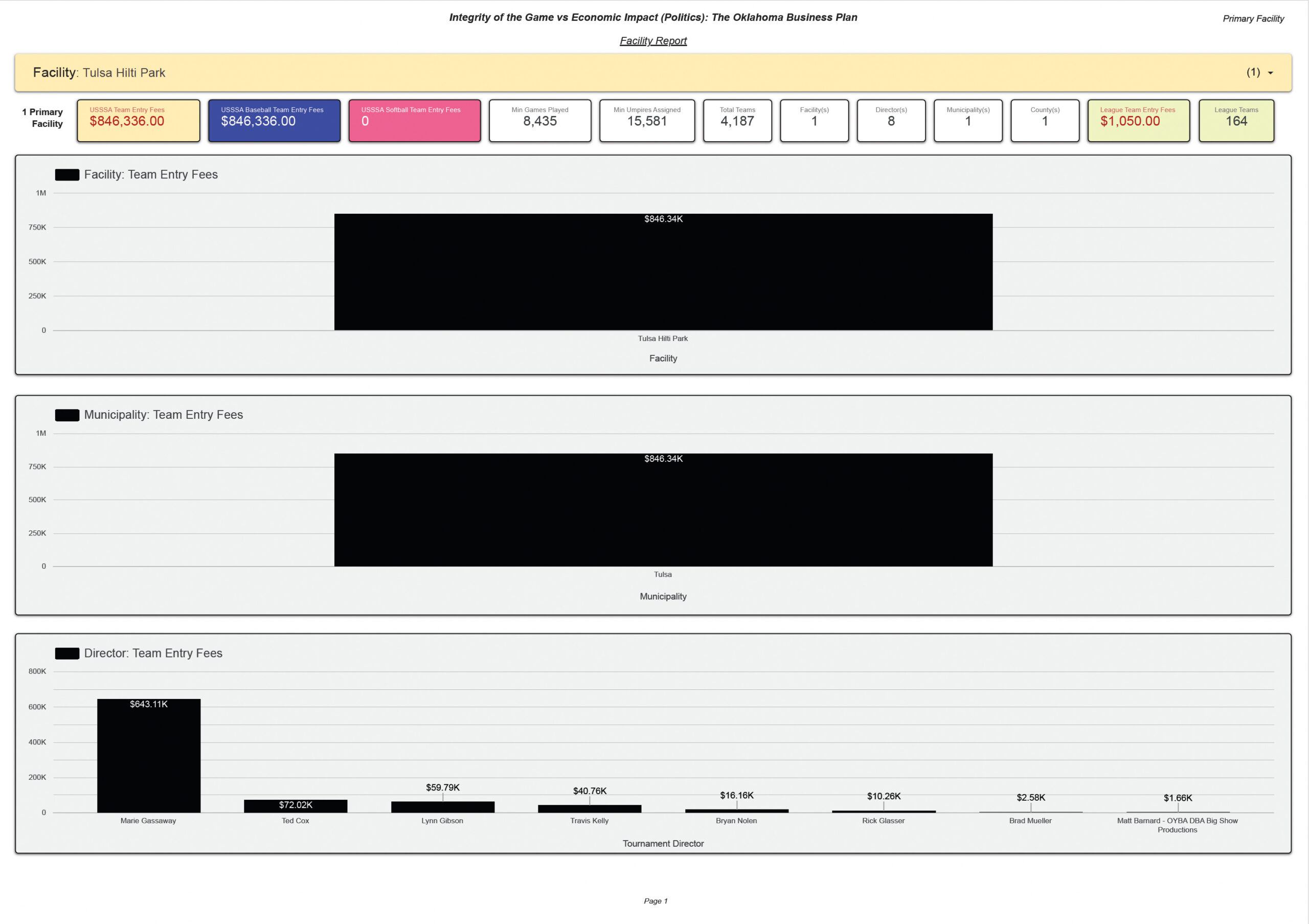
The report identifies $846,336 in direct Calculated Team Entry Fees associated with records listing Tulsa Hilti Park alone. The displayed direct activity is entirely baseball, with $0 in softball.
Those records represent 4,187 teams, at least 8,435 games, and 15,581 umpire assignments.
- Marie Gassaway — approx. $643.11K
- Ted Cox — approx. $72.02K
- Lynn Gibson — approx. $59.79K
- Travis Kelly — approx. $40.76K
- Bryan Nolen — approx. $16.16K
- Rick Glasser — approx. $10.26K
- Brad Mueller — approx. $2.58K
- Matt Barnard – OYBA DBA Big Show Productions — approx. $1.66K
Annual and sport trend analysis

| Season | Total | Baseball | Softball |
|---|---|---|---|
| 2022 | $840 | $840 | $0 |
| 2021 | $10.46K | $10.46K | $0 |
| 2020 | $20.37K | $20.37K | $0 |
| 2019 | $26.61K | $26.61K | $0 |
| 2018 | $30.99K | $30.99K | $0 |
| 2017 | $53.50K | $53.50K | $0 |
| 2016 | $83.37K | $83.37K | $0 |
| 2015 | $94.54K | $94.54K | $0 |
| 2014 | $93.94K | $93.94K | $0 |
| 2013 | $93.51K | $93.51K | $0 |
| 2012 | $95.85K | $95.85K | $0 |
| 2011 | $66.68K | $66.68K | $0 |
| 2007 | $8.12K | $8.12K | $0 |
| 2006 | $29.93K | $29.93K | $0 |
| 2005 | $19.64K | $19.64K | $0 |
| 2004 | $54.54K | $54.54K | $0 |
| 2003 | $63.47K | $63.47K | $0 |
| 2002 | $0 | $0 | $0 |
Associated multi-facility / satellite activity
This analytical population excludes the stand-alone Tulsa Hilti Park records and captures events where Tulsa Hilti Park appears together with one or more additional facilities.
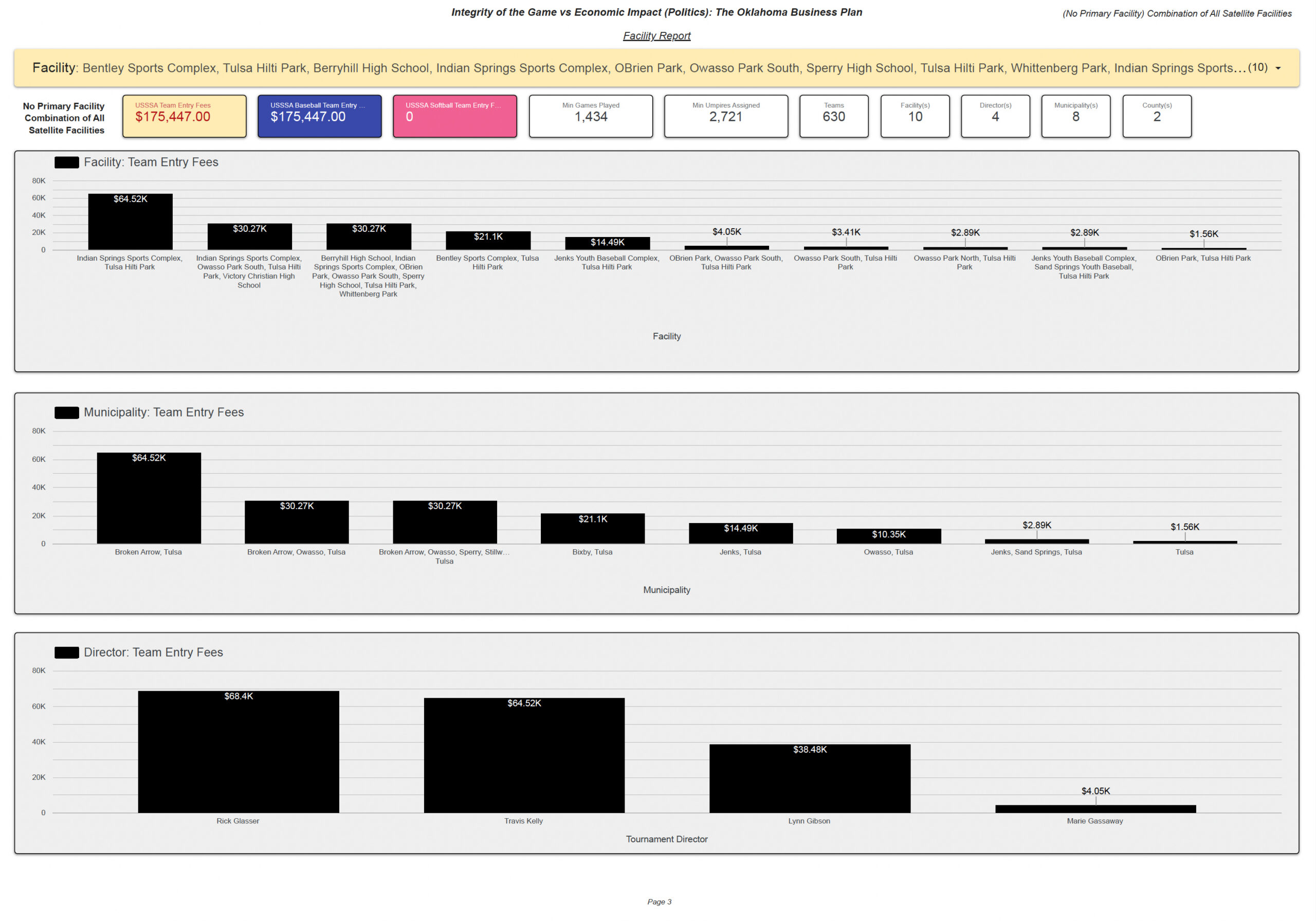
| Facility combination | Associated Calculated Team Entry Fee activity |
|---|---|
| Indian Springs Sports Complex + Tulsa Hilti Park | $64.52K |
| Indian Springs Sports Complex + Owasso Park South + Tulsa Hilti Park + Victory Christian High School | $30.27K |
| Berryhill High School + Indian Springs Sports Complex + OBrien Park + Owasso Park South + Sperry High School + Tulsa Hilti Park + Whittenberg Park | $30.27K |
| Bentley Sports Complex + Tulsa Hilti Park | $21.10K |
| Jenks Youth Baseball Complex + Tulsa Hilti Park | $14.49K |
| OBrien Park + Owasso Park South + Tulsa Hilti Park | $4.05K |
| Owasso Park South + Tulsa Hilti Park | $3.41K |
| Owasso Park North + Tulsa Hilti Park | $2.89K |
| Jenks Youth Baseball Complex + Sand Springs Youth Baseball + Tulsa Hilti Park | $2.89K |
| OBrien Park + Tulsa Hilti Park | $1.56K |
Combined documented activity footprint
Pages 1–2 direct activity + Page 3 associated multi-facility activity = Page 4 combined documented facility activity footprint.
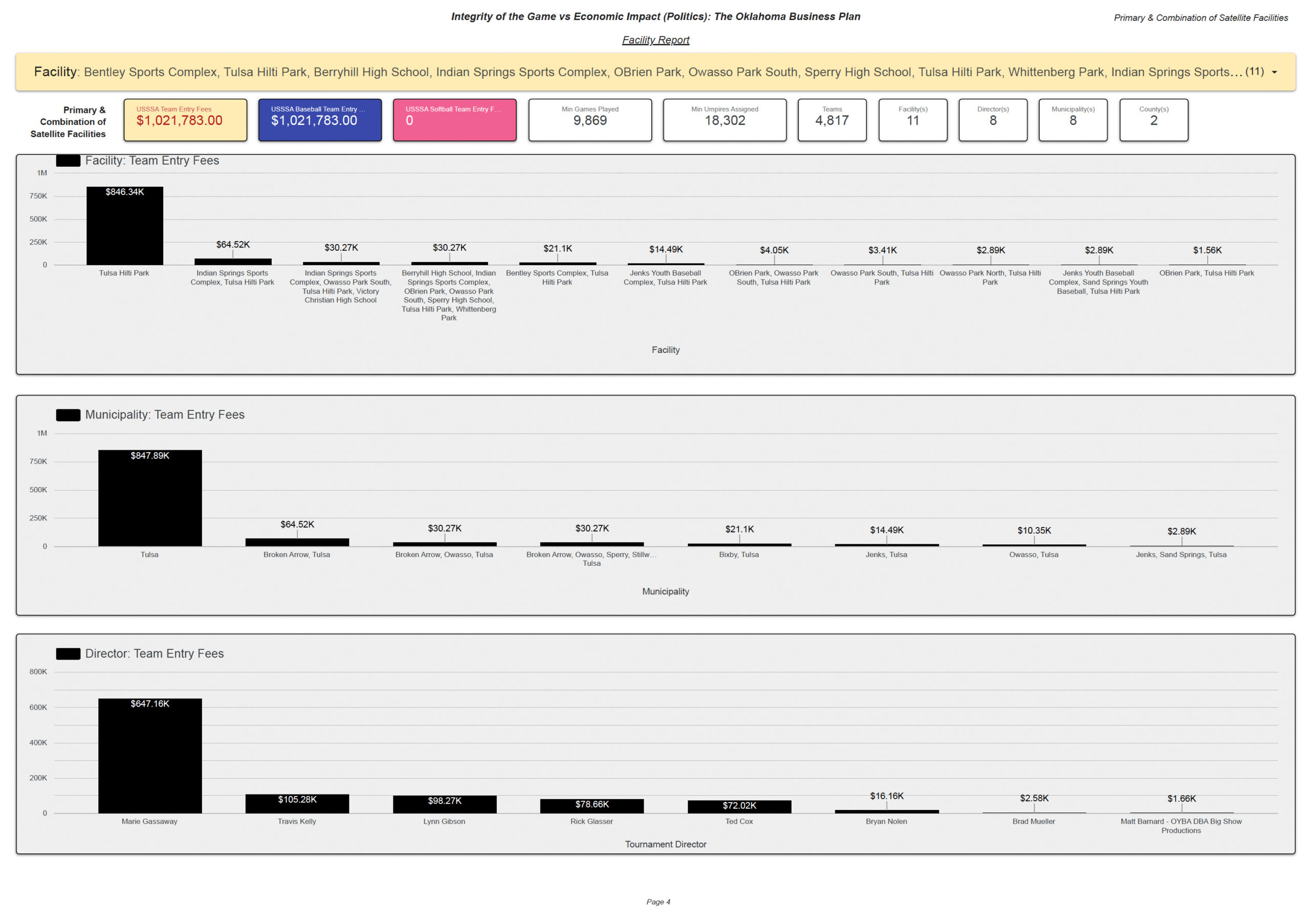
- Marie Gassaway — approx. $647.16K
- Travis Kelly — approx. $105.28K
- Lynn Gibson — approx. $98.27K
- Rick Glasser — approx. $78.66K
- Ted Cox — approx. $72.02K
- Bryan Nolen — approx. $16.16K
- Brad Mueller — approx. $2.58K
- Matt Barnard – OYBA DBA Big Show Productions — approx. $1.66K
The combined report identifies 11 facilities, 8 municipality groupings, and 2 counties associated with the complete activity footprint.
Tulsa is the principal municipality grouping shown in the combined view at approximately $847.89K.
Direct, associated and combined
Records listing Tulsa Hilti Park independently, excluding multi-facility combinations.
Records where Tulsa Hilti Park appears with one or more additional facilities.
The broadest documented activity footprint associated with Tulsa Hilti Park across direct and multi-site records.
Calculated Team Entry Fee methodology
Participating Teams × Publicly Posted Team Entry Fee = Calculated Team Entry Fees
The calculation is an analytical measure of documented participation and publicly posted pricing. It is not, by itself, evidence of actual collections or the ultimate disposition of funds.
Calculated figures should not automatically be interpreted as facility revenue, municipal revenue, tournament-director income, profit, taxable income, bank deposits, gate receipts, concession revenue, or audited financial statements.
The direct profile identifies 164 league teams and $1,050 in League Calculated Team Entry Fees.
The Hidden Valley dataset includes both tournament and league records where publicly available historical information permits.
A publicly displayed $0.00 Team Entry Fee is not automatically treated as proof of zero operational activity. It may reflect a free event, a locally handled fee structure, incomplete historical information, or another circumstance not resolved by the public record alone.
Tulsa Hilti Park context and documentary photographs
Supporting facility material identifies Hilti Park at 12148 E. 51st St., Tulsa, Oklahoma 74146 and describes the sports complex as a 15-field youth baseball and softball facility used for league play, tournaments, practices and rentals. The supporting material also states that Hilti Baseball Fields are managed by The Diamonds at LaFortune. These facility-context statements are separate from the USSSA activity calculations.
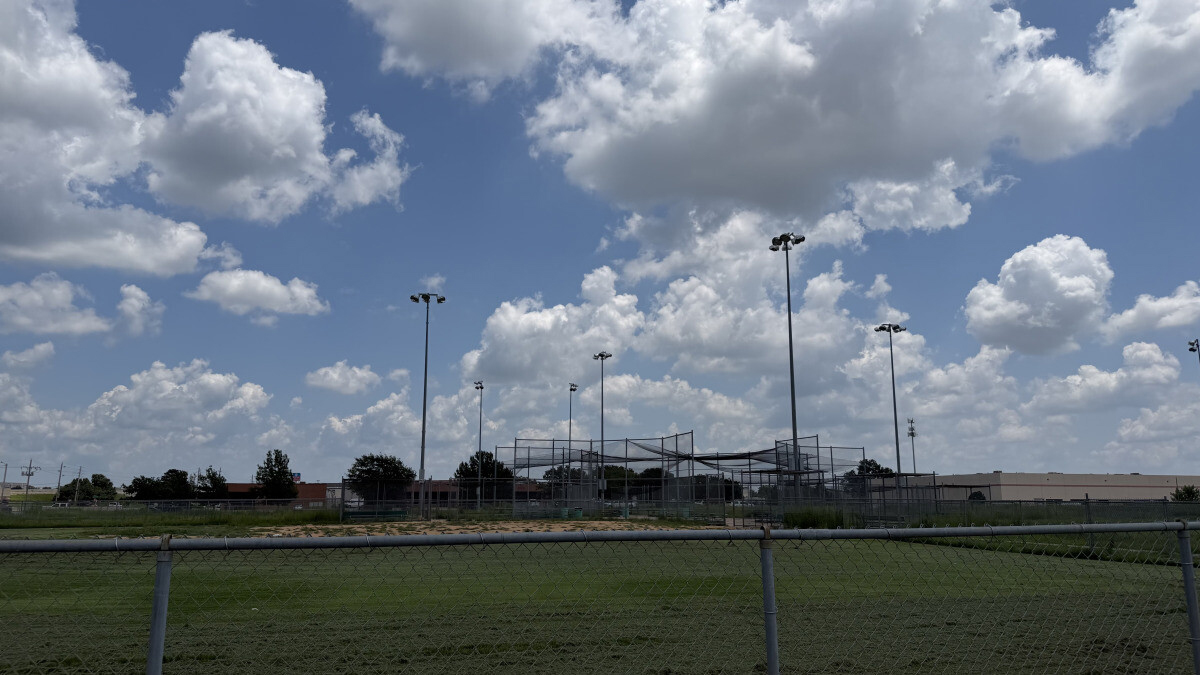
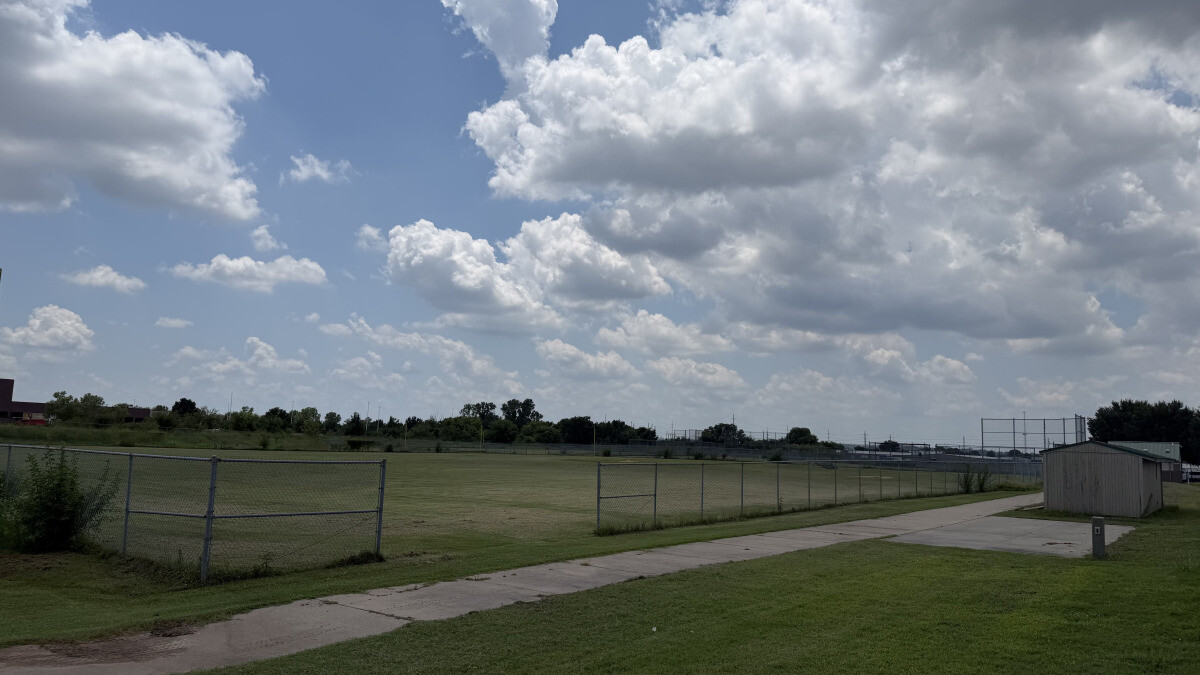
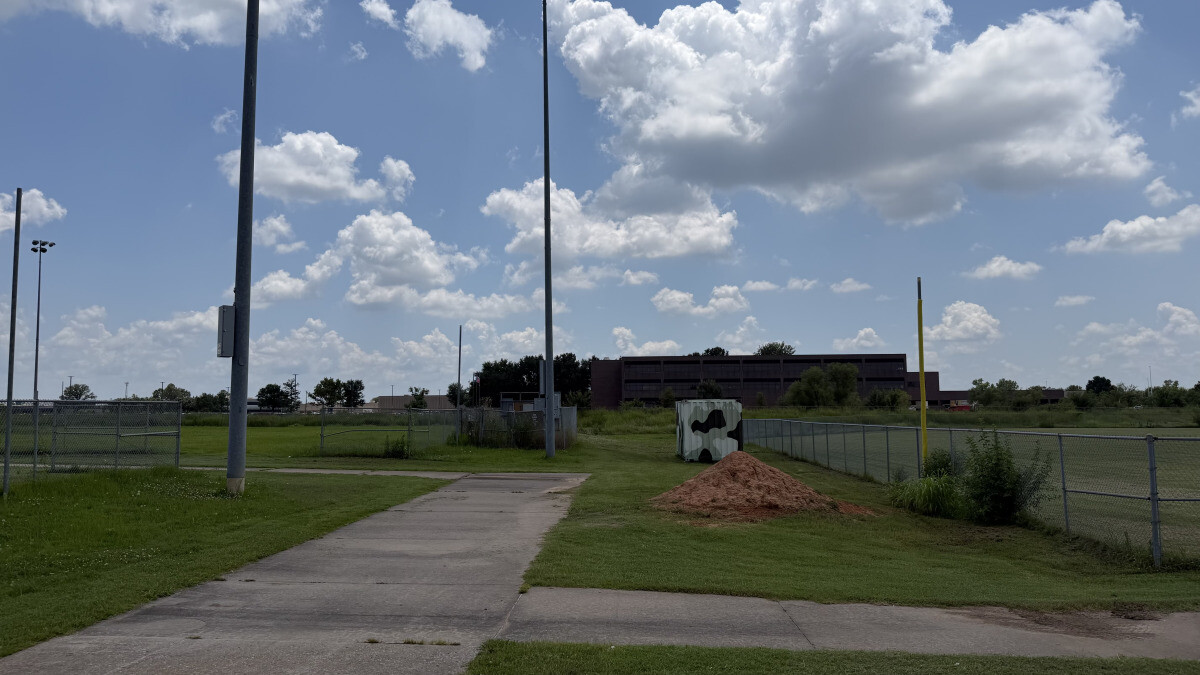

Facility report pages 1–4
What the public dataset establishes — and what it does not
- Teams and seasons represented in preserved or accessible USSSA records.
- Facility and multi-facility associations.
- Named tournament directors associated with event records.
- Municipality and county associations.
- Posted team entry fees and Calculated Team Entry Fees.
- Minimum games and minimum umpire assignments where displayed.
- Tournament and league activity reflected in the source records.
- Actual collections, gross receipts, or bank deposits.
- Facility or municipal revenue.
- Director compensation, personal receipt, or profit.
- Taxable income or tax liability.
- Gate or concession revenue.
- Rental payments, revenue sharing, or bank ownership.
- Allocation of multi-facility event funds among individual locations.
- Ultimate disposition of funds.
Tulsa Hilti Park — documented USSSA activity profile
The Facility Report identifies $846,336 in direct Calculated Team Entry Fees associated with records listing Tulsa Hilti Park independently. All displayed direct activity is baseball. The direct population includes 4,187 teams, at least 8,435 games, 15,581 umpire assignments, eight directors, and direct league activity of 164 teams with $1,050 in League Calculated Team Entry Fees.
The annual direct series shown in the report spans displayed seasons from 2002 through 2022, with the highest displayed season in 2012 at approximately $95.85K. Marie Gassaway represents the largest direct director concentration at approximately $643.11K.
Page 3 separately identifies $175,447 in associated multi-facility Calculated Team Entry Fee activity involving 630 teams, at least 1,434 games, 2,721 umpire assignments, 10 facility combinations, four directors, eight municipality groupings and two counties. The largest listed configuration is Indian Springs Sports Complex + Tulsa Hilti Park at approximately $64.52K.
Combining the direct and associated populations, Page 4 reports a documented activity footprint of $1,021,783, all baseball, involving 4,817 teams, at least 9,869 games, 18,302 umpire assignments, 11 facilities, eight directors, eight municipality groupings and two counties.
Association is not allocation: multi-site amounts identify activity associated with complete event configurations and should not be assigned entirely to Tulsa Hilti Park or split among individual facilities without additional evidence.
Independent research publication
The Hidden Valley — Integrity of the Game dataset is an independent research reconstruction based primarily on publicly accessible USSSA event, tournament, league, director, facility, team, pricing and related historical information.
Historical records may contain missing fields, naming variations, reused or inconsistent identifiers, facility-name changes, zero-dollar listings or other limitations inherent in historical public data. The research is not an official USSSA accounting system.
Calculated financial figures are research estimates derived from publicly available information and the documented methodology. They are not audits, tax determinations, forensic-accounting conclusions, legal findings, or allegations that any person or organization received, retained, concealed, misreported, or improperly used the calculated amounts.
Identification of an individual, director, organization, facility, municipality, school, or other entity within the dataset does not itself imply wrongdoing, misconduct, tax noncompliance, criminal activity, or civil liability.
The purpose of the research is to document and analyze available information, identify patterns and questions worthy of further examination, improve transparency, and provide a reproducible analytical foundation from which preserved source records and independently obtained documentation may be evaluated.