AI Infrastructure & Youth Sports Economic Model

The Land Between Opportunity and Accountability

“The modern gold rush is no longer railroads, oil fields, or manufacturing plants. It is data.”

There are moments in public policy where an idea begins not with certainty, but with a question.

Sometimes the question emerges from a boardroom. Sometimes from a university lecture. Sometimes from a campaign speech.

And sometimes, the question emerges while driving across Oklahoma highways, passing thousands of acres of open land, oil wells, electrical infrastructure, aging small towns, abandoned storefronts, taxpayer-funded sports complexes, and communities struggling to understand where the future is headed.

That question began to take shape after listening to discussions regarding the future of artificial intelligence, data centers, and Oklahoma’s opportunity to position itself as a national leader in the next technological frontier.

Across America, governors, legislators, municipalities, and private investors are all racing toward the same destination:

Artificial Intelligence Infrastructure

Massive campuses requiring endless electricity, industrial-grade cooling systems, fiber connectivity, and land footprints stretching across rural America are rapidly reshaping economic development conversations nationwide.

Investors see opportunity. States see industrial expansion. Municipalities see temporary construction growth.

But citizens increasingly see something else:

  • Rising utility concerns
  • Water consumption fears
  • Infrastructure strain on rural communities
  • Public incentives benefiting corporations
  • Minimal long-term local sales tax generation

And beneath all of those concerns lies a larger question:

What does a community truly receive in return?

That question may ultimately define Oklahoma’s future.

Oklahoma possesses something many states no longer have:

Vast Open Land
Oil & Gas Infrastructure
Central Geographic Position
Expanding Transmission Capability
Lower Development Costs
Tourism & Sports Culture

But Oklahoma also faces another reality often overlooked in economic development presentations:

  • Schools fighting declining enrollment
  • Deteriorating infrastructure
  • Tightening municipal budgets
  • Public trust erosion
  • Infrastructure aging faster than tax revenue can repair it

For years, the Hidden Valley research project has documented Oklahoma’s youth sports economy and revealed a recurring pattern:

Economic Activity Exists.

Public Infrastructure Exists.

Public Incentives Exist.

But Accountability and Measurable Public Benefit Often Do Not.

The question then becomes:

What if Oklahoma has been building economic infrastructure incorrectly all along?

What if AI infrastructure could be merged with:

  • Youth sports tourism
  • Hotels and hospitality corridors
  • Retail and entertainment districts
  • Workforce training partnerships
  • Public accountability frameworks
  • Regional economic ecosystems

What if Oklahoma could transition from fragmented growth toward integrated “Mega Campus” development designed around:

Sustainable Infrastructure
Tourism Sales Tax Engines
Resource Optimization
Public Accountability

Perhaps the real opportunity hidden beneath the AI conversation is not simply building the next generation of infrastructure — but reimagining what Oklahoma itself could become.

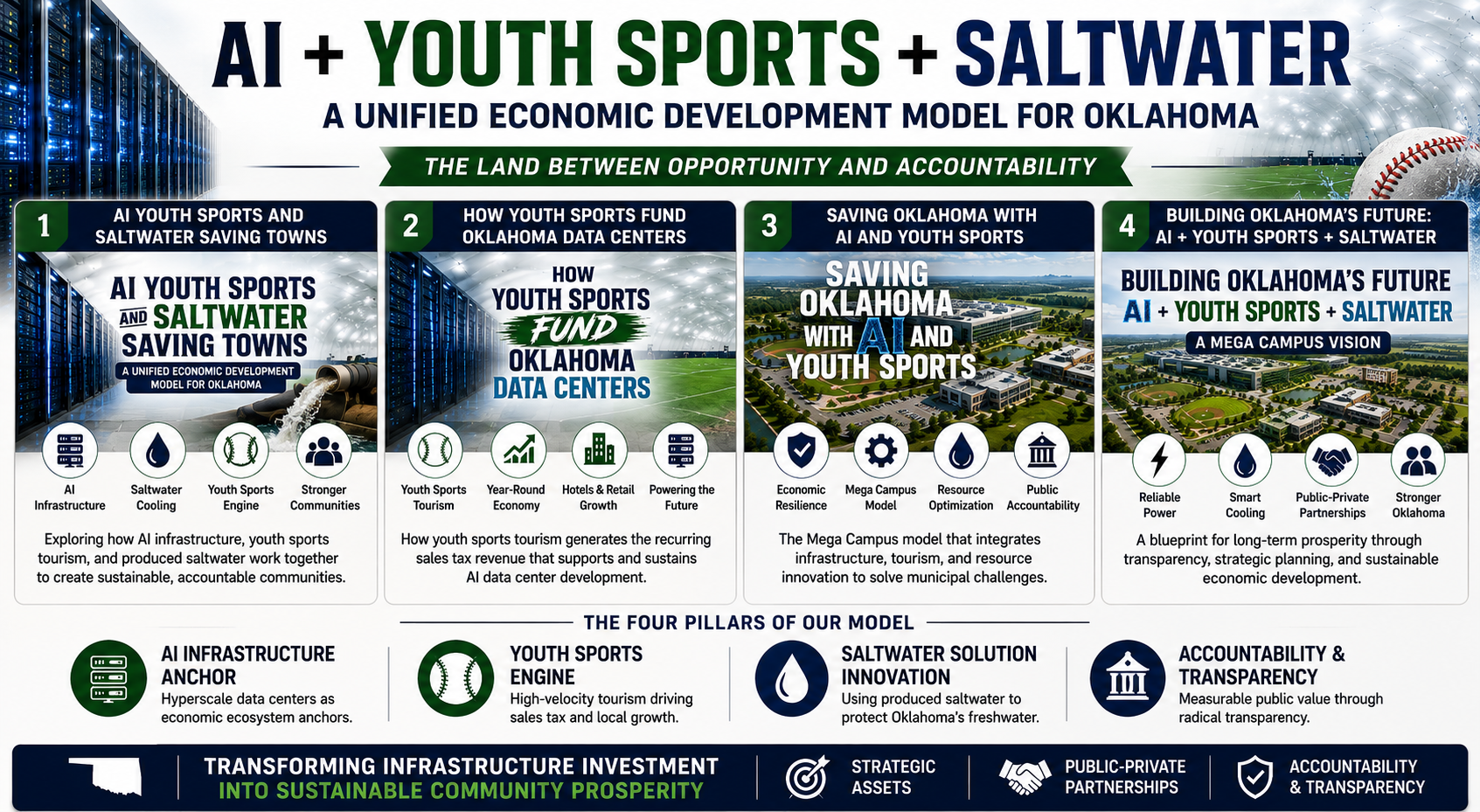
AI Youth Sports and Saltwater Oklahoma Economic Development Model

AI + Youth Sports + Saltwater

A Unified Economic Development Model for Oklahoma

“The Land Between Opportunity and Accountability”

Project Introduction

This research series explores a proposed hybrid economic development framework for Oklahoma that reimagines AI data centers not as isolated utility-consuming industrial facilities, but as long-term economic ecosystem anchors.

The central concept is simple but transformational: pair high-infrastructure AI data centers with high-activity youth sports tourism, hospitality corridors, retail development, workforce training, and public accountability dashboards. The goal is to create integrated “Mega Campus” districts capable of producing measurable public value, recurring sales tax activity, and sustainable municipal growth.

Oklahoma has vast land, oil and gas infrastructure, transmission capacity, central geographic positioning, and the opportunity to lead the next technological frontier. But without transparency, resource optimization, and public-private accountability, communities risk absorbing the strain while private interests capture the reward.

AI Infrastructure Anchor

Power, fiber, land, and industrial investment create the foundation for regional development.

Youth Sports Engine

Tournaments drive hotel stays, restaurants, fuel purchases, retail sales, and recurring sales tax activity.

Saltwater Solution

Produced saltwater from oil and gas operations could reduce freshwater strain for AI cooling systems.

Public Accountability

Transparency dashboards, utility disclosures, tourism metrics, and ROI benchmarks protect taxpayers.

NotebookLM AI Generated Podcast Series

1. Saving Oklahoma With AI and Youth Sports

This opening discussion frames the larger question: can Oklahoma align AI infrastructure, youth sports tourism, and public accountability into a single long-term economic development model?

View Documentation

2. How Youth Sports Fund Oklahoma Data Centers

This episode explains the “reciprocal subsidy” model: AI data centers provide infrastructure, while youth sports tourism generates the recurring sales tax activity needed to support local services.

View Documentation

3. Oklahoma’s Mega Campus Economic Model

This video presents the integrated Mega Campus as a regional anchor combining AI data centers, sports tourism, hotels, retail, education, workforce training, and public accountability.

View Documentation

4. AI Youth Sports and Saltwater Saving Towns

This discussion focuses on the produced saltwater concept: using Oklahoma’s oil and gas byproduct as a possible cooling resource to protect freshwater while supporting AI expansion.

View Documentation

Core Question

What does a community truly receive in return when public land, public infrastructure, public incentives, and public trust are used to build the next economy?

This project argues that Oklahoma’s future depends on aligning technology, tourism, energy, transparency, and measurable public benefit.