
Shawnee Lions Club Park — February 21, 2024
Post-tornado facility-condition and public-safety research.
The purpose of this project is not to declare that a federal or Oklahoma RICO violation has occurred. It is to organize a large public-source and governmental-record research archive into a reproducible investigative framework showing what is documented, what is calculated, what is modeled, what was alleged in prior litigation, what remains unresolved, and what primary records would be required for a competent governmental investigation.
U.S. District Court, Middle District of Florida, Orlando Division — Case No. 6:23-cv-1637-RBD-RMN. The principal pleading reviewed is the Second Amended Complaint, Dkt. 155, filed April 17, 2024.
The complaint asserted federal RICO participation and conspiracy, federal whistleblower-retaliation claims, contract and defamation claims, and Florida whistleblower claims. Its RICO theory alleged an association-in-fact enterprise and a pattern of predicate acts involving bank, mail and wire fraud, gambling/money-laundering allegations, witness tampering, and witness retaliation.
LITIGATION ALLEGATION
The case did not produce a trial verdict establishing the complaint's misconduct allegations. The federal RICO claim was dismissed in November 2024 on an enterprise-distinctness issue. Litigation continued afterward and the parties later publicly announced a confidential mutual settlement finalized April 21, 2025.
PROCEDURAL RECORD
| Predicate Group | Category Alleged | Period Alleged | Pleading Theory |
|---|---|---|---|
| 1–4 | Bank, mail and wire fraud | 2016–2020 | Loans and 2020 amended/restated notes |
| 5–11 | Mail and wire fraud | 2016–2022 | Form 990 governance and financial reporting |
| 12 | Money laundering / illegal gambling | 2014–2023 | Alleged sports-betting operation |
| 13–14 | Witness tampering | 2022 / earlier contractor episode | Employee and independent-contractor allegations |
| 15–16 | Witness retaliation | 2020–2022 | Employee and independent-contractor allegations |
| 17–18 | Witness tampering | 2022–2023 | Wegman and Horrom allegations |
| 19–20 | Witness retaliation | 2022–2023 | Wegman and Horrom allegations |
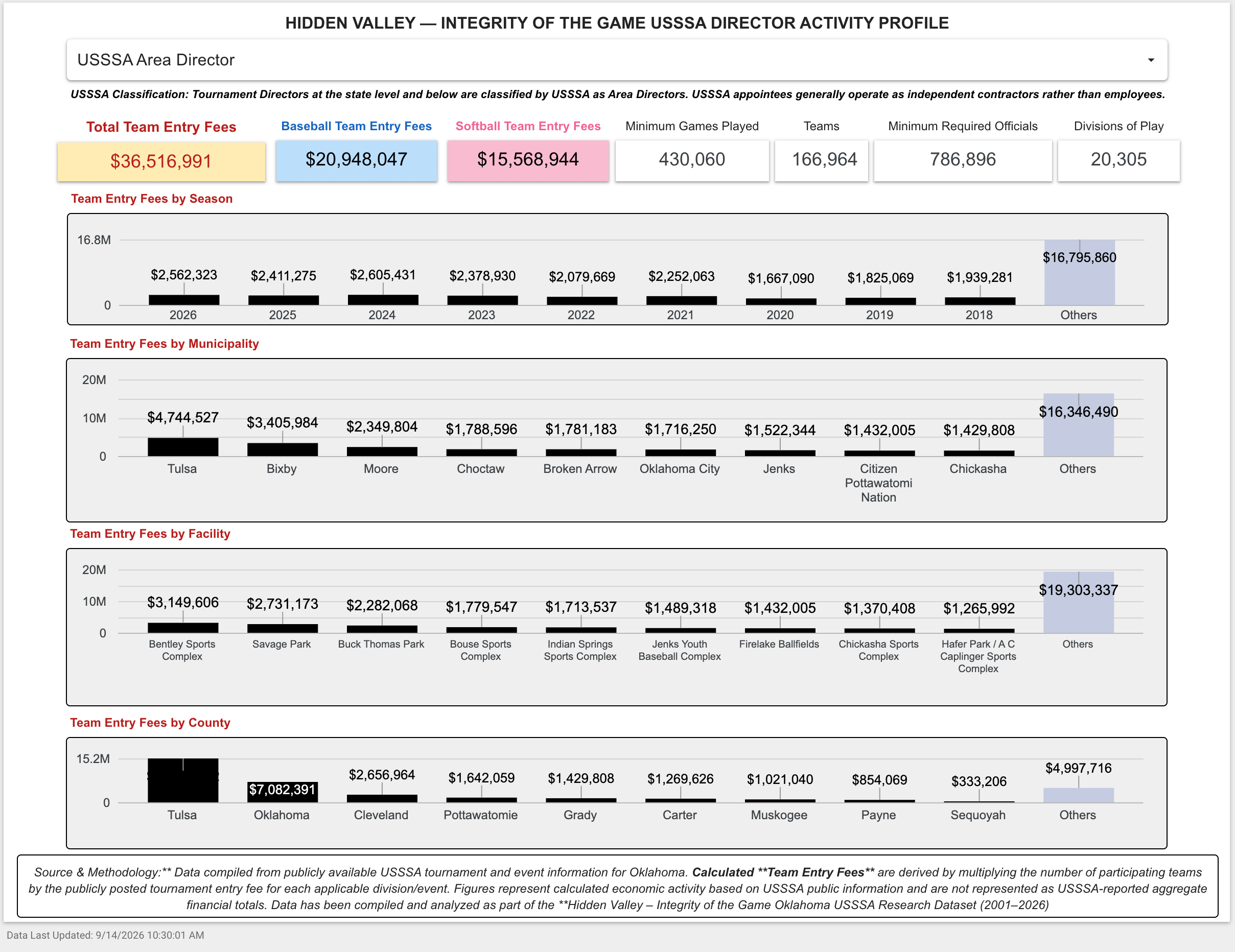
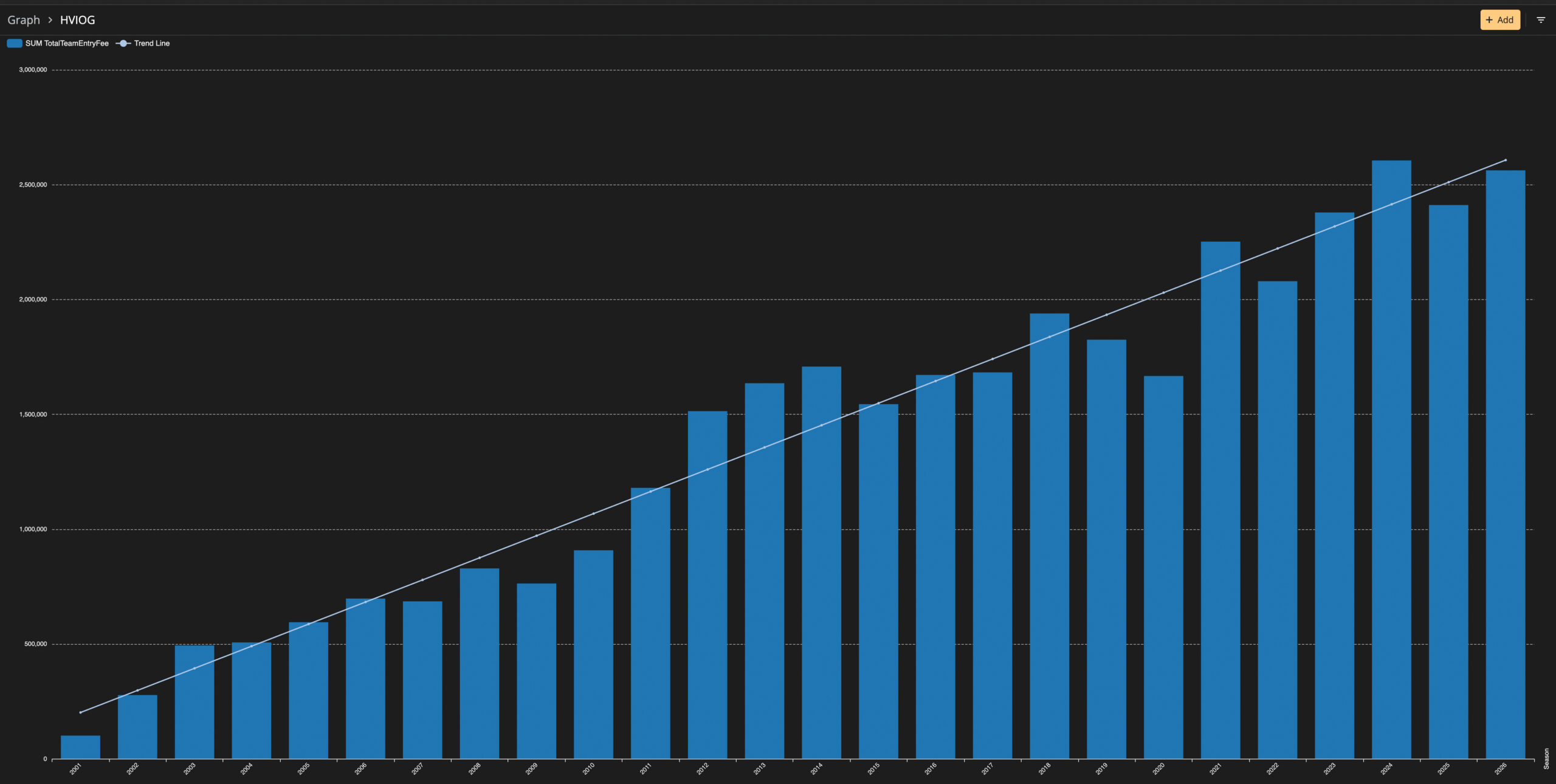
The Oklahoma dataset reconstructs publicly available USSSA event activity across seasons, sports, teams, tournament directors, facilities, municipalities, counties, posted entry fees, and related event fields. Its principal value is longitudinal: it allows recurring relationships and activity patterns to be examined across more than two decades.
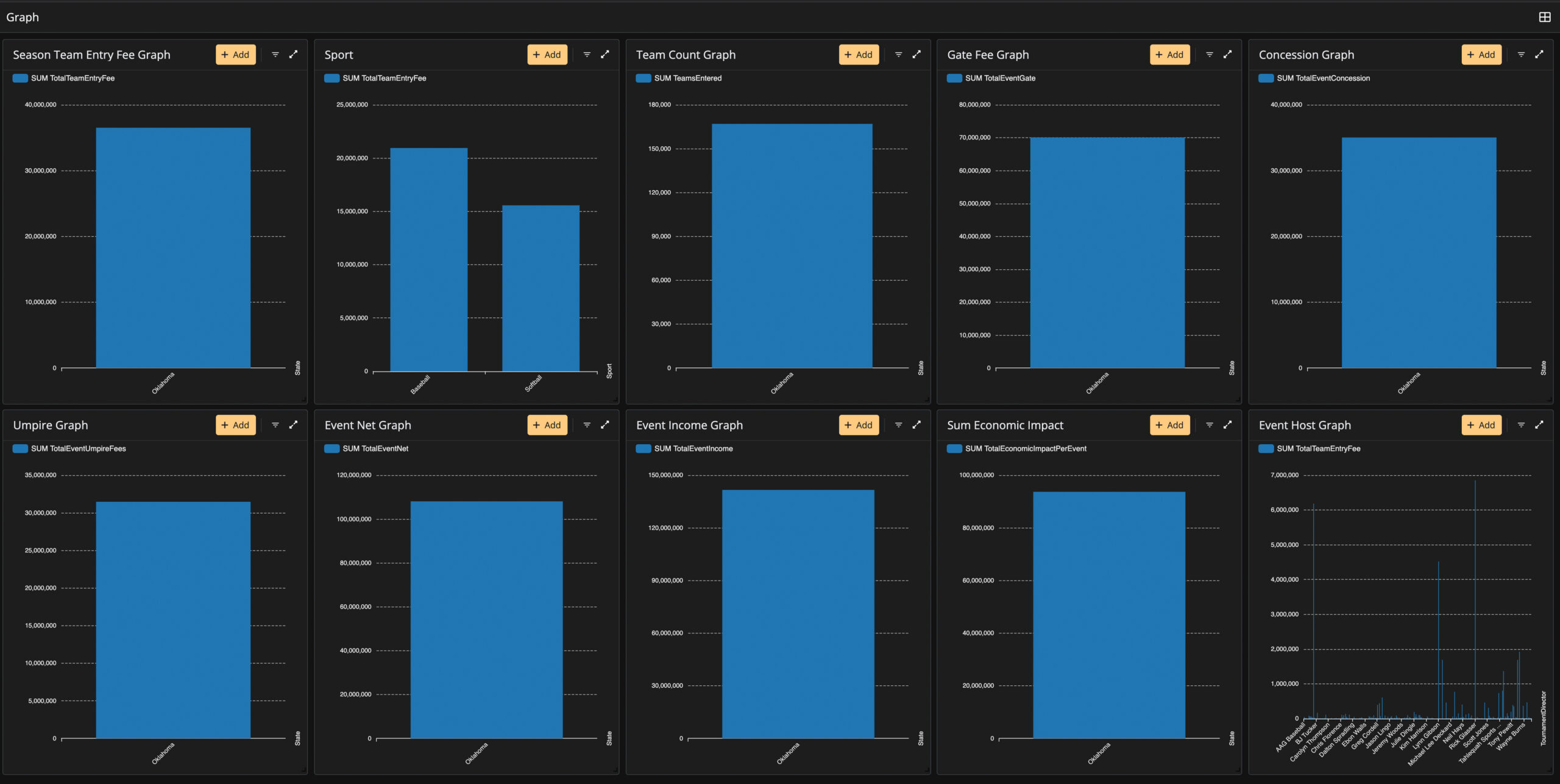
Gate, concession, umpire, event-income, event-net, and economic-impact fields are useful analytical models, but should be treated as a separate evidentiary class from public team counts and posted team entry fees. The landing page intentionally does not convert these modeled values into assertions about actual receipts, taxable income, profit, municipal revenue, or director compensation.
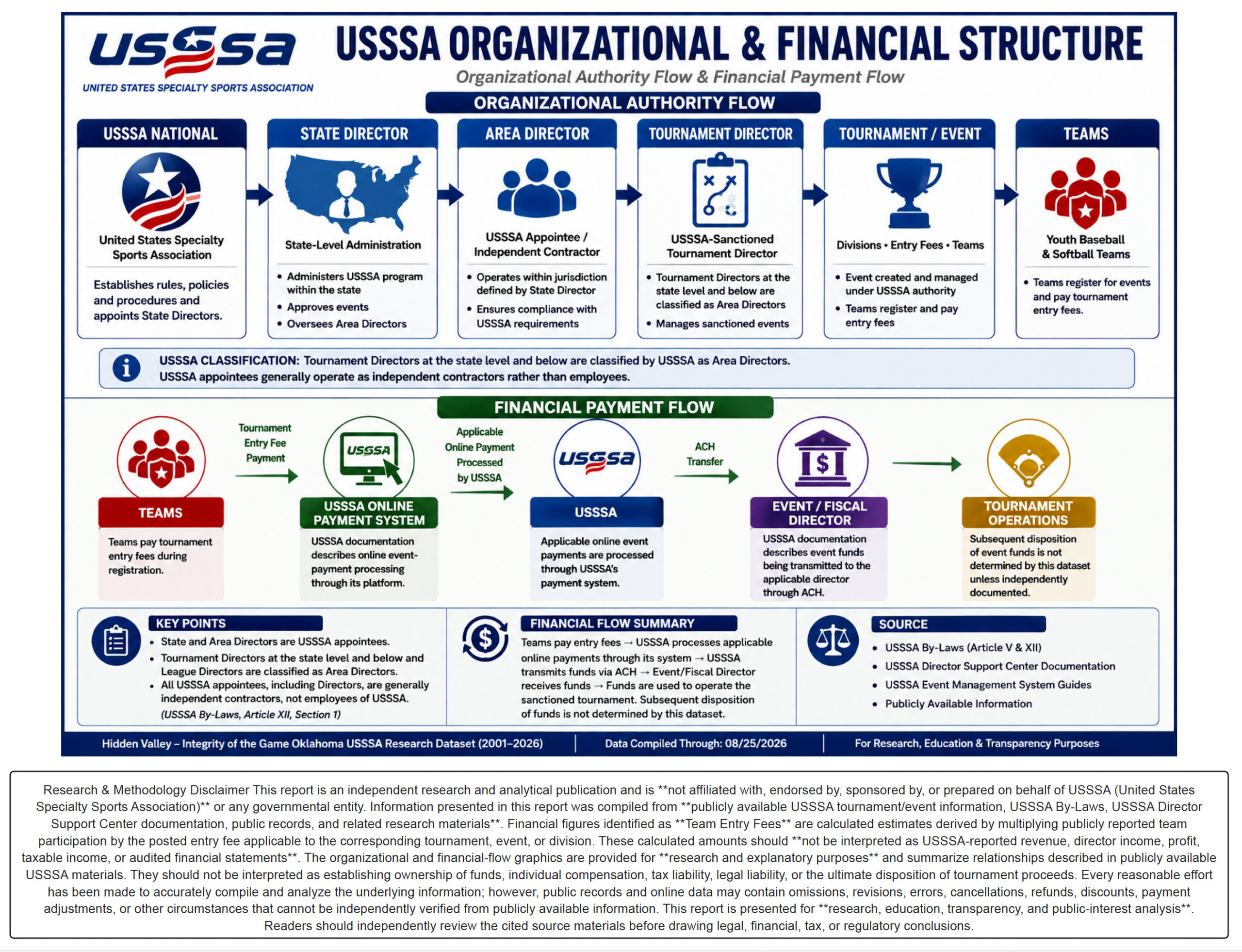
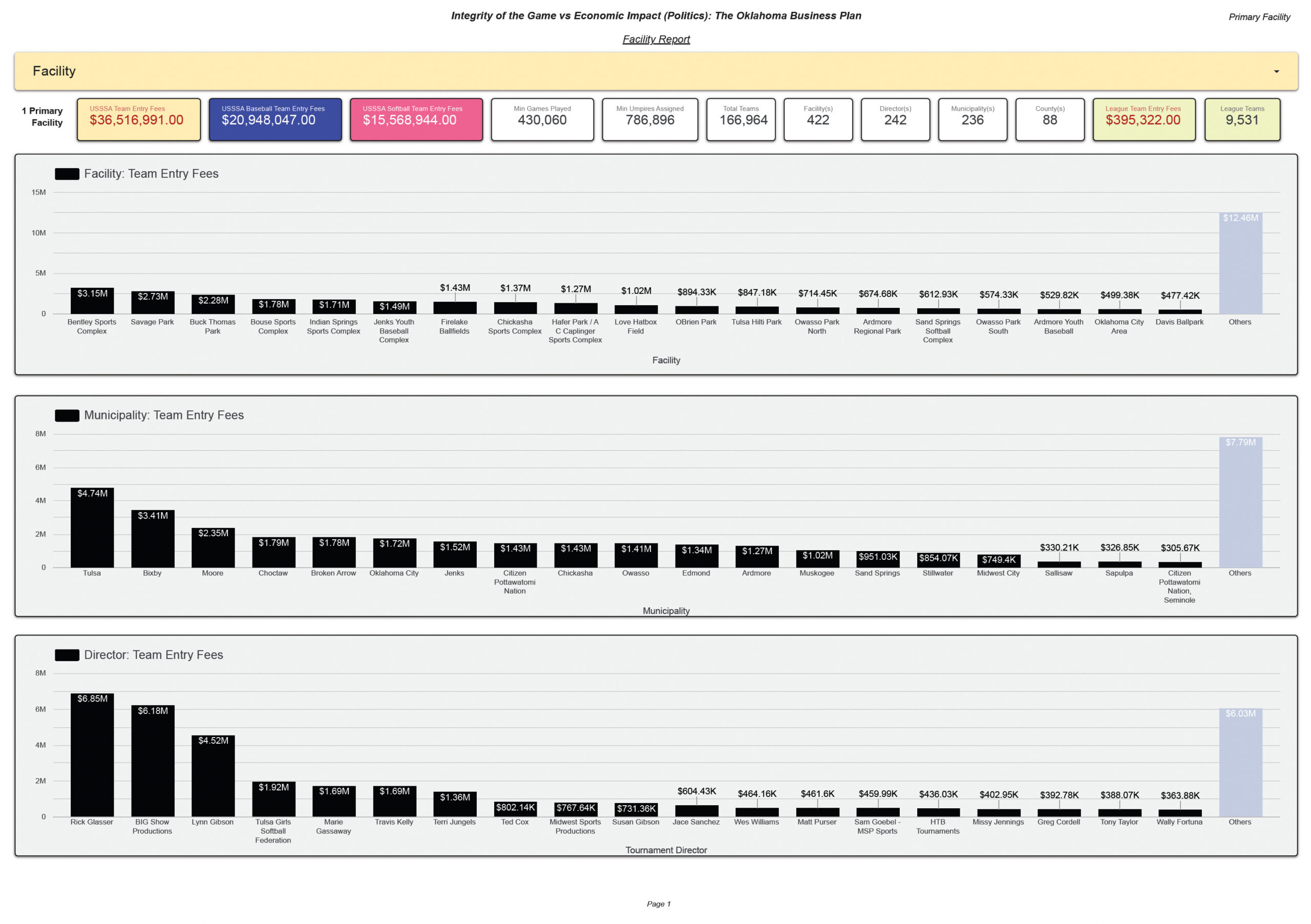
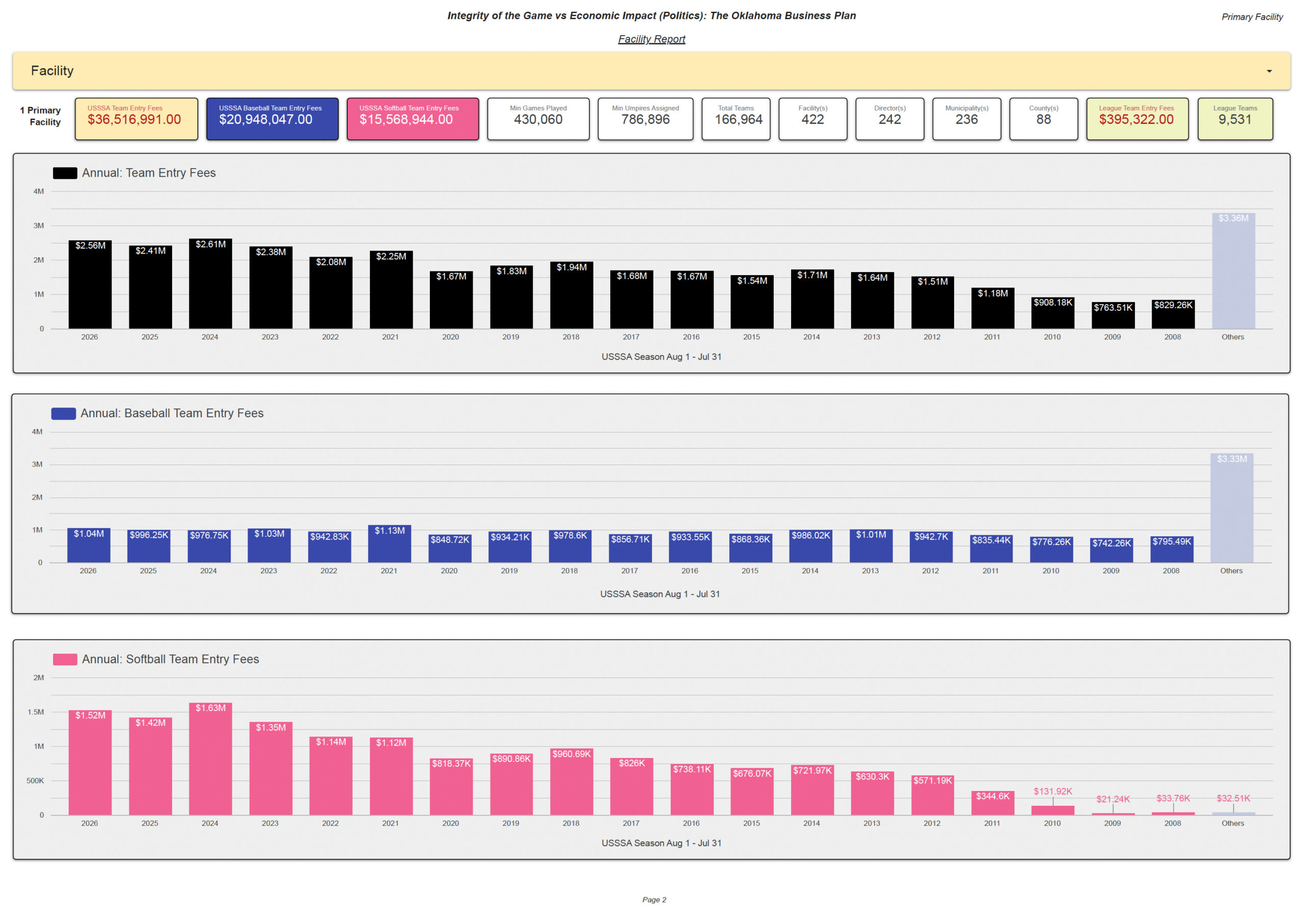
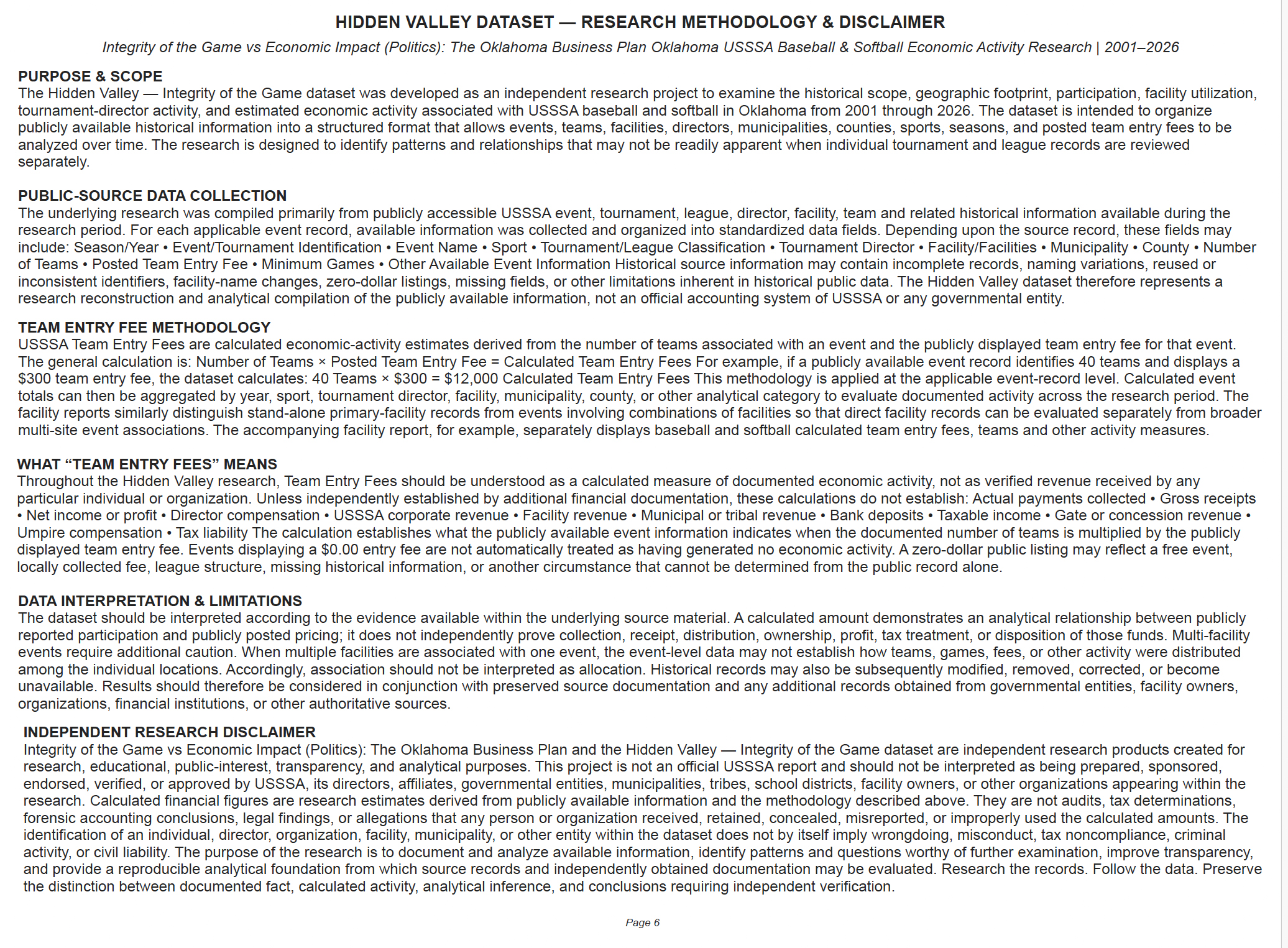
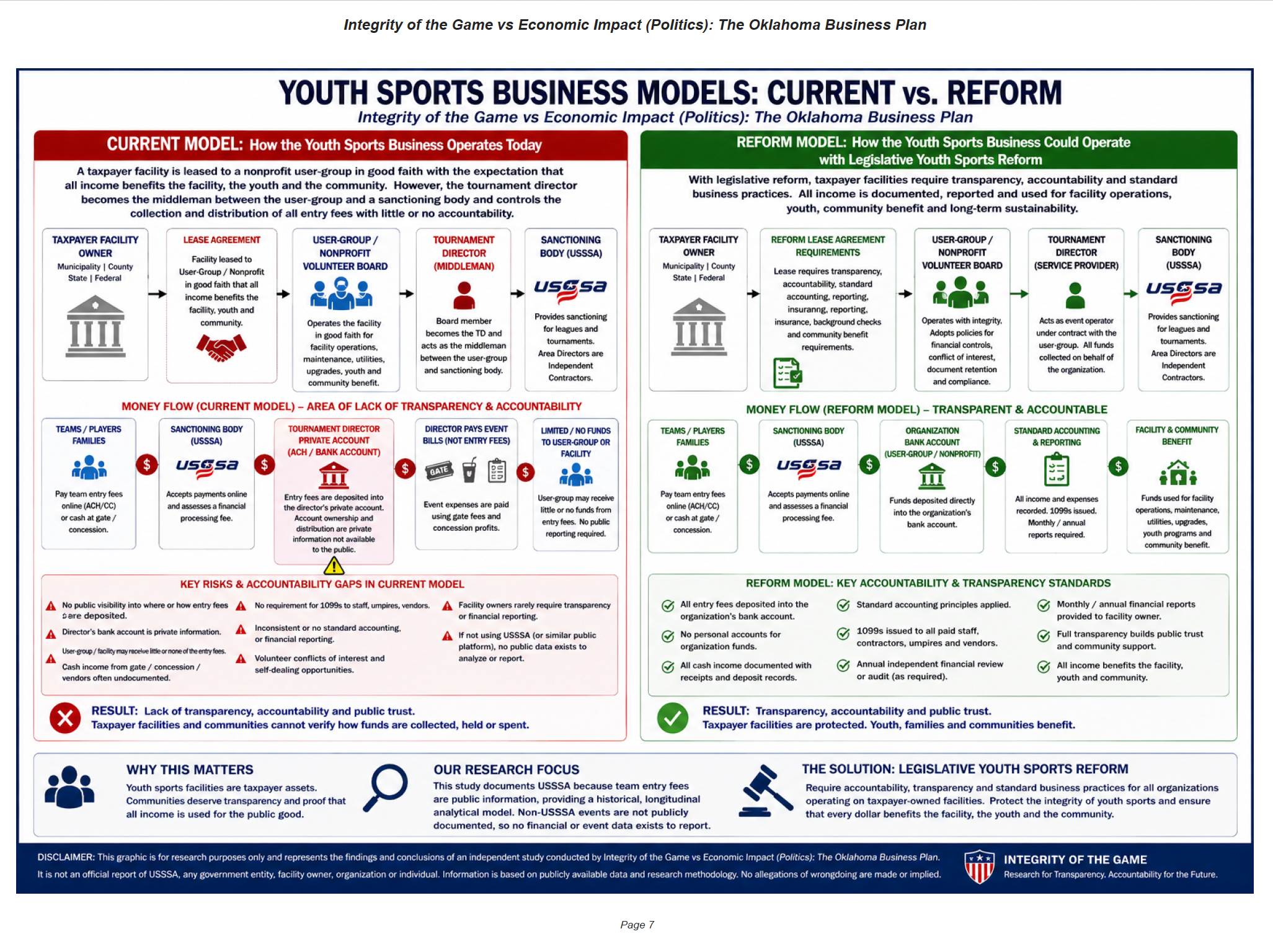
Replacement September 2026 graphics use the current statewide totals and revised facility methodology. Each large report page is displayed at full width so chart labels, methodology notes and scorecards remain visible on desktop, tablet and mobile.



Federal RICO is codified at 18 U.S.C. §§ 1961–1968. Section 1962(c) prohibits a person employed by or associated with an enterprise affecting interstate or foreign commerce from conducting or participating in the enterprise's affairs through a pattern of racketeering activity or collection of unlawful debt. A pattern requires qualifying predicate offenses; ordinary opacity, poor governance, aggressive business practices, or large dollar amounts are not RICO predicates by themselves.
Investigators must identify the relevant person(s) and a legally cognizable enterprise. The Florida dismissal shows why enterprise distinctness must be analyzed carefully rather than assumed.
The research can identify interstate tournament activity, digital systems, organizational relationships and multi-state participation, but the legal interstate-commerce nexus must be established from admissible evidence.
Director titles and event associations may identify relationships, but investigators would need evidence showing who actually directed, managed, controlled, approved, or participated in relevant affairs.
Potential predicate theories require proof of each underlying offense. Financial modeling cannot replace evidence of material representations, intent, transfers, concealment, obstruction, or other statutory elements.
The 2001–2026 dataset is especially useful for locating recurring actors, facilities, events and payment structures over time. Duration can help identify where to investigate continuity; it does not prove criminal continuity.
Common membership, overlapping facilities or repeated business relationships do not prove agreement. A conspiracy theory requires evidence of an agreement to violate RICO, not merely parallel or recurring activity.
Oklahoma's RICO statute is codified at Title 22, §§ 1401–1419. Section 1403 contains the principal prohibitions, and § 1419 directs Oklahoma courts to consider federal construction when the state language is the same or similar. The Oklahoma analysis therefore should be maintained as a separate state-law research track rather than treated as a duplicate of the Florida federal case.
Oklahoma entities and actors; qualifying state-law predicate offenses; recurring transactions; municipal or school-district contracts; public-facility operations; public funds; electronic payment channels; records retention; contractor arrangements; nonprofit/user-group governance; and documented state or local financial representations.
A questionable public contract, inadequate reporting, a tax issue, an Open Records Act dispute, a procurement concern, or use of a public facility is not automatically racketeering. Each possible state RICO theory must begin with a qualifying predicate offense and evidence satisfying the statutory elements.
Statutory reference: Official Oklahoma Statutes — Title 22, Chapter 26.
| Investigative Question | Research Currently Available | What It Can Establish | What It Does Not Establish | Primary Records Needed |
|---|---|---|---|---|
| Scale and recurrence of Oklahoma USSSA activity | 2001–2026 event dataset; annual charts; team counts; sport breakdown | Historical scope, recurrence, participation, event relationships and geographic footprint | Criminal pattern, intent or predicate acts | Internal USSSA event databases; archived registration records; correspondence |
| Team-entry-fee activity | Teams × publicly posted entry fee | Calculated economic activity at the event/division level | Actual collections, refunds, discounts, deposits, ownership or taxable income | Merchant-account reports; bank records; processor settlements; general ledgers |
| Director / event-host relationships | Director activity profiles; event listings; organizational materials | Who is publicly associated with particular events, facilities and time periods | Who ultimately received proceeds or exercised unlawful control | Contracts; W-9s; 1099s; ACH records; internal director agreements; tax records |
| Electronic payment flow | USSSA platform documentation and organizational/payment-flow research | Published or documented process relationships and likely record custodians | Fraudulent intent, false representation, or actual disposition of every payment | Processor logs; ACH instructions; bank statements; merchant IDs; refund logs |
| Gate and concession activity | Modeled gate and concession fields | Analytical estimate of potential event economics | Actual cash receipts, deposits, tax reporting or beneficiary | Daily closeouts; POS reports; deposit slips; concession agreements; sales-tax records |
| Umpire / contractor payments | Game and minimum-official modeling; director/facility research | Estimated labor demand and likely payment scale | Actual worker classification, amount paid, 1099 issuance or recipient | 1099s; W-9s; payroll/contractor ledgers; payment-app records; bank/cash logs |
| Public-facility use | Facility reports; leases; minutes; public records; municipal and school research | Documented use of public assets and contractual/governmental relationships | Improper subsidy, unlawful private benefit, or diversion without transaction evidence | Executed agreements; invoices; utility bills; insurance; field-prep costs; revenue remittances |
| Public-school / education-tax questions | Pottawatomie County case study; audits; election records; school-board documents; records requests | Overlap between tax-supported school operations and third-party event use where documented | That a specific USSSA event caused a particular tax-funded expense without matched records | Event-date utility detail; facility-use agreements; invoices; receipts; board approvals; payment records |
| Federal tax compliance | IRS Form 211 submissions; director profiles; public data; selected financial records | Specific questions and persons/entities/tax years for IRS reconciliation | Tax deficiency, unreported income or willfulness | Returns; Forms 1099/W-2/W-9; bank records; books and records; IRS account data |
| RICO enterprise / agreement | Organizational structure; director network; recurring event relationships | Potential associations and documentary leads | Unlawful common purpose, agreement, management or criminal enterprise | Internal communications; contracts; financial transfers; testimony; governance records |
Director-level profiles organize events, facilities, municipalities, seasons, sports and calculated team-entry-fee activity. These profiles are investigative indexes — not determinations of personal income.
Facility studies examine public infrastructure, lease/user-group arrangements, maintenance, public expenditures, tournament activity and available revenue records. Examples include Savage Park, Bouse Sports Complex, Buck Thomas Park and other Oklahoma facilities.
This research examines qualifying Pottawatomie County public-school facilities, tax-supported operating costs, third-party event use, audits, election records, board records and unresolved transaction questions. Tribal FireLake facilities are treated separately rather than as education-tax beneficiaries.
School-district records requests seek agreements, utility records, approvals, invoices, user-group records and communications that can match specific event activity to actual public costs and contractual terms.
IRS Form 211 materials and supplemental director/entity packets identify possible tax-compliance questions, persons, entities, periods and third-party record custodians for IRS reconciliation.
The congressional briefing materials frame the larger policy problem: a decentralized interstate youth-sports economy using taxpayer facilities without uniform national transparency, contractor reporting, financial reconciliation or independent integrity standards.
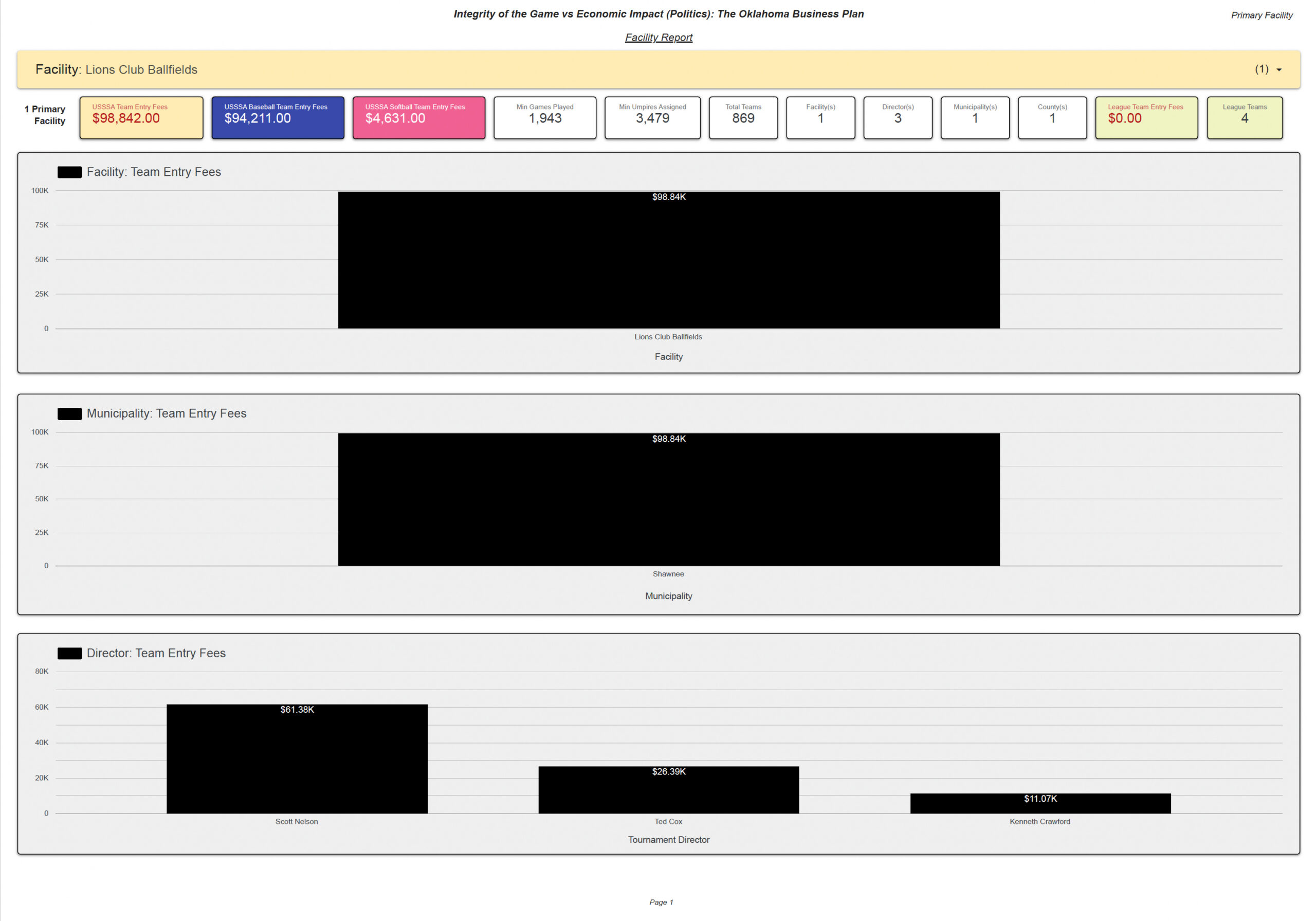
Lions Club Ballfields provides a different investigative lens from the statewide USSSA dataset. The facility record combines documented USSSA event activity with municipal operating agreements, public utility obligations, third-party facility use, a 1947 federal Instrument of Transfer, post-tornado public-safety research, and unresolved questions that can be tested against primary governmental and financial records.
The controlling direct-facility report identifies $98,842 in calculated Team Entry Fees, consisting of $94,211 baseball and $4,631 softball activity, across 869 teams. The current standardized report identifies three directors and direct facility activity from 2002 through 2008.
The 2013 municipal record documents a transition from SYAA stewardship to a YMCA operating framework. The research identifies maintenance, public-utility, third-party-use, financial-reporting and City-review provisions that create specific categories of records capable of independently verifying facility operations.
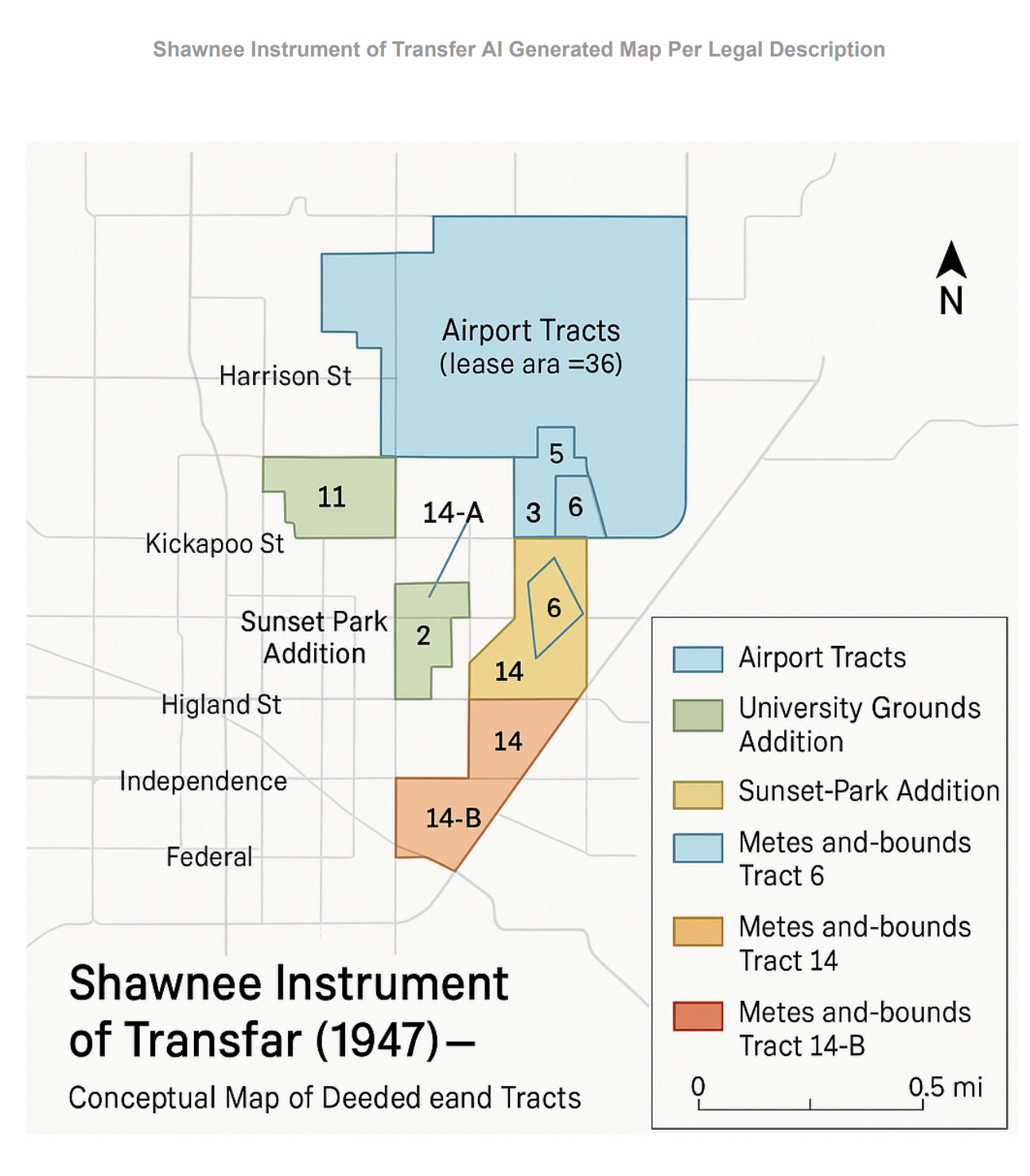
Deed Record 179 / Instrument No. 10739-47 documents a 1947 federal surplus-property transfer to the City of Shawnee. The research identifies restrictions, public-airport obligations, federal emergency-use rights, successor-transfer provisions and reversion language. Parcel-specific applicability and any approvals, releases or amendments require authoritative verification.
The facility archive preserves photographs, video and research concerning conditions after the April 19, 2023 tornado and subsequent demolition activity. These materials identify verification questions; they do not independently establish negligence, causation, damages or legal liability.


| Question | Available Research | What It Can Establish | Primary Records Still Needed |
|---|---|---|---|
| USSSA activity at the facility | Event dataset + facility report | Direct event association, teams, posted fees, seasons and directors | Registration settlements, invoices, bank/merchant records, allocation records |
| Public operating costs | City/YMCA agreements and municipal research | Contractual responsibility for utilities, maintenance and reporting | Utility bills, work orders, invoices, City payments and event-date reconciliation |
| Third-party event use | YMCA operating framework | Existence of provisions allowing third-party use and cost assessment | User agreements, fee schedules, insurance, invoices and receipts |
| Financial accountability | Reporting/review provisions identified in municipal documents | Categories of financial records that should exist if provisions were implemented | Semiannual statements, business-activity reports, City reviews and underlying ledgers |
| Federal property restrictions | 1947 Instrument of Transfer + conceptual research | Historical federal conveyance framework and verification questions | Certified title chain, survey, releases, amendments, FAA/successor-agency determinations |
| Post-tornado response | Photos, videos and research chronology | Visible conditions and chronology requiring official-record comparison | Inspection reports, hazard notices, FEMA correspondence, demolition and environmental records |
Post-tornado facility-condition and public-safety research.
Research presentation connecting facility history to the federal transfer record.
YMCA / Lions Park facility context.
AI-assisted research podcast tracing the progression from safety questions into municipal and land-record research.
These videos are part of the research record and provide public-facing context for the documentary, congressional-oversight, transparency and youth-sports-reform components of the project. AI-generated podcast material should be read together with the underlying court filings, governmental records, datasets and source documents linked elsewhere on this page.
AI-generated research podcast examining taxpayer-supported athletic facilities, public accountability, interstate tournament operations, financial transparency, child protection and possible congressional oversight of the modern youth-sports economy.
Watch on YouTubeResearch record concerning discussions associated with the Office of U.S. Senator James Lankford and the broader request for congressional review of youth-sports governance, public assets, transparency and accountability.
Watch on YouTubeNotebookLM research podcast addressing the proposed congressional role in examining fragmented accountability involving interstate youth sports, public facilities, financial transparency, safeguarding, federal property obligations and governance systems.
Watch on YouTubeVideo included in the supplied USSSA RICO research-link inventory as part of the governmental outreach and congressional-discussion record.
Watch on YouTubeForm 211 and supplemental submissions organize Oklahoma USSSA director/entity activity for tax-year, entity, facility, event, payment-record and third-party reconciliation. Later supplemental materials expressly state that calculated team-entry-fee figures are analytical measurements rather than assertions of taxable income or verified cash receipts.
The Pottawatomie County education-sales-tax complaint package organizes the case study, official audits, election records, school-board records and requested governmental review while preserving unresolved questions about specific event-related transactions.
Congressional briefing materials request oversight and agency referral concerning public assets, tournament economics, nonprofit governance, worker classification, reporting systems and youth-sports transparency. The packet expressly distinguishes oversight questions from findings of fraud or RICO liability.
Municipal, county, school-district and other governmental records are necessary to move the research from public event association to transaction-level verification: executed agreements, invoices, utilities, insurance, cash controls, deposit records, facility charges and official approvals.
Priority should be given to court orders, filed pleadings, official governmental records, executed contracts, audits, tax filings, board minutes, invoices, payment records, preserved USSSA public event records and original organizational documents. Secondary reporting is used for context and should not override primary records.
Multi-facility event records may establish that multiple facilities were associated with an event without establishing how teams, games, fees, officials or revenue were divided among them. Facility reports should not simply be added together to create statewide totals because multi-site events can produce duplicate attribution.
Team Entry Fees are a calculated measure based on public participation and posted pricing. They should not be represented as USSSA-reported revenue, director income, profit, taxable income, bank deposits or audited financial statements without independent records.
Gate, concession, umpire, event-income, event-net and economic-impact values are analytical models unless corroborated by accounting, contract, tax, bank, municipal or other primary financial records.
This library uses the current September 2026 replacement reports where updated versions are available. Superseded August report links have been removed to prevent stale or broken media references.
This page is an independent research and analytical publication. It is not affiliated with, endorsed by, sponsored by, or prepared on behalf of USSSA, any person identified in the research, or any governmental entity. References to the Florida litigation describe allegations and procedural history from court records; allegations are not presented as adjudicated facts.
Oklahoma financial figures identified as Team Entry Fees are calculated research estimates derived from publicly available team participation and posted event pricing. Other economic fields, including gate, concessions, umpire fees, event income, event net and economic impact, are analytical or modeled measures unless independently corroborated. They are not represented as audited financial statements, verified organizational revenue, personal income, taxable income, bank deposits, profit, tax liability, or proof of the disposition of funds.
Identification of an individual, director, entity, facility, municipality, school district, nonprofit, public agency or other organization within the dataset does not by itself imply wrongdoing, racketeering, fraud, tax noncompliance, conspiracy, corruption, or civil liability. Legal conclusions require competent authorities to evaluate admissible evidence against the elements of applicable law.