
Before the Gates Opened
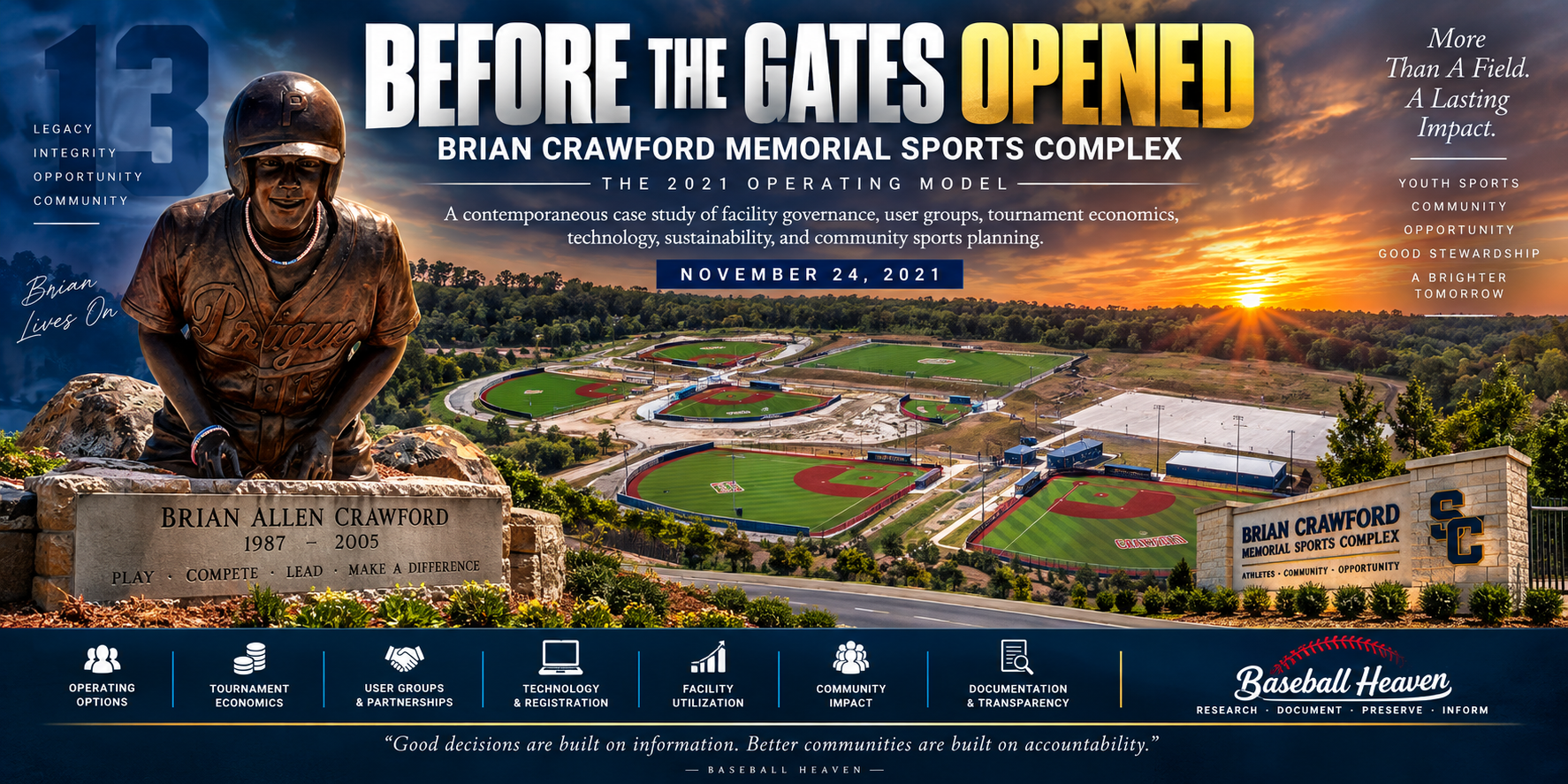
Before the Complex Had an Operating History
Two contemporaneous presentations preserve a planning moment surrounding the Brian Crawford Memorial Sports Complex: governance, user groups, facility fees, concessions, tournament economics, community programming and technology.
Six Operating Options
Foundation Operated
No outside user groups; operations handled through the owner/Foundation.
Multiple User Groups
The facility owner working alongside several user groups.
Exclusive User Group
A sport-specific exclusive arrangement and its governance implications.
Community Sports Commission
A shared community structure around youth sports, school activity and economic impact.
“Flip Flop” Model
Maximize field-use value while contracting concessions through revenue sharing.
Institutional Operation
Operation through the president’s office or another internal designee.
Facility Utilization & Revenue Scenarios
Historical planning scenarios, not audited forecasts.
Field Utilization Illustration
Showcase Rental Scenario
Economic Impact vs. Facility Revenue
The 2021 presentation framed a tradeoff between direct usage fees and broader visitor economic activity, while asking how much event activity should be operated internally versus leased to outside operators.
Direct Facility Revenue
Field-use fees, concessions and other revenue paid directly to or retained by the facility.
Economic Impact
Visitor activity associated with teams, families, lodging, food and other local spending.
The Operating Choice
Operate internally, lease to outside operators, or share responsibility through another structure?
Rethinking Fields, Fees & Concessions
The proposal tested another allocation: maximize field-use value, contract concessions for a percentage, establish a performance benchmark, and share revenue above that benchmark.
Building an Operating System, Not Just a Website
The companion tutorial envisioned a clean public-facing site tied to Playbook 365 for registration, payments, team information, tournament presentation and scheduling.
Options — User Groups, Fees & Operations
SSCEF Website Tutorial Explanation
More Than Tournament Revenue
The planning record also contemplated youth-program pathways, including an All-Star or draft-style league intended to provide an opportunity for children who might not already have a team or coach.
Documentation & Transparency
The operations presentation describes documentation as a lesson learned through earlier youth-sports work and emphasizes being able to produce supporting records when needed.
2021 Questions. 2026 Research.
| 2021 Question | Later Research Lens |
|---|---|
| Can another person step into the system? | Institutional continuity and documented procedures. |
| Foundation operation or user groups? | Who controls scheduling, revenue streams, responsibilities and access? |
| Exclusive user group? | What safeguards accompany exclusive or preferred access? |
| Usage fees or economic impact? | How are facility revenue, visitor spending and community benefit distinguished? |
| Operate events or lease fields? | Where do revenue, costs, risk and responsibility reside? |
| Retain or contract concessions? | How are ancillary revenues and responsibilities allocated and documented? |
| Central registration/payment platform? | Can participation, scheduling and financial activity be reconstructed? |
| Community sports commission? | Can shared governance align access, sustainability and economic objectives? |
| Documentation? | Are claims supported by records that can be independently reviewed? |
A Defined Moment in Time
November 24, 2021: the operating-model and website presentations document the planning discussion.
Late 2021: the complex was at or near its occupancy/opening transition in the case-study chronology.
December 31, 2021: Kenneth Crawford identifies this as his final day working with Seminole State College and the Educational Foundation.
2022–2026: later operations and independent research form a separate period for retrospective comparison.