
Legends Sports Complex
The facility began as a privately developed sports complex designed to attract youth tournaments, regional events and visitor spending to Oklahoma City.
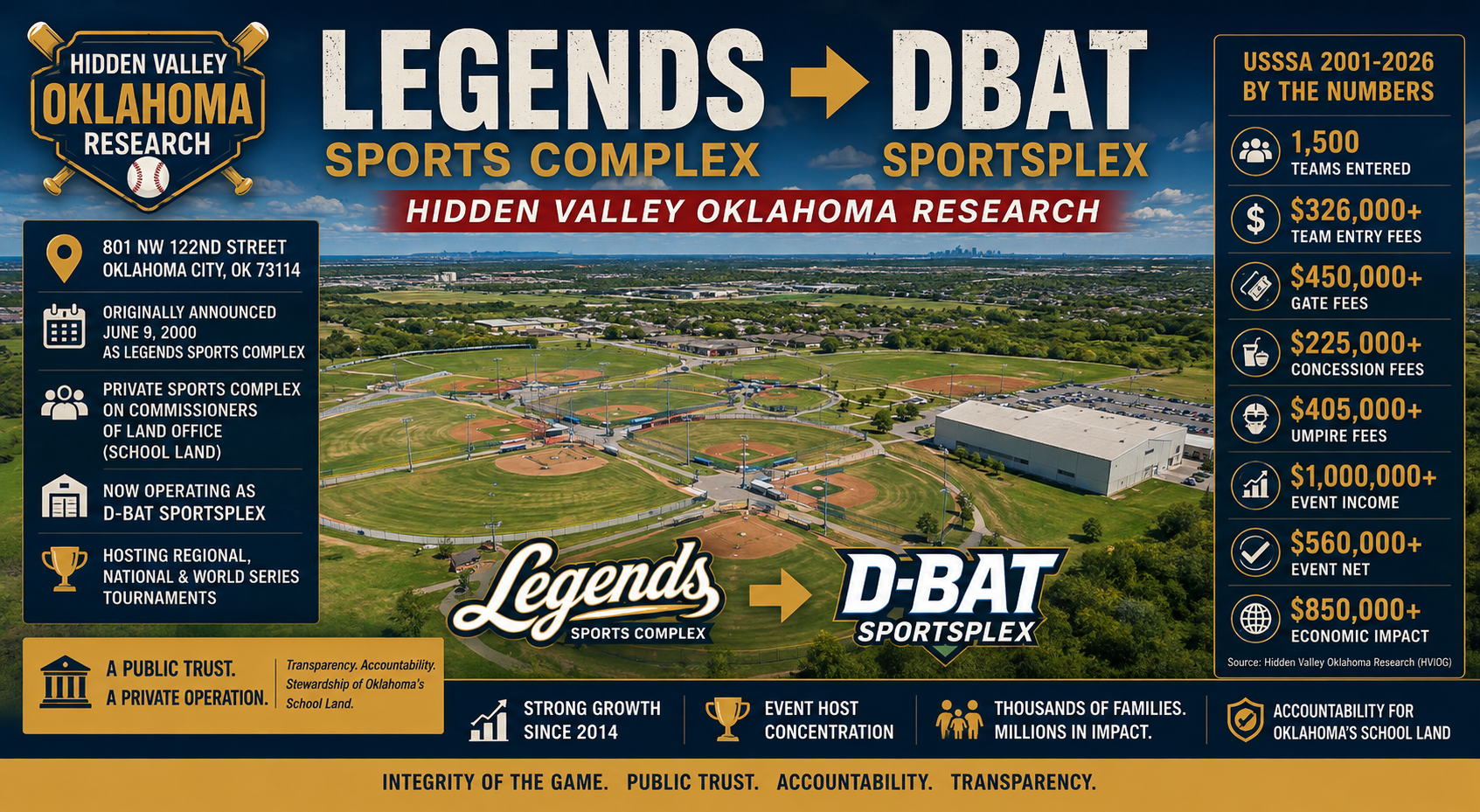
This facility-level case study examines the evolution of a privately developed youth-sports complex in Oklahoma City from its Legends Sports Complex identity into the later D-BAT SportsPlex era. The research combines historical development records, USSSA tournament activity, modeled tournament economics, event-host concentration, facility condition and the distinctive fact that the complex is identified in the research framework as operating on Commissioners of the Land Office / Oklahoma school-trust land.
That land structure makes the site fundamentally different from both a conventional city-owned complex and a privately owned fee-simple sports property. The central public-interest question is not simply how much tournament activity occurred, but what leasehold structure governed the land and what documented return flowed to the school-land trust.
The facility began as a privately developed sports complex designed to attract youth tournaments, regional events and visitor spending to Oklahoma City.
The site's later identity incorporated the D-BAT SportsPlex brand and a substantial indoor baseball/softball component adjacent to the outdoor fields.
The school-land component creates a separate stewardship inquiry involving lease terms, rent, assignments, improvements, trust return and the long-term disposition of the property.
The supplied facility images document both the scale of the developed sports campus and visible condition at part of the outdoor complex.
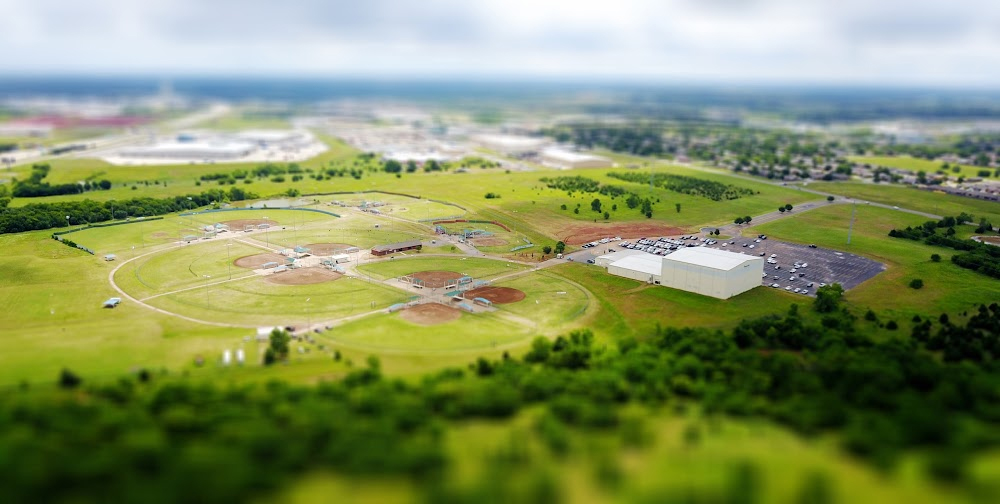
The aerial view documents multiple outdoor diamonds, parking, internal circulation and a prominent indoor sports structure.

This image documents visible deterioration in part of the outdoor complex. It does not by itself establish cause, duration, maintenance responsibility or the condition of the entire property.
The consolidated dashboard brings the major Hidden Valley measures together: team participation, sport mix, team-entry fees, gates, concessions, umpire activity, Event Income, Event Net, Economic Impact and event-host concentration.

The Legends Sports Complex → D-BAT SportsPlex Executive Research Summary consolidates the facility's development history, school-land framework, USSSA tournament activity, sport mix, modeled economics, event-host concentration and public-interest stewardship questions.
The annual USSSA team-entry-fee graph shows a clearly rising fitted trend, with the strongest visible tournament activity occurring in the mid-to-late 2010s.

Visible activity begins at lower levels in the early 2000s, including approximately $18,000 in 2002 and $11,000 in 2005, with smaller amounts in 2008, 2011 and 2013.
Activity accelerates beginning around 2014. The graph shows approximately $35,000 in 2014, about $49,000 in 2015, roughly $53,000 in 2016, around $21,000 in 2017, and the highest visible year in 2018 at approximately $67,000, followed by roughly $37,000 in 2019.
The facility's USSSA tournament profile is heavily weighted toward softball, even though the complex historically supported multiple youth sports.
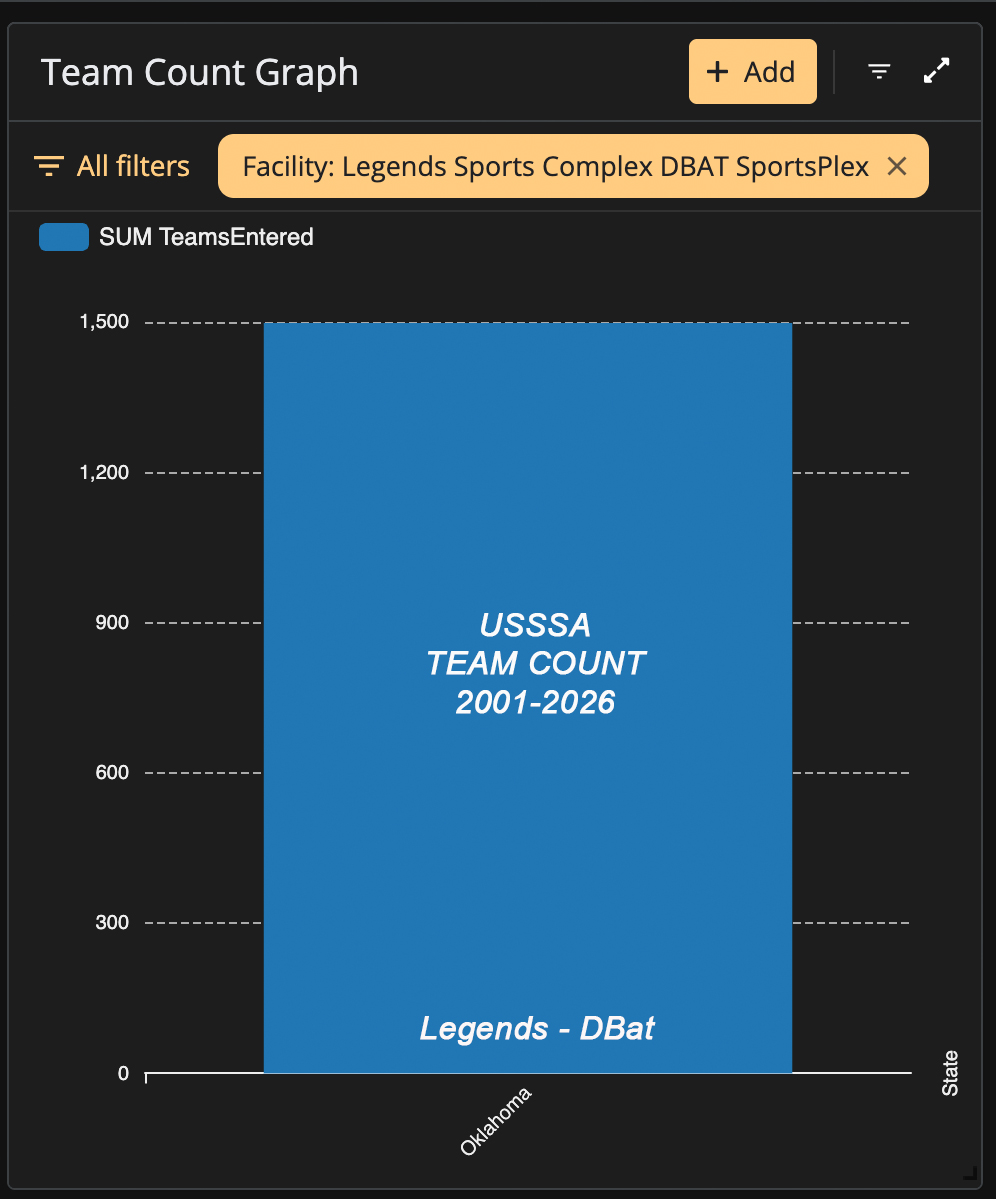
Cumulative team entries attributed to the facility in the Hidden Valley dataset.
What the Data SuggestsApproximately 1,500 team entries demonstrate significant tournament usage.
LimitationTeam entries are not necessarily unique teams because the same team may participate in multiple events or seasons.
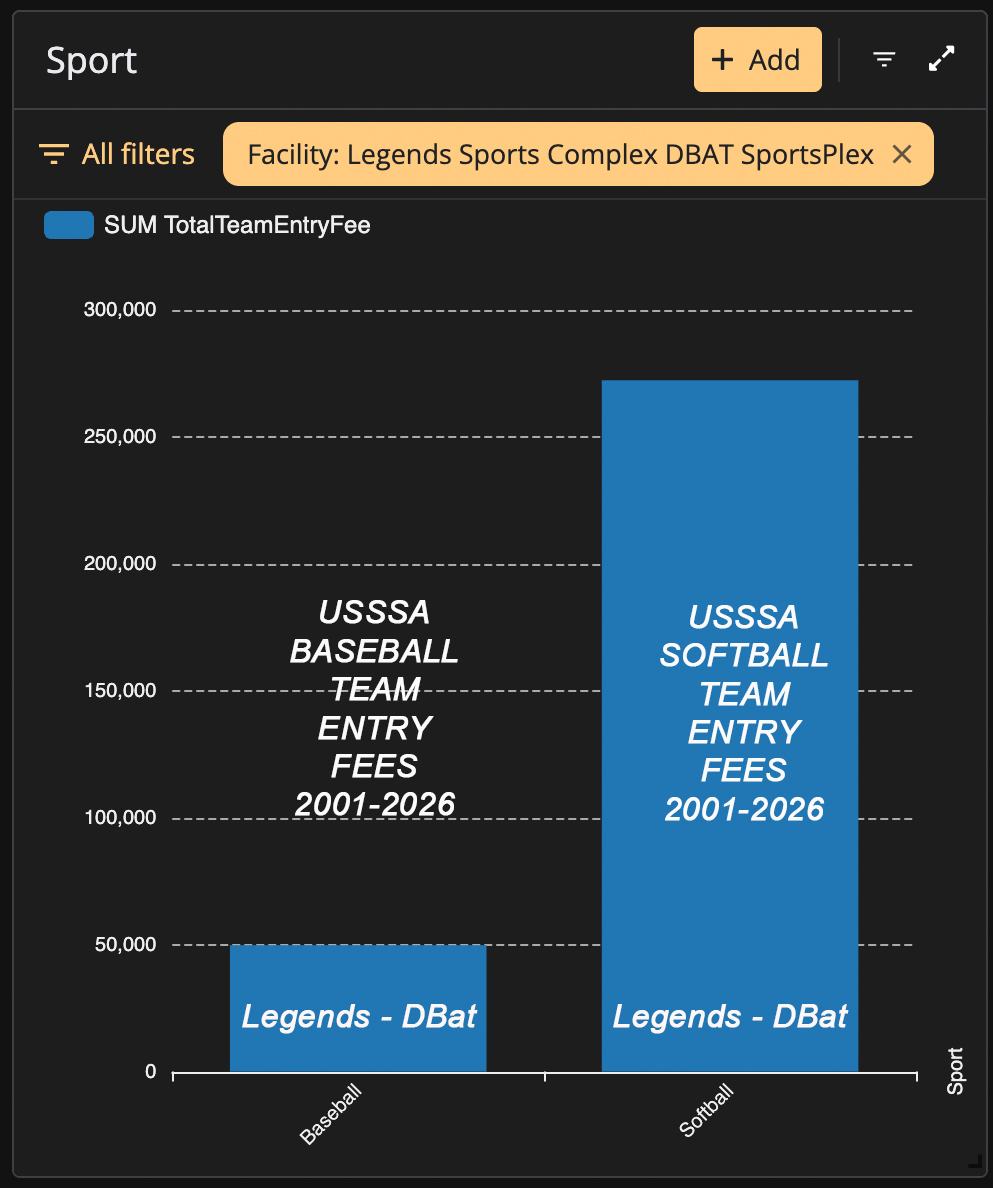
Softball appears near $270,000 in team-entry-fee activity, compared with roughly $50,000 for baseball.
Approximate MixBased on the visual estimates, softball represents roughly 84% of modeled entry-fee activity and baseball roughly 16%.
Why It MattersThe USSSA economic profile of this facility is substantially more softball-oriented than its broader multi-sport historical identity might suggest.
Hidden Valley separates participation fees, gate activity, concessions and umpire activity so that different economic components are not incorrectly collapsed into one number.

Approximately $320,000 in cumulative team-entry-fee activity.
LimitationThis is not proof of audited revenue, retained income or profit.
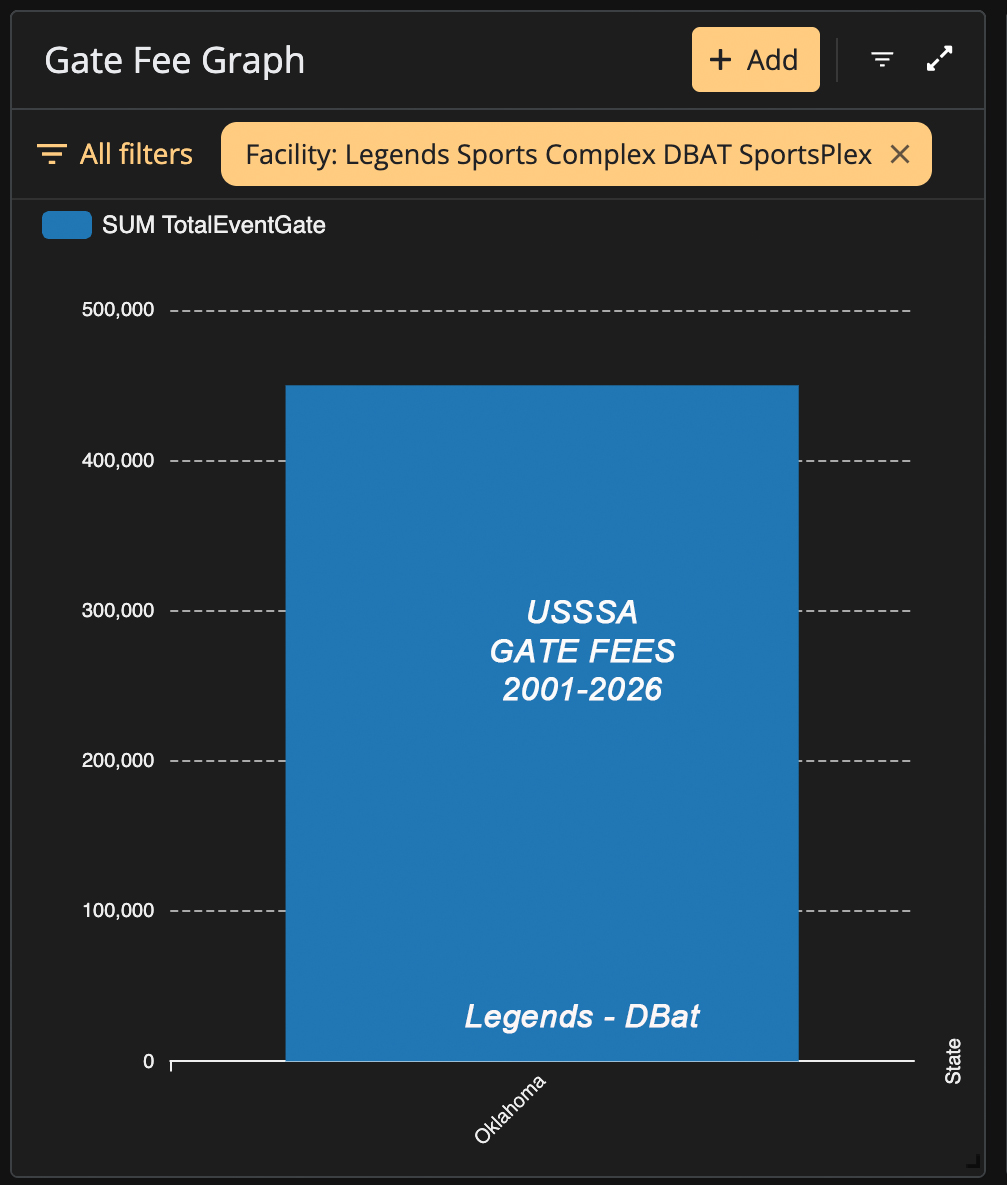
Approximately $450,000 in estimated gate activity.
Research QuestionWho controlled admission policy, collection rights and distribution of gate proceeds during the Legends and D-BAT operating periods?
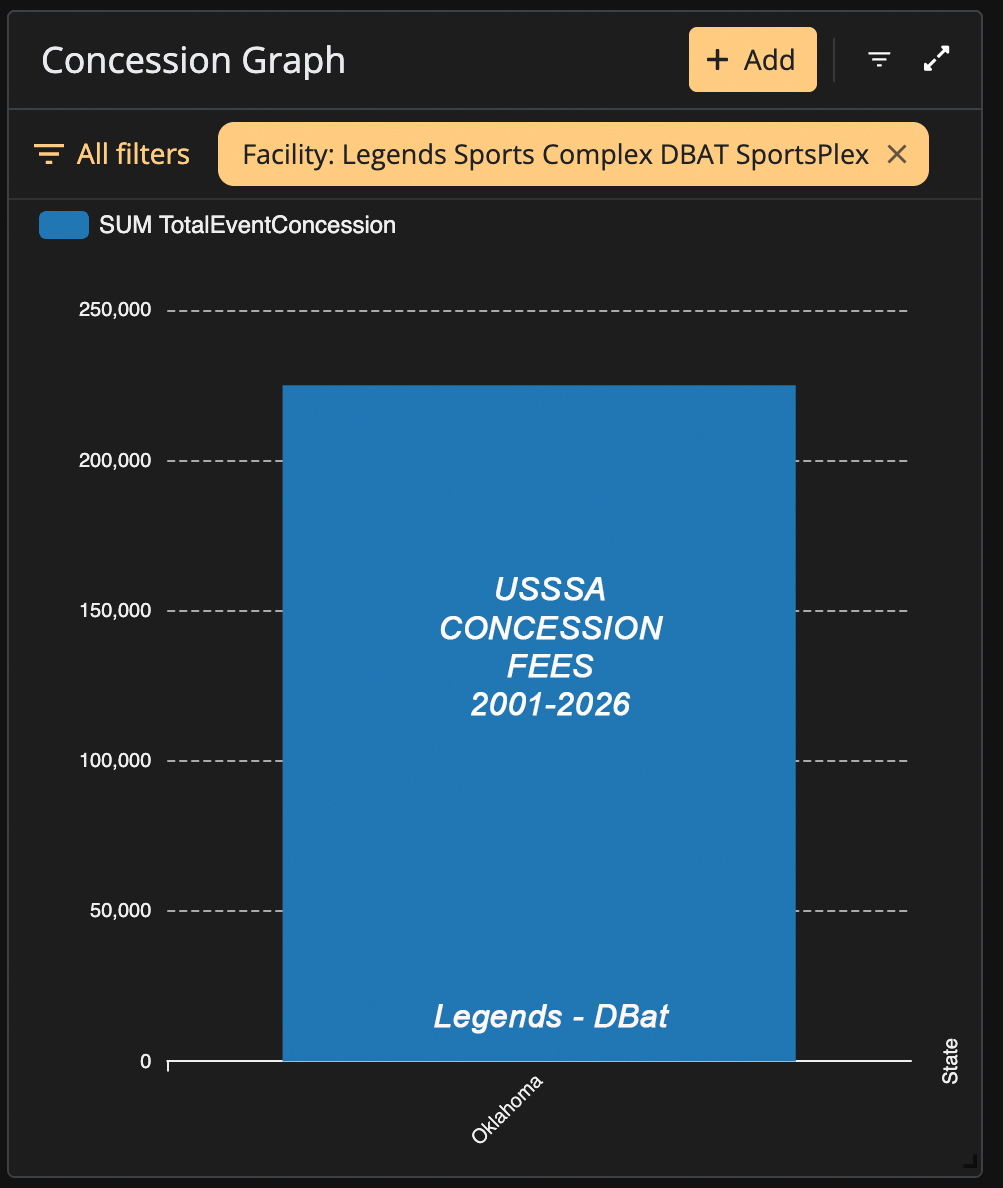
Approximately $225,000 in estimated concession activity.
LimitationThe graphic does not establish which operator, lessee or event host retained concession proceeds.
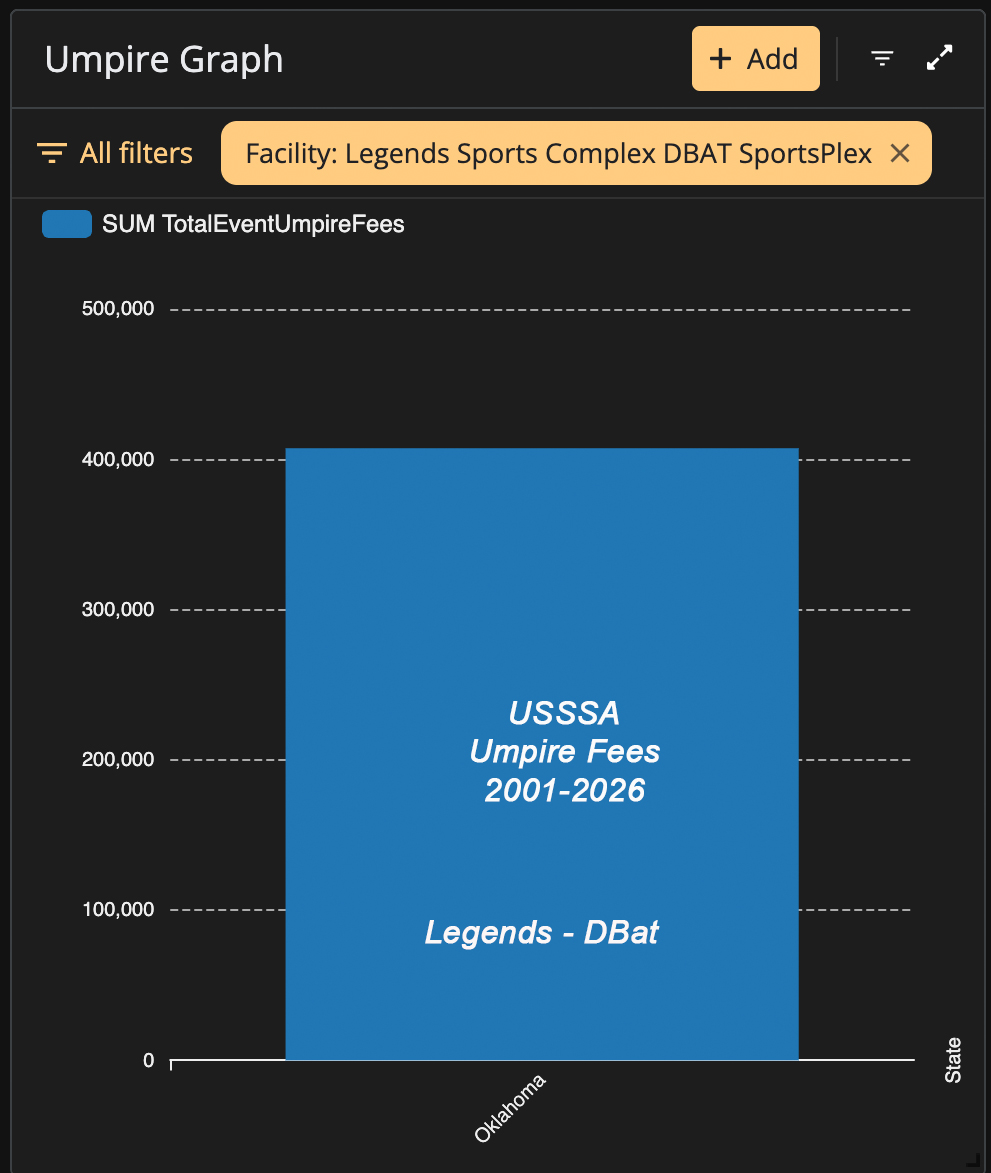
Approximately $405,000 in cumulative umpire-fee activity.
LimitationUmpire-fee activity should not be characterized as facility or organizational revenue without supporting records.
Event Income and Event Net are modeled Hidden Valley measures. Neither should be described as audited organizational profit or personal income.
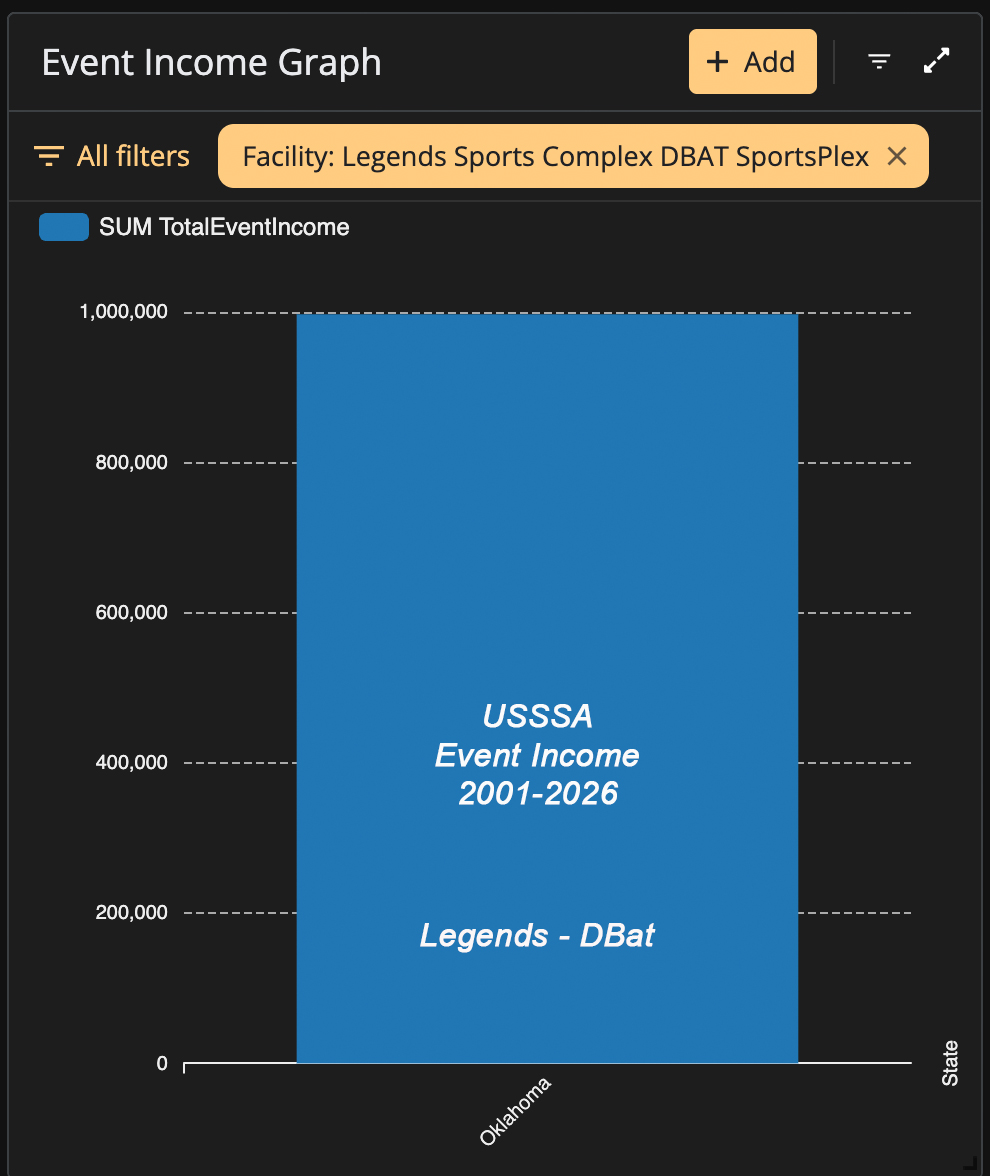
Approximately $1.0 million in modeled cumulative Event Income associated with the Legends / D-BAT dataset.
The figure should be treated as a research-model measure rather than audited revenue of a specific entity.
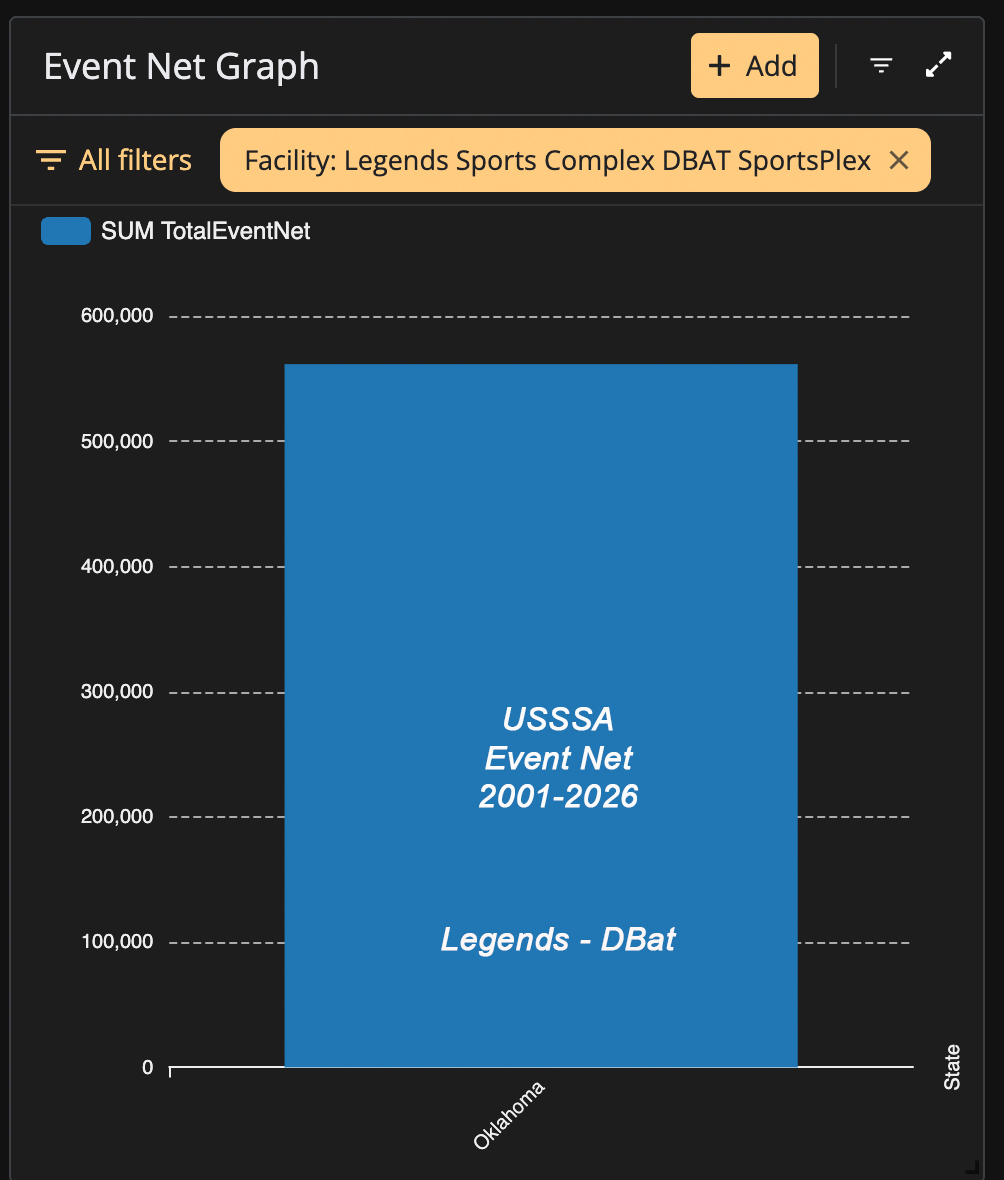
Approximately $560,000 in modeled net event activity.
Event Net is not equivalent to audited net income, taxable income or personal profit.
The Hidden Valley model separately estimates broader community economic effects associated with tournament participation and visitor activity.
The Economic Impact visualization indicates approximately $850,000 in modeled broader economic impact associated with Legends / D-BAT USSSA activity.
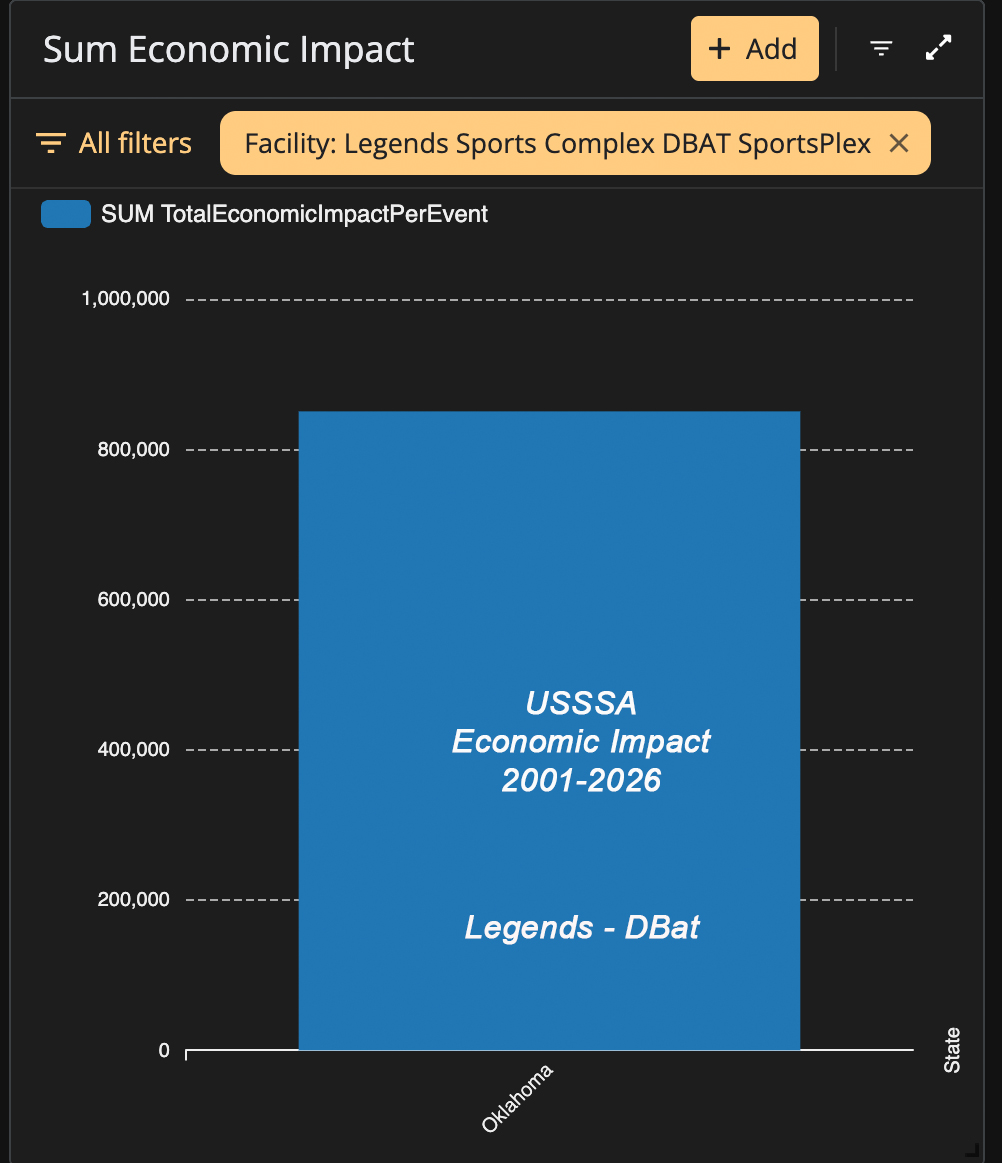
Approximately $850K in modeled broader community economic activity.
The Event Host visualization reveals a highly concentrated pattern of modeled team-entry-fee activity.
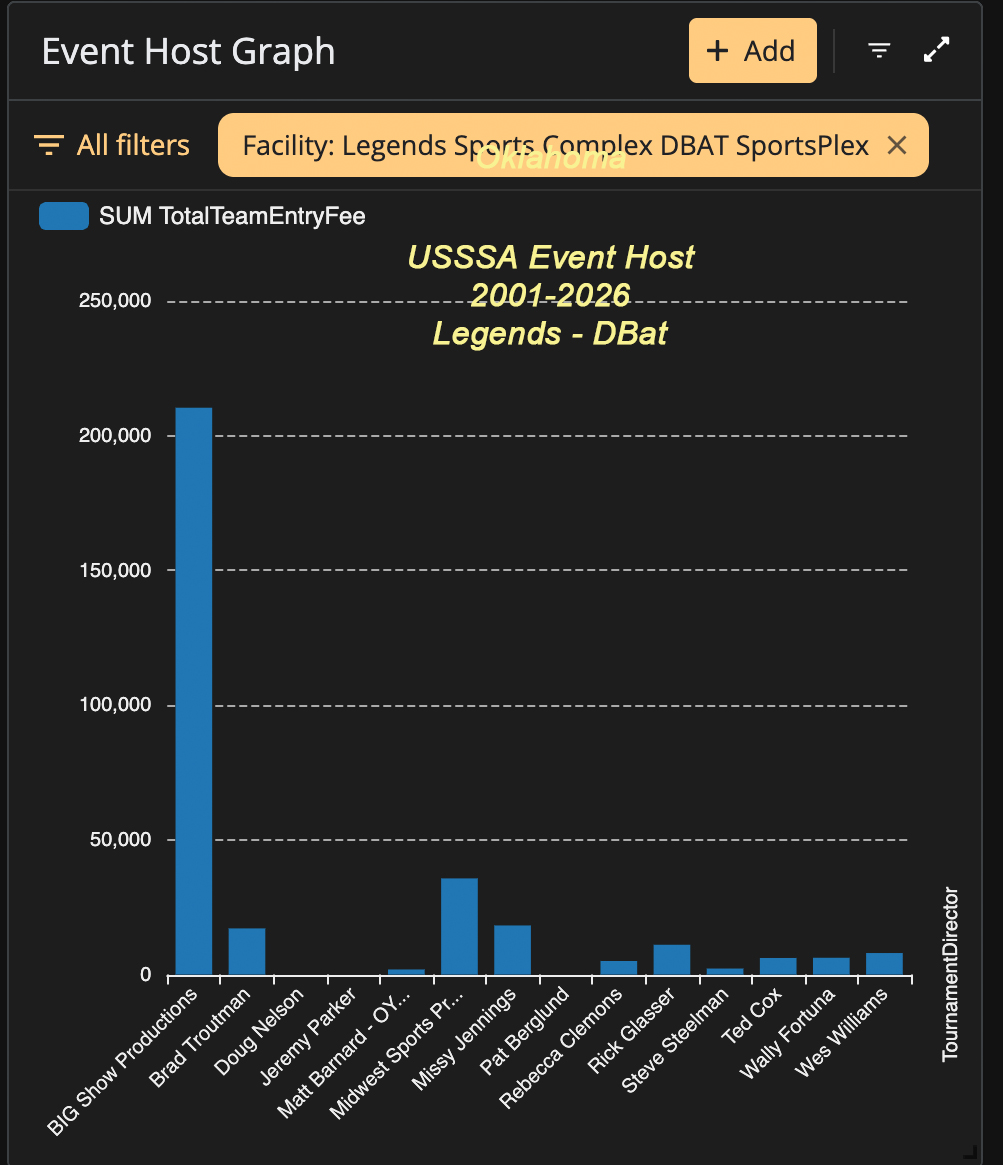
BIG Show Productions is visually associated with approximately $210,000 in modeled team-entry-fee activity, substantially more than any other listed host/director.
Midwest Sports Productions appears next at roughly $35,000. Brad Troutman and Missy Jennings appear in the mid-to-high teens, with smaller amounts associated with Rick Glasser, Wes Williams, Wally Fortuna, Ted Cox, Rebecca Clemons, Steve Steelman, Matt Barnard and others.
This facility should be analyzed as a private sports development on land identified in the research framework as Oklahoma school-trust property. That requires distinguishing the landowner, lessee, operator, developer and owner of improvements.
The facility was developed as a private sports complex intended to attract tournaments, training activity and visitor spending.
A complete lease analysis should determine who financed and owns the outdoor fields, indoor structure, lighting, parking, utilities and other improvements.
The operating identity changed over time. Lease assignments, amendments, approvals and successor rights should be documented through primary CLO records.
Rent, escalation, percentage rent, assignment consideration, land valuation and any other contractual return should be reconstructed over the life of the sports-complex use.
The current lessee, current rent, improvement ownership, maintenance obligations, reversion provisions and current legal status remain essential follow-up questions.
Legends / D-BAT connects private sports development, youth-tournament economics and school-land stewardship in one facility-level case study.
These are research and stewardship questions. They are not allegations or findings of misconduct.
Hidden Valley separates primary records, dataset observations, modeled estimates, historical reporting, analytical interpretation and unresolved questions.
CLO leases, assignments, title records, contracts, court records, facility records, tournament records and other primary-source documentation.
Reporting or compiled materials that help reconstruct development history and identify issues requiring confirmation from primary records.
Counts, trends, host concentration, sport mix and other relationships visible within the Hidden Valley dataset.
Financial or economic calculations derived from participation data, fee schedules and stated methodological assumptions.
Research conclusions drawn from the relationship among data, historical records and institutional context.
A matter requiring additional evidence before a definitive conclusion should be reached.
Legends Sports Complex → D-BAT SportsPlex is a meaningful example of private youth-sports development occurring on a public-trust land framework.
The Hidden Valley dataset documents approximately 1,500 team entries, a strongly rising historical tournament trend and substantial modeled financial activity. The facility history also identifies a transition from Legends to D-BAT and a developed multi-field / indoor sports campus.
The evidence does not, standing alone, establish wrongdoing or an inadequate return to Oklahoma's school-land trust. It establishes a legitimate public-interest basis for obtaining the CLO lease chain, identifying ownership of improvements, reconstructing rent and assignment history, and comparing private economic use of the property with the trust's documented return.
The Legends / D-BAT case study is one facility-level component of Hidden Valley Oklahoma Research. The statewide initiative examines tournament economics, facility ownership, public assets, private operators, municipalities and governance structures across Oklahoma youth sports.
BaseballHeaven.net and Hidden Valley Oklahoma Research are independent research, educational, commentary and public-interest initiatives. Unless expressly stated otherwise, neither is affiliated with, endorsed by, sponsored by or acting on behalf of Legends Sports Complex, D-BAT SportsPlex, D-BAT, USSSA, the Oklahoma Commissioners of the Land Office, any lessee, developer, operator, event host/director or other entity discussed in this research.
Statements concerning the facility's location on Commissioners of the Land Office / Oklahoma school-trust land are part of the research framework for this case study. Precise legal rights, lease terms, acreage, assignments, improvement ownership, rent, renewal rights and current legal status should be established through primary CLO lease and land records before being stated as final facts.
Financial and economic figures presented on this page may include analytical estimates derived from tournament records, participation data, fee schedules and stated research assumptions. Unless explicitly identified as audited data, such figures should not be represented as verified revenue, profit, personal income, taxable income, tax liability or audited financial information.
Financial activity associated with an identified event host or tournament director represents tournament activity attributed through the corresponding field in the research dataset. It does not establish that an individual personally received, retained or earned the associated amount.
Publication of a discrepancy, question, estimate, allegation, historical report, public record or investigative lead is not proof that an individual or organization violated a law, regulation, policy, lease, fiduciary duty, contract or ethical obligation.
Conclusions regarding fraud, lease impropriety, inadequate trust return, misappropriation, tax liability, breach of fiduciary duty or other misconduct require appropriate supporting evidence and, where applicable, determination by a competent authority.
Modeled community economic impact is analytically different from tournament Event Income. Economic-impact estimates may reflect visitor spending or other broader community activity and should not automatically be characterized as money received by a sports organization, tournament director, lessee, property operator or the school-land trust.
Photographs showing visible deterioration document only what was observable at the time the image was taken. They do not independently establish the cause, duration, maintenance responsibility or current condition of the entire property.
Hidden Valley Oklahoma Research is a continuing initiative. Additional CLO lease records, assignments, land valuations, improvement records, contracts, financial records, corrections or other reliable evidence may clarify, supplement or change earlier interpretations.
Individuals, organizations and governmental entities discussed in this research are encouraged to provide relevant records, factual corrections, clarifications or substantive responses when they believe published material is incomplete or inaccurate.
Nothing published through Baseball Heaven or Hidden Valley Oklahoma Research constitutes legal, tax, accounting, real-estate, appraisal, fiduciary, investment or other professional advice.
The purpose of this research is to document matters of public interest, preserve relevant evidence, encourage transparency, evaluate the economics and governance of youth sports, and support responsible stewardship of publicly held or public-trust assets used for private or nonprofit sports activity.
Readers are encouraged to examine the underlying evidence, distinguish source-derived claims from established primary-record facts, evaluate the methodology and reach their own conclusions.