
Shawnee Regional Sports Park Promise vs Actual Outcome
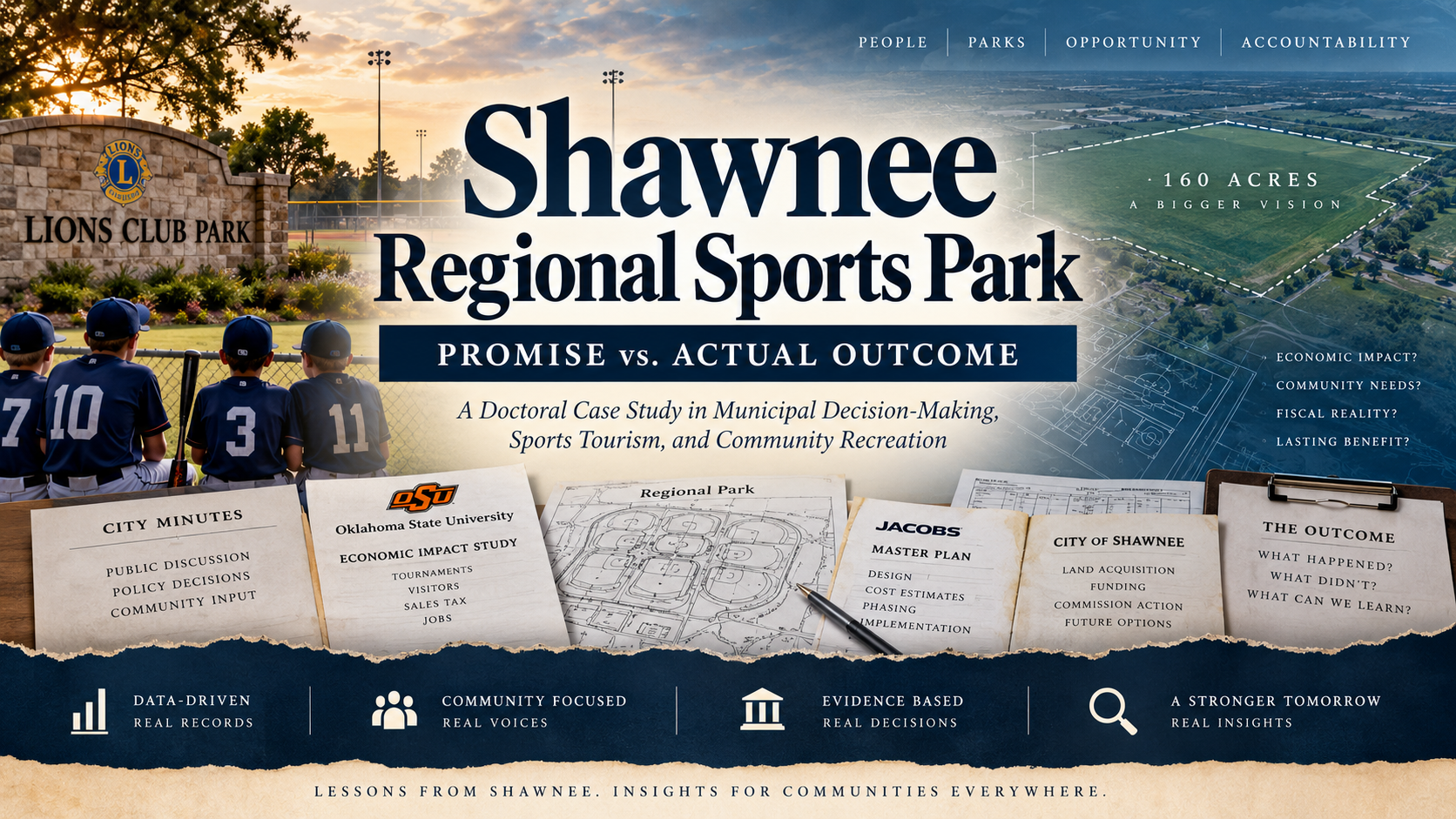
Shawnee Regional Sports Park: Promise vs. Actual Outcome
A retrospective study of municipal recreation policy, Oklahoma State University's 2011 economic-impact model, Lions Club Ballfields, public investment, and Oklahoma's youth-sports tournament market, 2000–2026.
From projected demand to facility-level outcomes
Core question: What institutional, facility, governance, public-finance, and market conditions determine whether projected sports-tourism demand is converted into sustained activity at the public facility for which the projection was originally made?
Expanded question: How did Shawnee balance existing community youth-sports infrastructure—particularly Lions Club Ballfields—against a multi-year effort to develop a new Regional Sports Park justified partly through regional tournament tourism and economic impact?
Planning, finance & the 2011 model
Lions Club Ballfields & the Regional Park
Existing community infrastructure
The minutes document Lions Club capital needs, volunteer maintenance, user-group proposals, field preparation, cleanup/restoration, and later public concern about facility adequacy.
Regional sports-tourism infrastructure
The Regional Park developed through changing sites, advisory committees, grants and leases, dedicated financing, professional planning, a 160-acre acquisition, Jacobs Engineering, and OSU's 2011 study.
From municipal promise to actual outcome
OSU model → municipal expectation → observed outcome
City staff presented the completed OSU economic-impact study; the OSU economist was not personally present. Municipal discussion also went beyond OSU's modeled 17 baseball tournaments, including a suggestion that Shawnee might potentially host 30.
OSU baseball peer communities — 2011 forward
This is not a replication of OSU's survey. OSU used community-reported participation across facilities; Hidden Valley observes public USSSA event records.
Shawnee, Lions Club & FireLake
Research-model measures from the September 10, 2026 Hidden Valley dataset. Calculated fees are not proof of actual receipts, profit, municipal revenue, tax liability, or disposition of funds.
Open Records Request 26-99
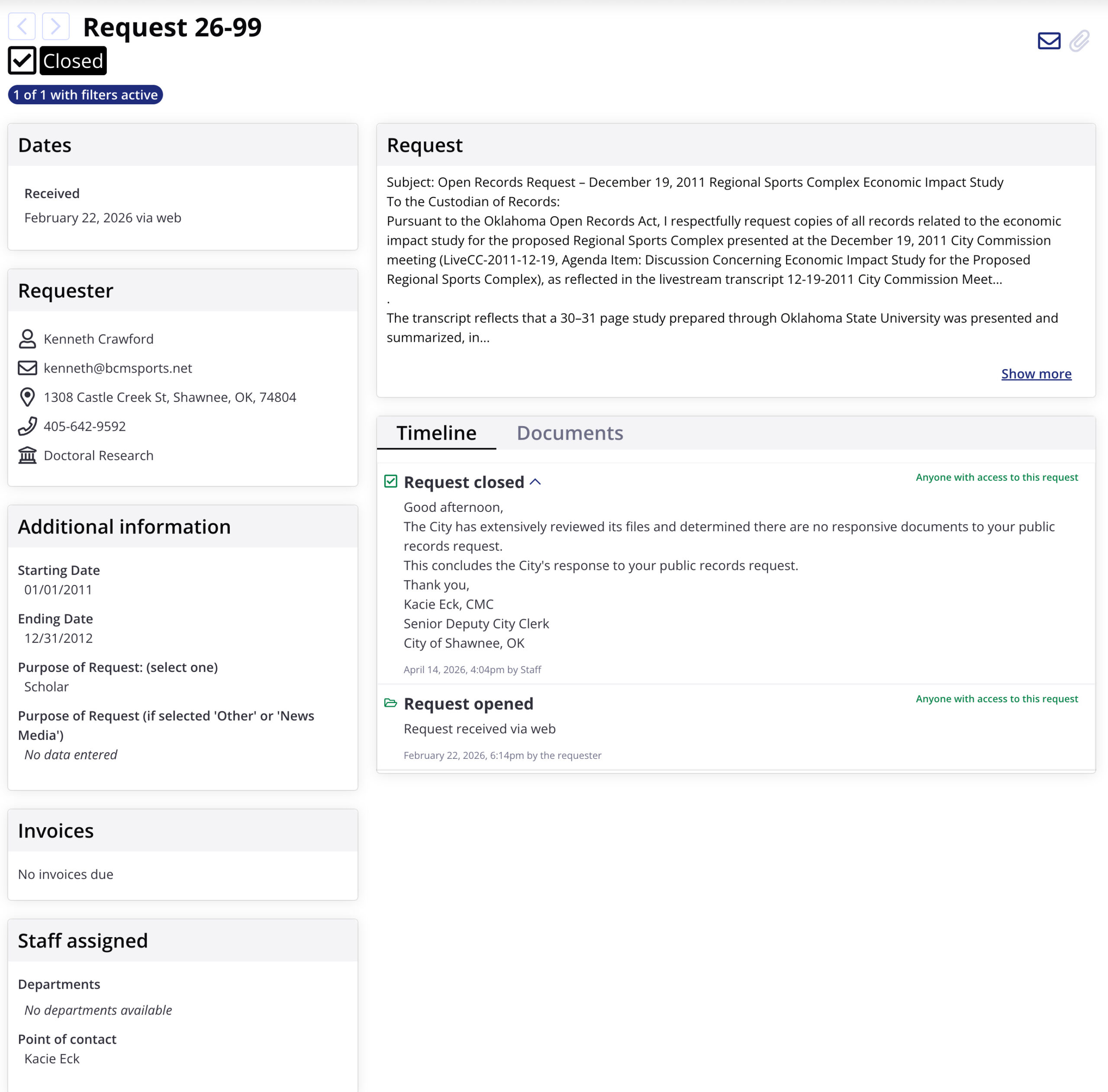
The 2026 records search
The request sought the study, one-page summary, supporting data, contracts, communications, web-posting records, and later reliance records. The City's response stated that an extensive review found no responsive documents.
Open Records Request PDF
The contemporaneous record
The 2011 meeting documents that City staff possessed and distributed the full OSU study and a one-page summary, described a City contract with OSU Extension, and said the report would be posted online.
Watch MeetingMarket validation with institutional and geographic divergence
The later evidence supports a more nuanced interpretation than simply asking whether OSU was “right.” The tournament market existed, but peer outcomes were heterogeneous. Municipal Shawnee does not show a comparable post-2010 USSSA baseball footprint, while FireLake documents substantial regional activity. The minutes also show continuing community-facility needs and implementation barriers surrounding the proposed Regional Park.
What the evidence does—and does not—establish
USSSA represents only one sanctioning ecosystem. Municipality fields are not identical to economic catchment areas. OSU survey variables and Hidden Valley variables are related but not identical. The records-request response establishes a documentary disconnect, not why the materials became unavailable. The case study distinguishes documented facts, calculated measures, retrospective comparisons, and hypotheses requiring additional records.
Shawnee Regional Sports Park: Promise vs. Actual Outcome | 2000–2026