
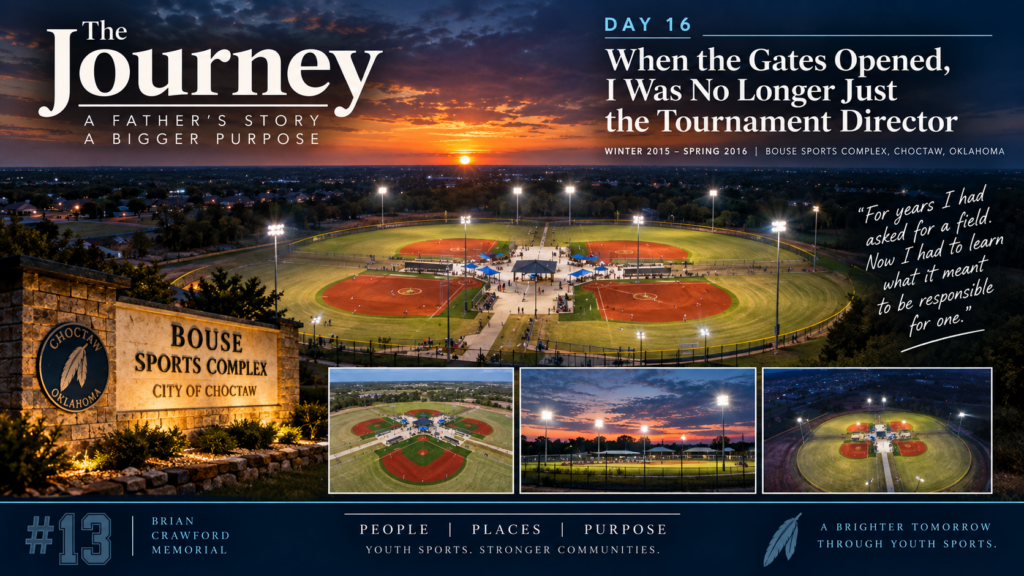
The Journey · Day 16
When the Gates Opened, I Was No Longer Just the Tournament Director
Journey Marker: Winter 2015–Spring 2016 | Bouse Sports Complex, Choctaw — From Proposal to Operation
The December letter told me we had been selected.
But a letter and an operating sports complex are two very different things.
For years, I had been the person calling cities, asking for fields, negotiating tournament weekends, building brackets, finding umpires and hoping the weather cooperated.
Now the responsibility was changing sides.
The Brian Crawford Memorial was moving into Bouse Sports Complex, but I was no longer coming in for one weekend and leaving when the last game ended.
We were becoming part of the operation.
Building Something Around the Memorial
My focus was still Brian.
That matters to me when I tell this story today.
I wasn't sitting down in late 2015 thinking about public-finance models, municipal governance or statewide youth-sports reform. Those ideas came years later.
I was thinking about whether we could build something good.
Something families wanted to be part of.
Something that could give Brian's memorial a permanent home.
From the Historical Record
The later BCM Sports research framework describes Bouse as the point where the organization moved from its earlier role as a memorial mission, annual tournament and facility user into recurring municipal field and program operations.
The operating environment included community league programming, tournaments, gate responsibilities, officials management and municipal usage obligations. The City of Choctaw remained the owner of the taxpayer-funded complex and municipal contracting authority, while concession operations were structurally separate from BCM's field and program operation.
That meant the work wasn't just Saturday and Sunday anymore.
It meant league schedules. Practice schedules. Tournament calendars. Officials. Coaches. Parents. Field usage. Gate operations. Working with the City.
And learning that different pieces of one sports complex could be controlled by different people.
At the time, I accepted those divisions as simply how the operation was structured.
Only much later would I understand how important divisions of responsibility and revenue could become.
April 1, 2016
Opening Day
Then the gates opened.
A surviving Choctaw Times page documents Bouse Sports Complex opening for play on April 1, 2016.
The newspaper identified me with league and tournament operations and described Bouse as the new home of the Brian Crawford Memorial Tournament.
There were photographs from the opening: city officials, baseball players, the new fields and a ceremonial first pitch.
Across the bottom of the newspaper page was something else that represented the transition:
www.bcmsports.net
Looking at that page now feels different than it did then.
At the time, I saw possibility.
The newspaper quoted me describing the moment as “a wonderful dream come true.”
And I meant it.
Brian's tournament had spent years moving from place to place.
Shawnee. Norman. Chickasha.
Every year involved another agreement, another weekend, another uncertainty.
Now I was standing inside a new eight-field sports complex thinking:
Maybe we finally have a home.
The Other Side of the Fence
There is something you don't fully understand when you're only renting fields.
As a tournament director, you see your event.
As an operator, you begin seeing everything around the event.
Who schedules the fields?
Who recruits the umpires?
Who collects which fees?
Who pays which expenses?
Who handles concessions?
Who is responsible when games run late?
Who deals with complaints?
Who bears the financial risk if participation is low?
And who benefits when participation is high?
I didn't have a research vocabulary for any of that in 2016.
I was learning it by living it.
Looking Back
This is one of the places where The Journey and Integrity of the Game have to remain separate.
The Journey tells what I experienced.
The later research asks what those experiences meant.
Today, with hindsight, I can see that Bouse began teaching me a question that would eventually become central to my work:
What happens when responsibility, control and money do not all sit in the same place?
I wasn't asking that question on April 1, 2016.
I was too busy trying to make the place work.
And maybe that is exactly why the lesson mattered.
I learned the system before I ever tried to study it.
“For years I had asked for a field. Now I had to learn what it meant to be responsible for one.”
Question for the Reader
When you finally receive the opportunity you have been hoping for, at what point does opportunity become responsibility—and how does that change the way you see the system around you?
Next on The Journey
Opening the gates was only the beginning.
A sports complex needs more than fields.
It needs people.
And one of the hardest parts of youth sports was about to become one of the most important parts of our operation: officials.
I needed somebody I trusted to help build that part of the operation.
Next on The Journey: Building the Umpire Program — Why I Put Eddie Woods in Charge.
The Journey is a continuing first-person series tracing the path from family, baseball and memorial work to research, public accountability and youth sports reform.