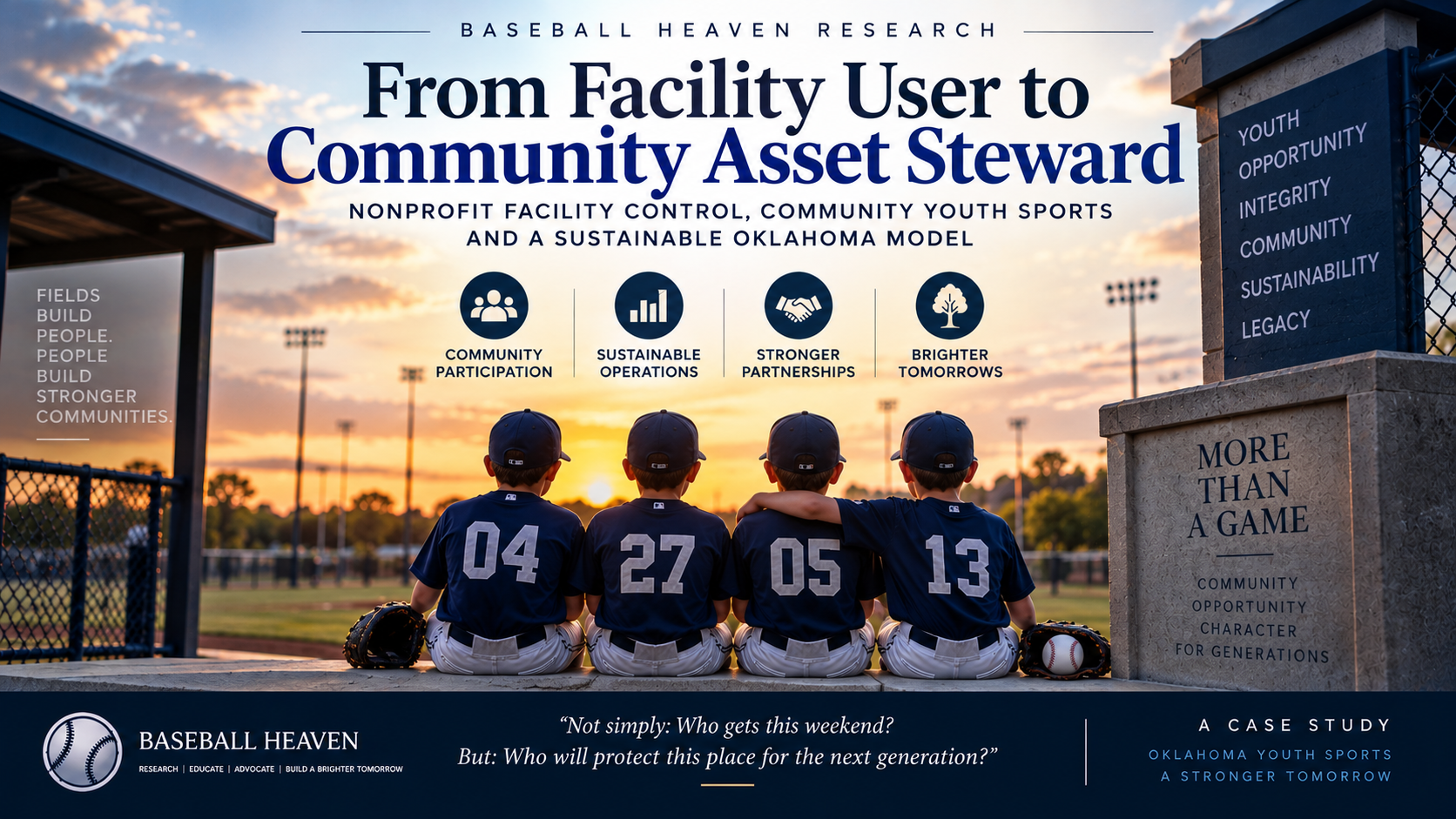
From Facility User to Community Asset Steward
Nonprofit facility control, community youth sports, and a sustainable Oklahoma model for protecting access, accountability and mission across generations.
A community youth-sports organization cannot fully protect its mission over generations if its continued existence depends entirely upon someone else controlling the facility.
Fee-simple nonprofit ownership offers the strongest protection, but durable, transparent and mission-protected nonprofit stewardship under a long-term agreement can provide another viable pathway.
From documenting the system to designing an alternative.
Baseball Heaven research has examined what happened, how Oklahoma youth-sports operations function, how money and authority move through the system, and who ultimately controls facilities. This case study asks the next question: What should a sustainable community-centered model look like?
Success does not equal security.
A youth organization can build participation, events, volunteers, relationships, field improvements and community goodwill without gaining a permanent right to remain where that value was created.
The research describes this as sweat equity without property equity.
Value a community organization may create
Volunteer labor • fundraising • equipment • improvements • maintenance • customer relationships • tournament reputation • institutional knowledge • goodwill.
What those contributions do not automatically create
Ownership • guaranteed scheduling • permanent operating authority • protected revenue rights • long-term access.
More than operating tournaments.
The Brian Crawford Memorial adds a dimension an ordinary facility study does not have. The investment includes memorial identity, charitable fundraising, volunteer effort, community trust, organizational goodwill and a mission created in Brian's name.
Memorial Investment
Brian's name, legacy, purpose and the community commitment created in his memory.
Community Investment
Donations, volunteers, relationships, participation and years of support.
Operational Investment
Tournament development, scheduling, marketing, programming and accumulated knowledge.
The child who does not already have a team.
The proposed model is not an argument against travel, showcase or competitive baseball. It addresses children who need an accessible local entry point into the game.
Community recreation and competitive advancement can coexist. The question is whether local children still have a meaningful place to begin, learn, compete and belong without first securing a position on a preassembled team.
Economic impact is not facility sustainability.
A tournament may create visitor spending while producing a very different result for the facility, operator or local youth program.
Regional Economic Impact
Hotels, restaurants, fuel, retail and visitor spending.
Facility Revenue
Rentals, concessions, gates and contractual receipts retained by the facility.
Operator Revenue
Entry fees and event income controlled by the operator.
Community Benefit
Participation, affordability, development, recreation and access.
Research context
The 2011 Oklahoma State University Shawnee report was an economic-impact analysis, not a feasibility or benefit-cost analysis. The Baseball Heaven framework therefore treats visitor economic activity, facility cash flow and public return as distinct questions.
Align responsibility, revenue and mission.
Land ownership, operations, scheduling, tournament activity, gate receipts, concessions, entry fees and capital responsibility can be divided among different parties. The proposed alternative is deliberate alignment.
Tournaments
Support fields and the youth mission.
Concessions & Sponsors
Support operations and affordability.
Donations
Become durable capital improvements.
Reserves
Protect maintenance and future replacement.
Ownership is strongest. It is not the only pathway.
Nonprofit Ownership
The youth nonprofit owns and operates the asset.
Protected Public Lease
Government retains title while a community league receives durable contractual control.
Nonprofit Stewardship
Public ownership is paired with independent nonprofit operation, development and maintenance.
Intermediary Model
Ownership and operations are separated through user groups, contractors or changing leaseholders.
The Community Asset Stewardship Model.
The next research phase can test a model designed around community access and institutional continuity.
Mission-Protected Governance
Community youth opportunity remains the institutional purpose.
Durable Facility Control
Ownership or a multi-decade agreement protects continuity.
Open Registration
Children can enter individually without a preassembled team.
Development & Parity
Balanced local play provides instruction, competition and a pathway forward.
Transparent Finances
Registration, events, concessions, sponsorships, donations and capital spending are documented.
Institutional Continuity
The structure is designed to survive changes in founders, boards, elected officials and administrators.
Facts, interpretation and unanswered questions must remain distinct.
The public-facing case study should clearly distinguish documented records from personal recollection, interpretation and hypotheses requiring further verification. Contested organizational or eligibility disputes should be described through sourced facts and attributed positions rather than unsupported conclusions about motives.
Likewise, the idea that voters may resist public sports-facility financing because of concerns about governance or user-group control should be treated as a research hypothesis unless supported by direct evidence.
A synthesis of the Baseball Heaven research architecture.
Who Controls the Field
Provides the comparative governance framework.
Brian Crawford Memorial History
Documents programming, relationships and operational experience.
Before the Gates Opened
Examines operating-system design before facility operation.
Shawnee Regional Sports Park
Separates economic promise, operating outcomes and facility revenue.
Hidden Valley
Examines financial flows, intermediaries and accountability.
Community Asset Stewardship
Begins converting accumulated research into a prospective alternative.
From a memorial mission to a generational community asset.
The objective is no longer simply to build or use another sports complex. The research now asks whether a transparent, accountable nonprofit institution can align youth access, facility stewardship, revenue reinvestment, capital planning and long-term community control.
“Not simply: Who gets this weekend?
But: Who will protect this place for the next generation?”