
2006 • Shawnee
The first Brian Crawford Memorial Tournament was held at the Lions Club ball fields in Shawnee. Later events moved through Norman, Chickasha, Choctaw, Tulsa and Seminole as facility needs and relationships changed.
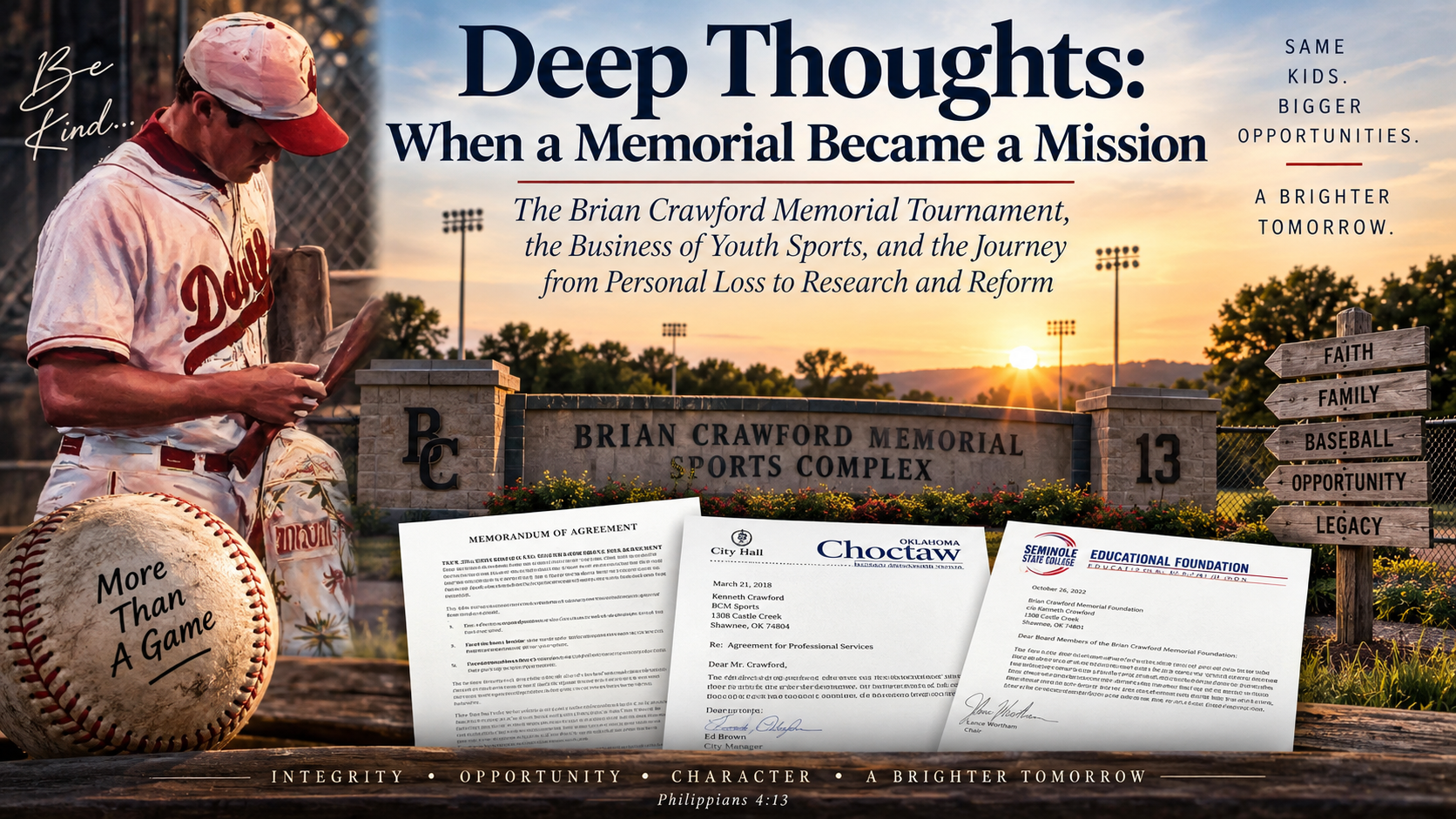
A first-person reflection on the Brian Crawford Memorial Tournament, the facilities and relationships that shaped it, the business realities discovered along the way, and how a family memorial ultimately became part of a larger research and youth-sports reform mission.
On September 22, 2026, Kenneth Crawford recorded a personal reflection about the Brian Crawford Memorial Baseball Tournament. The recording begins with places, dates and tournaments, but gradually reveals a deeper story: how a family used baseball to carry Brian's memory forward, how access to facilities and business relationships shaped that effort, and how those experiences eventually influenced a larger research mission.
This page deliberately distinguishes documented facts from personal recollection and interpretation. The primary records are provided for readers to examine directly. Reflective passages preserve the perspective expressed in the recording rather than presenting every recollection as an independently established fact.
The Memorial Tournament became an annual point of connection for the Crawford family and participating teams. Crawford describes it as a way of moving through personal loss by creating something constructive to work toward each year.
The first Brian Crawford Memorial Tournament was held at the Lions Club ball fields in Shawnee. Later events moved through Norman, Chickasha, Choctaw, Tulsa and Seminole as facility needs and relationships changed.
Crawford recalls coaches using the weekend to teach life lessons and participating families connecting with the story behind the tournament. The event's purpose became part of its identity.
The weekend provided a recurring opportunity to talk about Brian, distribute memorial items and baseball cards, fundraise, and introduce his story to people who never knew him personally.
Across two decades, changing locations produced an operational lesson that later became important to the Baseball Heaven research model: an organization can create demand, tradition and community value, but without long-term control of playing infrastructure, its future remains dependent upon facility owners and operating relationships.
The original home. As participation grew, facility capacity became a limiting factor.
The reflection describes weather challenges and a later $10,000 nonrefundable requirement as factors in searching for another location.
BCM Sports coordinated league and tournament play at Bouse Sports Complex before Crawford later became involved in development of the Brian Crawford Memorial Sports Complex.
That operational conclusion would later become part of a broader question about who controls youth-sports facilities and who captures the activity generated there.
The recording describes the Choctaw period as an early lesson in the difference between personal relationships and business relationships. The City's March 21, 2018 letter provides a documentary boundary around the termination itself.
The City cited the professional-services agreement's termination clause permitting either party to terminate upon 30 days' written notice and stated that the City Council was terminating the agreement effective July 2, 2018.
The letter also stated that cancellation should not be viewed negatively and expressed appreciation for BCM Sports' service coordinating league and tournament play at Bouse Park.
Crawford remembers surrounding conversations, relationships with other tournament operators and the City's desire to bring operations in-house as part of a more complicated story. Those details remain his recollection and interpretation unless separately documented.
One lesson remained: business relationships can fracture personal relationships.
The June 1, 2017 Memorandum of Agreement and later SSCEF correspondence allow the written record to be separated from later disagreement and interpretation.
The agreement describes a donation package in excess of $500,000: an initial $300,000 gift, $50,000 upon substantial completion, and five annual $30,000 gifts beginning October 1, 2019.
It also states that once total funds raised for the project through donations to the SSC Foundation reached $1,000,000, all obligations for further payments by the Brian Crawford Memorial Foundation would be waived by the SSC Foundation.
In the Deep Thoughts recording, Crawford describes this waiver as central to his understanding of the Foundation's obligation and to his later concern about the remaining balance. His recollection of conversations and motives is his perspective; the waiver language itself appears in the signed Memorandum.
SSCEF explicitly acknowledged that the Memorandum indicated that after $1 million was raised, BCM would have no further payment obligation. The letter also acknowledged that more than $1 million in other donations was eventually raised.
SSCEF argued that circumstances had changed substantially, describing growth from an anticipated project of approximately $2 million to a total cost close to $12 million. It asked BCM to consider paying the remaining pledge amount despite acknowledging the waiver language.
The complex grew far beyond the original quadriplex contemplated in 2017. Whatever later disagreements arose, the written record documents that Brian Crawford Memorial Foundation was a lead contributor and that the facility carried Brian Crawford's name.
Looking backward through the lens of later research, Crawford describes a financial ripple effect surrounding every event: entry fees, facility activity, officials, concessions, user groups and community spending. The tournament could be a memorial to one participant in the system and a revenue-producing weekend to another.
The repeated search for host sites illustrated how much control facility owners and primary operators possess over programming, continuity and event viability.
Crawford recalls starting umpire compensation around $20–$25 per game and later moving to $40 as competition for officials increased. Even a new turf complex still needed an adequate officiating workforce.
The difficult lesson was not that business itself was wrong. It was that different participants could assign very different meaning to the same weekend and make decisions according to different incentives.
The recording describes the absence of the annual tournament as a loss of a family ritual: setting up booths, sharing Brian's story, distributing memorial items and baseball cards, fundraising and reconnecting around a common purpose.
The reflection also explains why restarting the tournament somewhere else was not viewed as a simple operational solution. In Crawford's view, holding a Brian Crawford Memorial Tournament somewhere other than the complex bearing Brian's name could create public confusion and potentially turn a memorial story into an institutional dispute.
From 2022 forward, Crawford describes redirecting much of the energy once invested in tournament operations toward documentation, the Hidden Valley research dataset, public-facility analysis and a broader youth-sports reform initiative.
Years of operating tournaments and working with facilities produced first-hand questions about leases, user groups, officials, revenue, facility control and public accountability.
Those questions became records requests, datasets, historical reconstruction, case studies and comparisons intended to make the business structure of youth baseball and softball more visible.
The stated goal in the reflection is to help municipalities, counties and policymakers better understand public youth-sports facilities and consider governance models that protect public accountability and community purpose.
This page is a reflection, not a legal conclusion. Readers are encouraged to examine the underlying documents and distinguish written terms from later recollection, interpretation and disagreement.
Includes the June 1, 2017 Memorandum setting out the donation structure, naming provision, committee participation and $1 million fundraising waiver, together with later correspondence included in the packet.
VIEW MEMORANDUMThe City's written notice invoking the professional-services termination provision and expressing appreciation for BCM Sports' coordination of league and tournament play at Bouse Park.
VIEW CHOCTAW LETTERSSCEF's letter describing the project's growth, its accounting of BCM contributions, the requested $148,855 balance, and its acknowledgment of the Memorandum's $1 million waiver language.
VIEW SSCEF LETTERDocumented Record identifies statements supported directly by the primary records displayed here. Personal Reflection identifies Kenneth Crawford's memories, impressions, conclusions or interpretation of events. Where the recording uses approximate figures from memory, this page favors exact figures stated in the available primary documents.
The purpose is not to turn Brian's memorial into a dispute. It is to preserve the historical record, explain the experiences that shaped later research, and allow readers to examine the evidence for themselves.
Before there was a Memorial Tournament, BCM Sports, a sports complex bearing Brian's name, Hidden Valley, Baseball Heaven, or a youth-sports reform initiative, there was a family experiencing the loss of a son.
This local television news report documents the accident and loss of Brian Crawford. It is presented here as a historical artifact and the starting point for the journey documented across these three connected projects.
WATCH ARCHIVED NEWS REPORT ON YOUTUBEThe story now lives across three websites, each preserving a different part of the same journey. This page serves as the bridge connecting Brian's personal legacy, the youth-sports organization that grew from the Memorial, and the research initiative shaped by those experiences.
Brian's story, remembrance, memorial activities, scholarships, family legacy and the continuing mission created in his name.
VISIT BRIAN CRAWFORD MEMORIALThe youth-sports organization and operational experience that grew from the Memorial mission through leagues, tournaments, facilities and community programming.
VISIT BCM SPORTSThe documentation, datasets, case studies and public-accountability research that grew from those years of youth-sports experience.
EXPLORE BASEBALL HEAVENAfter reviewing the reflection, documentary record and primary-source archive above, readers can listen to this NotebookLM-generated podcast exploring the larger story—from the Brian Crawford Memorial Tournament and facility relationships to the questions that eventually became research.
“No man alone could have built that facility.”
The September 22 reflection ultimately returns to faith and purpose rather than conflict. The tournament may no longer occupy an annual weekend on the calendar, but the mission continued—in Brian's name, in facilities, scholarships, family memories, research, and the effort to improve opportunities for the next generation.