
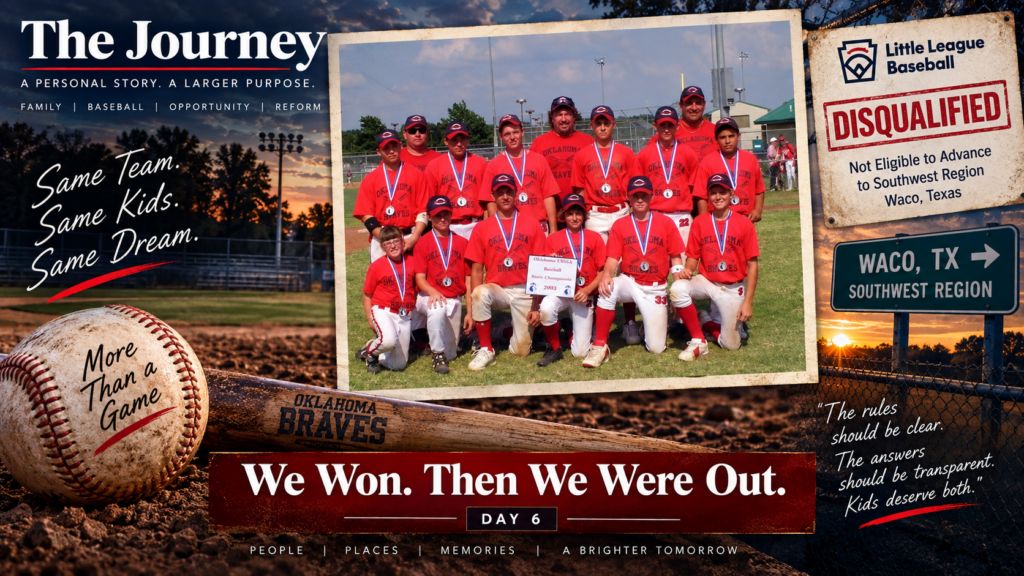
The Journey · Day 6
We Won. Then We Were Out.
Journey Marker: 2003 | Shawnee Little League — Oklahoma Braves
By 2003, the Oklahoma Braves had been together for years.
These weren't kids who showed up at a tryout one weekend and were assembled because somebody thought they could win a trophy. They had grown together. Some had been with me since they were little.
That distinction mattered to me then, and it matters even more when I tell this story now.
When Shawnee Youth Baseball moved toward becoming affiliated with Little League International, I wasn't sitting on the board making those decisions. I was a coach. My recollection is that the people handling the charter discussions were told our existing team could stay together as long as we participated in the local league.
So that's what I remember us doing.
We had four teams.
We played a twenty-game schedule—doubleheaders over ten weeks.
Then we represented Shawnee in the Oklahoma state tournament.
And we won.
At least that is my firsthand recollection of what happened.
We believed the next stop was Waco, Texas, for the Southwest Region tournament.
We never got there.
The Decision I Didn't Understand
I remember receiving word that our team had been disqualified.
What I understood at the time was that we were considered too competitive.
That made no sense to me.
These weren't handpicked all-stars in the way people sometimes picture competitive youth baseball. They were kids who had evolved together over several seasons. We had become good because they stayed together, practiced together and learned together.
One of our baseball-family connections tried to look into the decision. My memory is that communication eventually stopped and we never received an explanation that I felt I could understand.
That experience stayed with me.
For years afterward, I wanted almost nothing to do with Little League.
I wouldn't watch it on television.
In my mind, the organization had punished a group of kids who had done what we believed we were supposed to do.
But this is where I need to separate what I believed then from what I learned later.
Twenty Years Changes the Question
When I returned to Little League administration years later and began researching Oklahoma youth baseball more seriously, I came across information indicating that the stated issue wasn't that our team was “too competitive.”
The issue was described as failure to participate in the qualifying league.
That surprised me because my memory was very specific:
We had played the league schedule.
Twenty games.
Ten weeks.
My later recollection went further. I described the Tulsa charter as having protested our team and ultimately replacing Shawnee at the Southwest Region tournament in Waco.
But I want to be careful with that statement today.
That is my later recollection and interpretation.
The source materials I'm using for this installment do not include the original 2003 protest, Little League's written ruling, the tournament affidavit, league schedules or the underlying correspondence.
Without those records, I should not turn a twenty-year-old memory into an established institutional fact.
And strangely enough, that realization became more important than the old baseball argument itself.
Looking Back
Years later, Integrity of the Game would be built around a lesson I was beginning to learn without recognizing it:
Memory can tell you where to look. Records tell you what you can prove.
The research eventually moved away from relying only on stories and personal experience toward documentation that could be examined independently.
I didn't understand that in 2003.
I was a coach who believed his kids had earned the right to keep playing.
I was angry.
I was disappointed.
And then I moved on.
The Braves kept playing baseball. We competed successfully as thirteen-year-olds and fourteen-year-olds before the team eventually reached its natural end as the boys moved into school baseball.
But the Little League experience never completely disappeared from my memory.
Twenty years later, when I found myself asking questions about eligibility, governance, protests and transparency again, that old experience suddenly looked different.
Maybe the most important question wasn't whether my memory was completely right.
Maybe it was this:
Why was it so difficult for a family to understand exactly what happened?
“For years I remembered the punishment. It took much longer before I understood the importance of asking for the record.”
Question for the Reader
When a youth-sports organization makes a decision that ends a child's season, what does it owe the families affected—a final ruling alone, or a clear and reviewable explanation showing how that decision was reached?
I know what I would want today.
The documents. The rule. The evidence. And an explanation everyone can understand.
Next on The Journey
The Oklahoma Braves kept playing.
Life kept moving.
And then, in 2005, baseball suddenly became insignificant.
On April 27, my oldest son, Brian, was killed in an automobile accident.
The fundraiser tournaments we had once used to help a baseball team travel were about to become something entirely different.
Next: when a baseball tournament became a memorial—and a family's grief began changing the direction of everything that followed.
The Journey is a continuing first-person series tracing the path from family, baseball and memorial work to research, public accountability and youth sports reform.