The Journey · Day 5
The Miles Behind the Memories
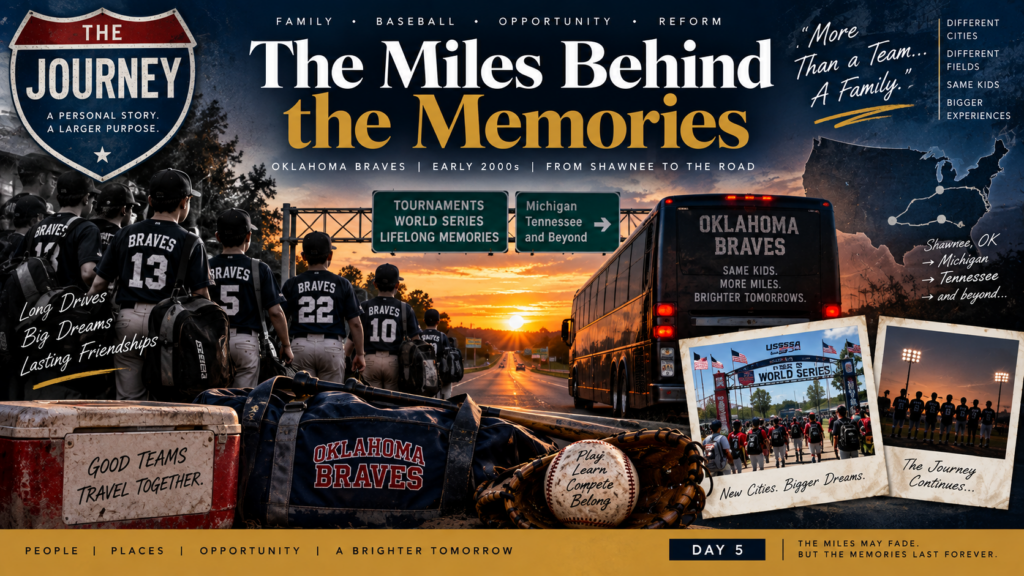
Journey Marker: Oklahoma Braves | Early 2000s — From Shawnee to the Road
By the time we had our indoor place to practice, the Oklahoma Braves had become more than a team that met a couple of evenings a week.
We were spending a lot of time together.
Practices. League games. Weekend tournaments. Long drives. Hotels. Meals between games. Parents sitting in lawn chairs for hours. Kids piling into vehicles with gloves, bat bags and whatever snacks somebody had packed.
And eventually, World Series trips.
Those trips are easy to remember today as baseball memories.
What is easier to forget is what it took for families to get there.
Baseball Wasn't Free
We had families from different financial situations.
Some could absorb the cost of competitive baseball easier than others. Some couldn't.
I remember single mothers and other parents stretching everything they had to make trips possible. I remember families using credit cards because their son had earned an opportunity to travel with the team and they didn't want money to be the reason he stayed home.
That is firsthand memory.
I didn't study the economics of it then.
I just knew I didn't want a kid's family finances to automatically decide whether he could be part of what we were building.
So we raised money.
I had been helping Shawnee youth baseball with its website as the Internet began becoming a bigger part of youth sports. In return, I was able to use tournament weekends for an Oklahoma Braves fundraiser.
We didn't sell enough candy bars to get ten kids across the country.
We ran baseball tournaments.
Families worked them.
The proceeds were divided based on participation and credited toward player expenses. My recollection is that, in strong years, we could put a couple thousand dollars into individual player accounts to help cover uniforms, tournament fees, travel, charter buses and World Series expenses.
At the time, it was just problem-solving.
We had kids who wanted to play. Playing cost money. So we figured out a way to help them earn it.
Then Came the Miles
As the Braves got older, baseball took us farther from Shawnee.
By twelve years old, we were traveling to a USSSA World Series in Michigan. My recollection is that the tournament was enormous and lasted most of a week. We kept playing deep into the tournament before taking our first loss.
But when I think about those trips today, the first thing I remember isn't a bracket.
It's the people.
The kids who had grown up together. The coaches. The mothers and fathers. The siblings. The hotel hallways. Eating together after games. Driving for hours and then waking up early enough to do it again.
A youth baseball tournament might appear on paper as seven innings and a final score.
For a family, it can be seventy-two hours of life together. Sometimes more.
We hosted tournaments where players and parents were together nearly an entire weekend. That much time together wasn't always perfect. Kids argued. Parents worried. Personalities collided.
But relationships were being built too.
We didn't hold traditional tryouts every year and go replace half the roster. Players came. Some left. Others stayed. Over time, the group evolved.
What remained was a core that had grown up together.
That's why those miles mattered.
Looking Back
Years later, when I wrote Integrity of the Game, those little fundraiser tournaments looked different to me.
To run even a modest fundraiser tournament, somebody had to schedule fields, coordinate teams, collect entry fees, arrange officials and maintain records.
I didn't know I was learning sports administration.
I didn't know I was learning tournament economics.
I certainly didn't know those experiences would eventually lead me into questions about facilities, nonprofit operations, public accountability and youth-sports reform.
I thought I was helping ten kids get to another baseball tournament.
And that is exactly what I was doing.
But hindsight tells me I was learning something else:
Opportunity has a cost.
Someone pays it with money. Someone pays it with time. Someone drives the miles. Someone works the gate. Someone gets up Monday morning exhausted and goes back to work.
The kids remember the baseball.
The adults remember what it took to get them there.
“The trophies tell you where we finished. The miles tell you what it took for us to get there.”
Question for the Reader
When youth sports creates opportunities that families cannot all afford equally, what responsibility—if any—do teams, leagues and communities have to keep money from deciding which children get those experiences?
There probably isn't one answer.
But I think every youth-sports organization ought to be willing to ask the question.
Next on The Journey
The Oklahoma Braves had traveled together, competed together and become something that felt like family.
Then came a moment that had nothing to do with winning a baseball game.
Little League told us our team could not continue.
Next on The Journey: what I remembered being told at the time, what I believed for years afterward—and what records much later caused me to reconsider about what actually happened.