
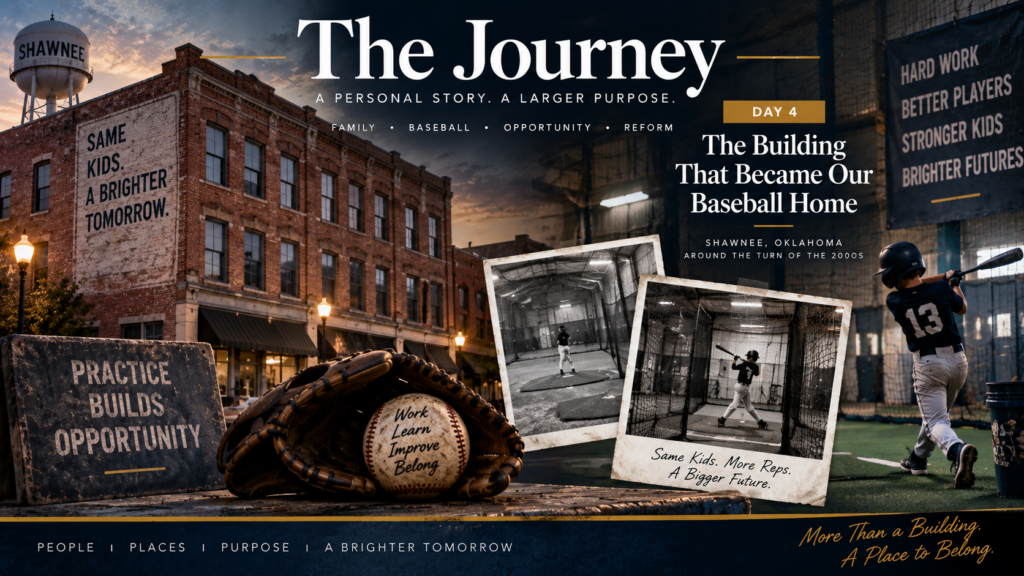
The Journey · Day 4
The Building That Became Our Baseball Home
Journey Marker: Shawnee, Oklahoma | Oklahoma Braves — Around the Turn of the 2000s
By the time the Oklahoma Braves started becoming a serious competitive team, I had learned something simple: if you want kids to improve, they need a place to work.
Not just when the weather cooperates. Not just when a public field happens to be open. They need repetitions. They need somewhere they can fail, adjust and try again.
Around that time, a friend and I became involved with an old building in downtown Shawnee that I remember as the old Roundhouse building. We originally had business ideas involving the Internet and a coffee shop.
Instead, that building ended up becoming something I never could have planned.
My recollection is that smaller downtown properties we looked at were considerably more expensive and still needed substantial work. This building came available for about $45,000. It was three stories with a basement, and the first floor already had tenants.
We each borrowed money from our retirement accounts to make the purchase happen.
Those details come from my memory of that period. I'm not presenting them today as a financial reconstruction of the property.
And somewhere along the way, I started looking at those upper floors and seeing baseball.
A Place to Work
We put batting cages upstairs.
We built three indoor dirt pitching mounds.
There was an office we could use for meetings and another area where we stored equipment.
The Oklahoma Braves could practice there, and so could Brian's Oklahoma Wolfpack team.
Brian's coaches, Mike Blocker and Mike Tennell, were coaches I respected. I watched things they did with Brian's team and incorporated some of those ideas into my own coaching.
That's another part of my coaching story that matters.
I didn't learn everything on my own.
I watched other coaches.
I borrowed ideas.
I experimented.
Sometimes something worked. Sometimes it didn't.
For our kids, the building became something close to having our own little recreation center.
We could practice almost whenever we needed to.
That was a tremendous advantage.
But it wasn't fancy.
Owning an old building also meant discovering all the things that come with owning an old building.
I remember learning very quickly what it cost to heat the place. I remember worrying about pipes and sprinklers freezing.
At one point, during a practice I wasn't attending, a sprinkler head was damaged. The water was stopped initially, but my recollection is that the system wasn't completely shut down. Pressure eventually built back up, and by the next morning the first floor had flooded.
Those aren't the stories people usually tell when they talk about competitive youth baseball.
But they're part of it.
Teaching With What We Had
What I remember most is how much we experimented.
I had seen a pitching drill using a two-by-four to help pitchers feel whether they were landing in proper alignment. If their foot placement was wrong, they got immediate feedback.
So we used it.
We had a pitching machine.
I set up a video camera and recorded our young pitchers. Then I went through the video frame by frame, looking at their eyes, body angles and mechanics.
We even used the building itself for conditioning—up one staircase, across the floor and down the other side.
There wasn't an app measuring everything.
There wasn't sophisticated technology telling me exactly what to fix.
We observed.
We experimented.
We taught.
And the kids worked.
Looking Back
Years later, facilities would become a much bigger part of my youth-sports research.
I would eventually begin asking questions about fields, complexes and athletic facilities that never crossed my mind when we were working with those kids in downtown Shawnee.
Who owns the facility?
Who controls access?
Who gets the desirable dates and times?
Who benefits economically from the activity taking place there?
And what happens when access to the places children need to develop becomes concentrated in the hands of a relatively small number of organizations or individuals?
Those are questions from later research and hindsight.
They were not what I was thinking about then.
Back then, I wasn't conducting a facility study.
I wasn't thinking about governance.
I wasn't trying to reform youth sports.
I was trying to teach a group of kids how to play baseball.
And we had something many teams didn't have:
A place to do the work.
That's what looks different to me now.
The building didn't make our kids talented.
It didn't guarantee that we would win.
It didn't replace coaching, effort or commitment.
But it gave us something extremely valuable.
Access.
Access gave us time.
Time gave us repetitions.
Repetitions gave kids opportunities to improve.
And once I began researching youth sports years later, I started recognizing how important that simple equation really was.
I had experienced the advantage long before I understood it as a larger issue.
That old building taught me another lesson too.
Sometimes the infrastructure surrounding youth sports can influence a child's opportunity almost as much as what happens during the game itself.
I didn't know that was part of The Journey yet.
I just knew we finally had somewhere to practice.
“We thought we were buying an old building. Looking back, we were buying time, repetitions and opportunity.”
Question for the Reader
How much does access to a place to practice determine which children get the opportunity to develop—and what happens when that access depends more on money, relationships or private opportunity than community availability?
I wasn't asking that question back then.
I do now.
Next on The Journey
The work inside that old building eventually had to show up somewhere else.
On the road.
Next, The Journey follows the Oklahoma Braves beyond Shawnee—to tournaments, World Series trips, Michigan, Tennessee, hotels, miles and the parents who sacrificed time and money to give a group of kids experiences none of us would forget.
Because somewhere along the way, the Oklahoma Braves were becoming more than a competitive baseball team.
We were becoming a family.