When a Memorial Became a Mission
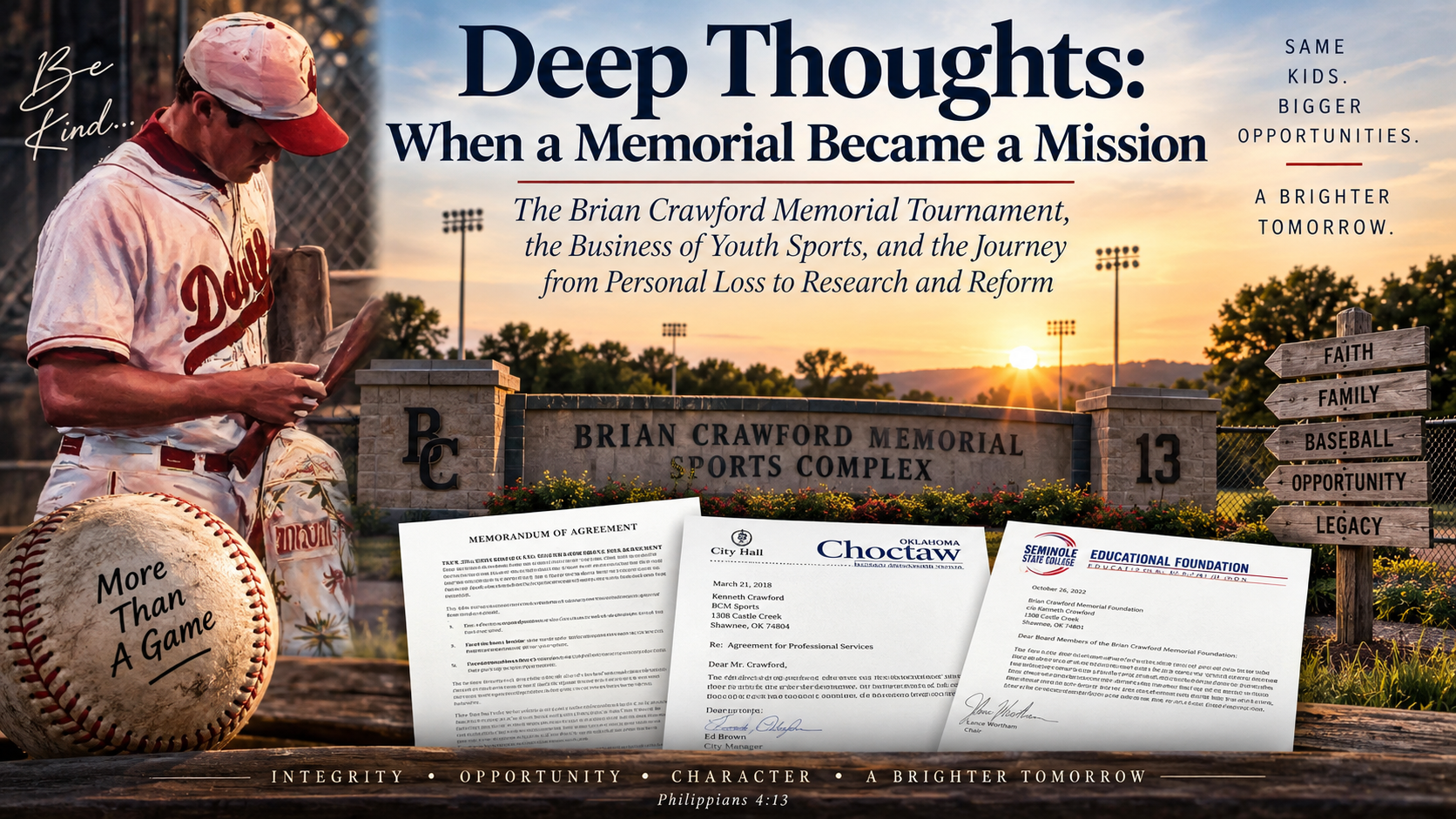
The Brian Crawford Memorial Tournament, the business of youth sports, and the journey from personal loss to research and reform.
This morning I sat down and recorded something different. There was no script, no prepared research presentation and no attempt to tell the entire history of the Brian Crawford Memorial Tournament. I simply began talking about what has been on my mind.
What came out was more than a story about baseball.
It was a reflection on Brian, our family, the Memorial Tournament, the facilities that hosted us, the relationships we built, the disappointments we experienced, and the lessons that eventually changed the direction of my work.
More Than a Tournament
The Brian Crawford Memorial Tournament began in 2006 at the Lions Club ball fields in Shawnee. Over the years, the tournament moved through different communities and facilities as it grew and circumstances changed.
But the location was never what made the tournament special.
Parents and coaches have told us through the years that the weekend was different. Coaches used Brian's story to talk to young players about things larger than baseball. Families connected with our family. The tournament became a place where we could talk about Brian and where people who never knew him could still learn something from his life.
The Business Lessons We Never Expected
As the tournament grew, I also began learning another side of youth sports—the business side.
Facilities had operators. User groups had agreements. Tournament directors needed fields. Officials had to be scheduled and paid. Concessions depended on attendance. Communities benefited from visiting teams and families. Relationships mattered, but so did contracts, operating decisions and economics.
Looking back with the benefit of the research I have conducted since then, I can now see something I did not fully understand when we began: one memorial tournament created a financial ripple far beyond the organization hosting it.
When Relationships and Business Collide
Our experiences at different facilities taught me that relationships in youth sports can feel personal while still being governed by business decisions.
That does not mean every difficult decision was wrong. It means the people involved can experience the same decision very differently.
The City of Choctaw relationship became one of those lessons. Years later, the development and operation of the Brian Crawford Memorial Sports Complex in Seminole would create another set of difficult questions.
Today, we have documents that help establish parts of that history. We also have my memories and perspective. Those are not always the same kind of evidence, and I believe it is important to distinguish between them.
The Annual Tradition We Lost
One part of this story is difficult to explain through contracts, numbers or research.
The tournament gave our family something on the calendar every year. We set up tables and booths. We shared memorial necklaces, bracelets, shirts and Brian's baseball cards. We talked to families. We told stories.
We talked about our son.
When the annual tournament stopped, our family did not simply lose another baseball event. We lost an annual tradition built around remembering Brian together.
Then the Questions Became Research
After tournament operations were no longer the center of my work, the questions did not disappear.
They became research.
I began documenting the relationships between municipalities, facility owners, user groups, tournament directors and officials. That work eventually contributed to the Hidden Valley dataset and a much broader examination of the business structure surrounding youth baseball and softball.
The question was no longer simply, Where can we hold Brian's tournament?
It became: How does this system actually work?
Who controls publicly owned facilities? Who controls access to the fields? Where does the money move? How are officials affected? What do municipalities know about the economic activity occurring at taxpayer-supported complexes? And what would a more transparent model look like?
Loss → Memorial → Baseball → Growth → Facility Relationships → Business Lessons → Questions → Documentation → Research → Reform → Purpose
Why I Am Telling This Story Now
I have tried through the years not to allow disagreements or fractured relationships to become Brian's story.
The Brian Crawford Memorial Sports Complex is about Brian. The tournament was about Brian. The scholarship is about Brian. The purpose was never supposed to become a story about personalities or institutions.
That is why the complete landing page accompanying this Special Edition takes a different approach. It places my September 22 reflection beside the available primary documents and clearly separates what the documents establish from what I remember, believe or felt at the time.
Readers do not have to rely solely on my interpretation. They can examine the documents themselves.
Read the Full Story & Primary Documents
The comprehensive landing page includes the complete historical reflection, the Choctaw and Seminole chapters, documented financial terms, the original Memorandum of Agreement, later SSCEF correspondence, the City of Choctaw termination letter, and the connection between these experiences and the research mission that followed.
READ WHEN A MEMORIAL BECAME A MISSION →The Tournament Stopped. The Mission Did Not.
When I finished recording my thoughts this morning, I found myself returning to the same place our family has tried to return to through every difficult chapter: faith and purpose.
Whatever disappointments occurred along the way, something remarkable was still built in Brian's name. His story continues to be told. His legacy continues through the people who remember him, the facilities bearing his name, scholarships, young athletes, our family, and now the research that grew out of those experiences.
Maybe that is the larger story.
The Memorial Tournament began because we needed a way to move forward after losing Brian.
Twenty years later, the tournament has become part of something we never could have imagined when we held that first event in 2006.