
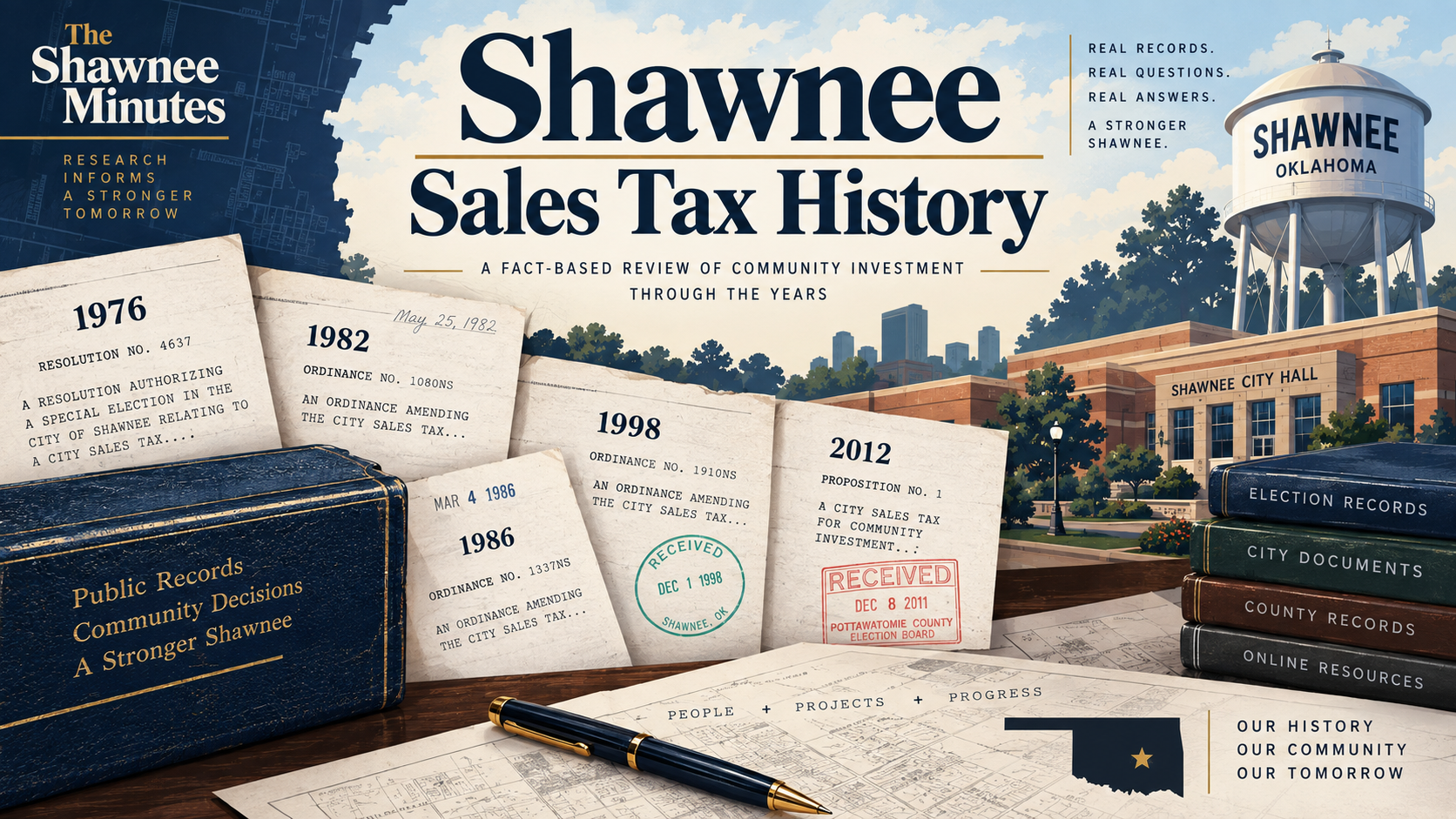
Shawnee Sales Tax History
Tracing voter propositions, ordinances, revenue purposes and public investment through the surviving documentary record.
This research begins with records obtained from the Pottawatomie County Election Board and cross-references them against City of Shawnee minutes and financial records, The Shawnee Minutes research archive, and additional public sources. The purpose is to identify what voters were asked, what ordinances authorized, how purposes changed, and where the surviving record remains incomplete.
What the Record Shows
The surviving documents show a layered history: a 2% sales-tax proposition in 1976; an additional 1% proposition in 1982; a 1986 proposition changing authorized uses of that existing 1%; a 1998 ordinance and March 1999 election record concerning a permanent 1% and its allocation; and a 2012 package in which a separate 0.5% sales-tax question was paired with distinct bond propositions.
Resolution No. 4637 called a special election concerning Ordinance No. 763NS and a 2% city sales tax.
Ordinance No. 1080NS proposed another 1%, with the ordinance stating that the referenced city rate would thereby increase to 3%.
The record concerns changes in how the existing 1% component could be used—not simply another percentage-point increase.
Ordinance No. 1910NS set out a permanent 1% structure and specific allocations for capital/economic development, police and fire.
The ballot package combined a half-cent sales-tax question with legally distinct bond propositions for public capital projects.
A City of Shawnee sales-tax presentation identifies a 3.5% city rate: 2% general fund, 1% dedicated uses and 0.5% dedicated to public safety, streets/roads, parks and public facilities.
A Documentary Timeline
The chronology matters because later ordinances amend, reallocate or build upon earlier tax structures. Rate changes, purpose changes and financing mechanisms should not be treated as interchangeable events.
The 2% proposition
The election-board record preserves a resolution authorizing a special election on a proposition concerning a 2% City of Shawnee sales tax. This is an election-call record; a certified final return was not included in the supplied 1976 packet.
Election Board RecordPrimary RecordAn additional 1% and specified public purposes
Ordinance No. 1080NS proposed an additional 1% sales tax and states that the referenced rate would increase to 3%. Proceeds were tied to enumerated public purposes, including public-trust debt service and infrastructure/public-works functions. The supplied packet preserves proposition and election materials, but not a certified final result.
Election Board RecordOrdinanceA change in authorized uses
The 1986 proposition addressed the purposes for which proceeds of the 1% tax levied under Ordinance No. 1080NS could be used. The event should not be described as though voters were simply asked to add another 1%. A separate county return confirms that the proposition went before voters; this research does not publish an aggregate margin without a clearly legible certified total.
County ReturnPurpose ChangeA permanent 1% and defined allocations
The ballot language preserved in the record allocated 7/8 of the 1% to capital improvements, economic development or related debt service; 1/16 to police above 1998–99 funding levels; and 1/16 to fire above 1998–99 funding levels. The supplied March 2, 1999 certification report lists 1,622 YES votes, but the supplied page does not show a corresponding NO total or complete final summary; this page therefore does not state a final margin.
Official BallotCertification RecordA half-cent question plus separate bond propositions
City Commission minutes document unanimous approval of Ordinance No. 2463NS and the companion special-election call. The election package submitted a separate 0.5% sales-tax question for capital expenditures/debt alongside bond questions involving Woodland Veterans Park, public-safety communications, streets, and economic/community development. The bond propositions were distinct financing instruments and should not be folded into the sales-tax rate.
City Commission MinutesElection PacketWhat Changed—and What Did Not
Not every election added tax
The record distinguishes a proposed rate increase from a change in the authorized uses of an existing tax. The 1986 materials are the clearest example.
Dedicated uses matter
Police, fire, capital improvements, economic development, debt service, streets, parks and public facilities appear at different points in the documentary history. Each purpose must be tied to the ordinance that authorized it.
Sales tax is not the same as bonds
The 2012 package shows why ballot questions must be separated. A sales-tax proposition and bond propositions may share a capital plan while remaining legally and financially distinct.
Cross-Reference: City of Shawnee Financial Records
The City’s own records provide an important second layer of evidence beyond the election-board packet.
| City source | What it adds to the record |
|---|---|
| December 5, 2011 City Commission minutes | Records the 7–0 approval of Ordinance No. 2463NS for an additional 0.5% sales tax and the special-election call for February 14, 2012. The minutes also describe the separate bond questions. |
| December 5, 2011 Shawnee Municipal Authority minutes | Documents sales-tax revenue notes and a year-to-year pledge of certain sales-tax revenues, illustrating the connection between sales-tax revenue and municipal financing. |
| City “Sales Tax – Fundamentals” presentation | Describes a 3.5% City rate framework: 2% for General Fund activities; 1% for capital improvements/economic development/debt service plus police and fire allocations; and 0.5% for public safety, streets/roads, parks and public facilities. |
| FY 2024–2025 proposed budget summary | Reports separate Police Sales Tax and Fire Sales Tax funds, demonstrating that dedicated sales-tax allocations remain visible in later City budgeting. |
How The Shawnee Minutes Changes the Research
The Shawnee Minutes dataset is an index and research layer—not a substitute for the underlying record. Its value is the ability to connect a tax proposition to commission minutes, authorities, public facilities, elections, financing decisions and later historical questions.
For sales-tax research, the most useful future structure is to index each proposition separately by ordinance number, election date, rate or allocation question, stated purpose, certified-result source, effective date, termination date if any, and later amendments. That prevents a later project financed with sales-tax revenue from being mistaken for the original proposition that authorized the revenue.
Five Findings That Matter
Cumulative and amendment-driven
Later ordinances repeatedly refer back to earlier ordinances. Shawnee’s sales-tax history is best understood as a chain of legal changes, not isolated ballot slogans.
Rate and purpose are different questions
A vote can change the permitted use of an existing tax without increasing the rate. The 1986 record makes that distinction explicit.
Ballot packages require separation
The 2012 election paired a sales-tax question with bond propositions. They belong in the same historical discussion but should not be combined into one tax figure.
Election calls are not election results
Where the supplied record lacks a complete certified return, this project leaves the result open rather than converting an election call into an assumed outcome.
Public investment spans many purposes
The documentary record connects sales-tax revenue with general government, infrastructure, public safety, capital improvements, economic development, public facilities and debt service.
A living chronology
This page should change when stronger evidence is located. Corrections and newly recovered records belong in the history rather than being silently overwritten.
What The Shawnee Minutes Add to the Election Record
The election-board documents establish what was formally placed before voters. The Shawnee Minutes research adds the operational history that followed: how dedicated revenue was discussed in budgets, how capital allocations were divided, how debt service affected available funds, and how named projects changed over time.
How the dedicated tax was explained
Shawnee research materials preserve City Manager Terry Powell-era presentations describing the third penny as a dedicated funding source connected to essential services and capital/public improvements. The ordinance remains the controlling source for the legal allocation; the minutes and presentations show how the measure was explained and administered.
A capital framework connected to a proposed community asset
Minutes and grant research document pursuit of an Oklahoma Tourism Recreation Department Land and Water Fund Grant for approximately 200 acres for a Regional Park, including a City cost-share. This connects the third-penny capital framework to a specific proposed community asset.
Officials discussed restrictions on dedicated capital revenue
The Shawnee Minutes research records budget discussion in which staff addressed third-penny restrictions and Regional Park funding. This is evidence of how City officials were describing the permitted use of dedicated capital revenue years after the 1999 election.
The 7/8 portion, police and fire were discussed separately
A City Commission discussion examined the 7/8 portion used for debt reduction, capital improvements and economic development, while the remaining 1/8 was divided equally between police and fire. A proposal to increase the economic-development share was deferred pending budget review.
The budget label changed to “Parks and Recreation Projects”
During the FY 2008–09 budget workshop, the research record documents a consensus to rename the budget line item “Regional Park” to “Parks and Recreation Projects.” This is a material historical change in how the capital program was labeled; it should be analyzed separately from the original voter proposition and from any conclusion about legal compliance.
Future third-penny revenue was evaluated as financing capacity
Commission discussions show third-penny capital revenue being evaluated as a source for debt service and capital financing. June 2012 discussion explicitly noted that borrowing against the third penny would restrict future funds to principal and interest for financed projects.
A proposed return to defined capital percentages
A 2013 budget transcript describes a proposed return to 43.75% for streets, 38.75% for general-fund capital, and 5% for economic development, with police and fire allocations remaining untouched. It also discusses moving pool and radio-tower debt service into the 301 capital fund.
Financing decisions affected later capital capacity
City materials state that the third-penny capital fund was constrained by debt service approved in December 2011 and proposed debt service for pool remodeling and an 800 MHz radio tower. This demonstrates why the history cannot stop at the election result: financing decisions affected later capital capacity.
The links below preserve the evidence trail so readers can move from the analysis back to the records on which it is based.
1976 Sales Tax
Open 1976 election record ↗Resolution No. 4637 / Ordinance No. 763NS election-call material concerning a 2% city sales tax.May 25, 1982 Sales Tax
Open 1982 election packet ↗Ordinance No. 1080NS and related election material for the additional 1% proposition.1986 Sales Tax
Open 1986 ordinance record ↗Material concerning the authorized uses of the 1% sales-tax component.April 22, 1986 County Return
Open 1986 return ↗Official county-return material preserved by the Pottawatomie County Election Board.1998 / 1999 Sales Tax
Open Ordinance No. 1910NS record ↗Ballot language concerning the permanent 1% and its allocation among capital/economic development, police and fire purposes.March 2, 1999 Certification
Open 1999 certification ↗The supplied certification page lists 1,622 YES votes; a corresponding NO total/final summary is not present in the supplied page.2012 Sales Tax & Election Package
Open 2012 election record ↗Ordinance No. 2463NS and the special-election package involving the 0.5% sales-tax question and separate bond propositions.Executive Summary
Open professional executive summary ↗Condensed chronology, findings, source distinctions, limitations and open research items.Independent & Institutional Cross-References
December 5, 2011 City Commission Minutes
Open City record ↗Documents Ordinance No. 2463NS, the 0.5% sales-tax proposal and the February 14, 2012 special-election call.2011 Shawnee Municipal Authority Minutes
Open SMA record ↗Documents sales-tax revenue notes and the year-to-year pledge of certain sales-tax revenues.Sales Tax – Fundamentals
Open City presentation ↗City presentation describing the 3.5% city sales-tax framework and allocation of the 2%, 1% and 0.5% components.FY 2024–2025 Proposed Budget Summary
Open City budget summary ↗Later financial context including separate Police Sales Tax and Fire Sales Tax funds.Open Research Questions
The current record is strong enough to establish the proposition language and legislative chronology described above, but it is not yet a complete election-results schedule. The highest-value next records are:
- Certified final returns for the 1976 sales-tax election.
- Certified final returns for the May 25, 1982 election.
- A clean aggregate certification for the April 22, 1986 election.
- The complete March 2, 1999 certification showing YES, NO and final disposition.
- The certified February 14, 2012 election results for each proposition.
- Later ordinances and elections needed to reconcile the transition from the historical 3% structure to the later 3.5% City framework.
The Record Is the Starting Point
Shawnee’s sales-tax history is ultimately a history of public choices: what voters were asked to fund, how elected officials structured those questions, how revenue was dedicated, and how public investment evolved over time. This page is designed to preserve that documentary trail and make it easier to test future claims against the underlying record.
Research Use & Source Standards
Primary records: Election-board copies, ordinances, propositions and certified-return material are treated as the strongest evidence for what was legally proposed or officially reported.
City online records: City of Shawnee online documents are used for corroboration and research access. The City’s archive states that its online copies are public-information devices and that official documents are maintained by the City Clerk.
The Shawnee Minutes: Dataset entries are research-index records. They help locate and connect evidence but are not automatically treated as official findings or verbatim transcripts.
Analysis: Comparisons, historical synthesis and conclusions are kept distinguishable from the source record. Reliable new evidence may clarify, supplement or correct this page.
Scope: This is a research publication, not a legal opinion, audit, or claim that every Shawnee sales-tax election or amendment has been identified.