
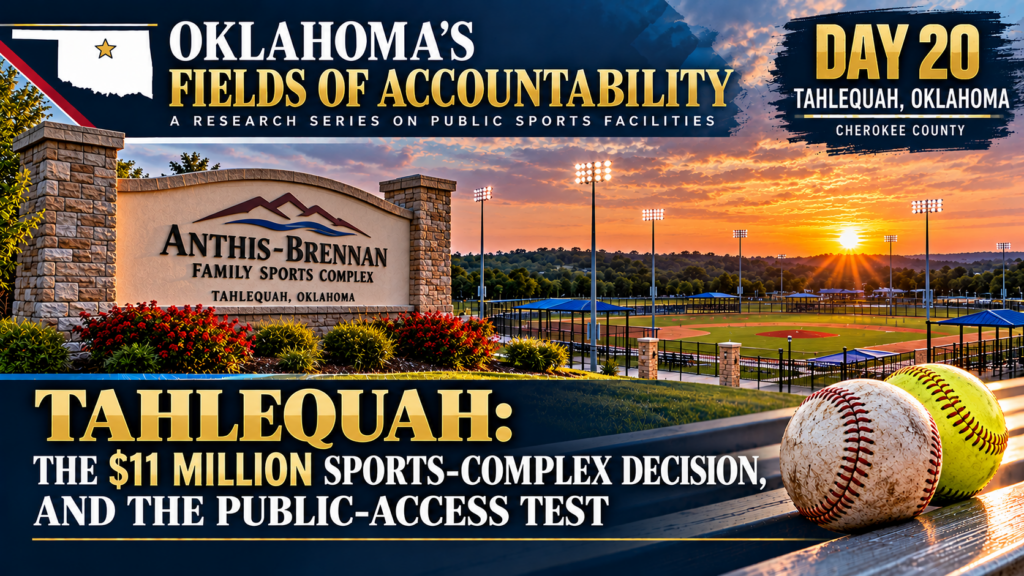
Oklahoma’s Fields of Accountability — Day 20
Tahlequah: Cherokee Fields, the $11 Million Sports-Complex Decision, and Who Benefits From Public Access
Research edition: October 26, 2026
Municipality / primary-facility county: Tahlequah, Cherokee County, Oklahoma
Facility: Anthis–Brennan Family Sports Complex, 1046 W. Allen Road; the City separately lists Cherokee Fields–Softball at 1052 W. Allen Road and Cherokee Fields–Baseball at 1070 W. Allen Road.
Public entity: City of Tahlequah. Separate government: Cherokee Nation, whose Council authorized negotiations over a connected land-and-sports investment.
Municipal decision window: 2023–2026, concentrating on 2024 authorizations, FY2025–26 budgeting and the February 2026 opening.
Hidden Valley/USSSA window: exact facility-label records 2022–2026; three represented seasons in the September 20, 2026 research inventory.
Series sequence: Tulsa remains Day 1, and Day 20 introduces Tahlequah after Day 19 Elk City. Prior locations including Day 8 Muskogee and Day 15 Midwest City are not repeated.
The central question: A public sports investment can attract travel tournaments and replace outdated fields. Which executed agreements, actual expenditures, priority rules and participation measures demonstrate that the resulting facility also serves local children, volunteer leagues and the public fairly?
Evidence notice: A governing-body authorization is not a paid invoice; an adopted budget is not a financial audit; a public price is not proof that every organization paid it; and Hidden Valley model values are not municipal revenue. The presence or absence of a document in this research review is not a finding of misconduct.
1. Executive findings — eight distinct matters to verify
- Ownership and venue. The City publicly identifies Anthis–Brennan as a municipal recreation facility and separately lists the new turf Cherokee Fields baseball and softball complexes. The official Recreation Department says it manages the new fields. [S1–S4]
- Two governments and two decisions. On April 15, 2024, the Cherokee Nation Council authorized its Chief to negotiate a package up to $7 million associated with Phoenix Park and construction at Anthis–Brennan. That announcement explicitly described the action as negotiation authority rather than an immediate binding obligation. [S5]
- City authorization. Reporting on a July 19, 2024 special meeting states the City Council authorized the mayor to sign an MOU relating to the Phoenix Park transaction and the expected $7 million project support. It reports a motion by Ward 4 Councilor Josh Allen and a second by Ward 3 Councilor Stephen Highers; the actual roll-call tally and final signed MOU have not been independently reproduced in this edition. [S6]
- Construction ceiling. Reporting from an August 14, 2024 special Council meeting describes a not-to-exceed $10.1 million authorization for the mayor to contract with Hellas for Anthis–Brennan improvements. The price ceiling is not proof that $10.1 million was disbursed. [S7]
- 2026 operations were separately budgeted. The City's adopted FY2025–26 budget establishes a $576,518 Cherokee Fields operating appropriation, separately from a $1,962,308 Anthis Brennan Expansion Fund appropriation. The operating budget forecasts $398,500 in fees, gate, concessions and sponsorships, plus a $200,000 General Fund transfer; these are budget lines, not verified collections. [S8]
- Public rental terms. The City's present facility pages publish $300 per field per day and a $300 deposit per event for baseball and softball. They do not explain whether all categories of league play are subject to identical rates or what waivers, priority rules or deposit-refund terms apply. [S2–S3]
- Shared and changing operating responsibilities. Tahlequah Sports League publicly says it manages activities and invites prospective tournament operators to request a field-use agreement. The City identifies its Recreation Department as operator of the new fields. Earlier public reporting describes a $5-per-game reinvestment model, while a 2025 account reports a proposed amendment reallocating maintenance, concessions and gate revenues. The final executed agreement and effective date must resolve these descriptions. [S4, S9–S11]
- Tournament activity is substantial but not a cash-flow audit. The authoritative facility-master inventory isolates 20 historical event identifiers, 66 division rows, 408 team entries and $99,450 in calculated team entry fees under the exact label Anthis Brennan Sports Complex. The counts exclude mixed-facility listings whose primary location is unresolved. [HV-1]
2. Facility geography and the correct jurisdictions
The Anthis–Brennan Family Sports Complex is a larger public recreation campus: playgrounds, soccer, football, basketball, pickleball, a pool and ballfields. The City's web directory gives 1046 W. Allen Road for the larger campus; it identifies Cherokee Fields softball at 1052 W. Allen and baseball at 1070 W. Allen. The City's 2026 facility descriptions say the softball surfaces were converted to turf and four baseball turf fields opened in February 2026. The baseball page says the new site replaced baseball fields formerly at Phoenix Park. [S1–S4]
These locations are one Tahlequah community complex, but not interchangeable labels in the historical tournament database. A registration naming the larger Anthis–Brennan campus may cover multiple physical diamonds. A mixed-site tournament naming Tahlequah plus Bixby, Owasso, Jenks or Tulsa must not be entirely assigned to Cherokee County merely because Anthis–Brennan appears in the facility text. Our county rule is primary facility county, with unresolved primary sites flagged rather than guessed.
The City of Tahlequah is the owner/public facility steward identified by municipal pages and budgeting. Cherokee Nation is a separate sovereign government involved in funding and conditions of a related transaction; it is not the city park department. Tahlequah Sports League is a community sports organization whose operational rights must be determined by the signed use agreement rather than treated as ownership. [S1, S4–S6, S9]
3. Documentary chronology: approval, construction and operation
| Date / period | Documentary development | Evidentiary status |
|---|---|---|
| 2023 | TSL president described a $5-per-game obligation with reinvestment in facilities in lieu of payment; he discussed Phoenix Park lighting and scheduling disruptions. | Public report of a Council presentation, not an independently inspected executed contract. [S10] |
| April 15–18, 2024 | Cherokee Nation Council authorized negotiation of a transaction associated with Phoenix Park and up to $7 million for new fields. | Tribal governing-body negotiating authority; not itself proof of executed payment. [S5] |
| May 6, 2024 | City's posted Council agenda included negotiation authorization for a land sale and Cherokee Nation funding. | Agenda item demonstrates an item under consideration, not final legal disposition. [S14] |
| July 19, 2024 | City Council reportedly authorized the mayor to sign the Phoenix Park/Cherokee Nation MOU and to negotiate a sports-construction arrangement. | Collective authorization reported contemporaneously; final contract and recorded vote needed. [S6] |
| August 5–14, 2024 | Council discussed project scope and potential removal/restoration of bid items; August 14 meeting reportedly authorized a Hellas agreement not to exceed $10.1 million. | Scope and contract ceiling reported; signed agreement, amendments and payments to reconcile. [S7] |
| 2025 | City Council reportedly authorized negotiation of an amended TSL agreement involving municipal maintenance and proposed financial changes. | Negotiation authority/proposed terms, not proof of executed final terms. [S11] |
| June 3, 2025 | City adopted FY2025–26 municipal budget, including Cherokee Fields Operations (Fund 118) and Expansion (Fund 437). | Adopted appropriations and forward-looking revenue estimates; not audited results. [S8] |
| February 2026 | City facility page places the new baseball opening in February; complex site identifies four baseball and four softball turf fields. | Public facility descriptions; compare certificate of completion and final punch list. [S2, S12] |
| October 26, 2026 | City publicly publishes $300 per field/day and $300 event deposit for both baseball and softball. | Current website pricing; application to user groups and refunds still to confirm. [S2–S3] |
An editorial correction control: The FY2025–26 budget narrative uses language suggesting the fields were complete earlier, while the more specific City baseball facility page states the new baseball fields opened in February 2026. Until dated acceptance and completion records are obtained, the February 2026 opening is the better-supported event date; the earlier narrative should not be substituted as proof of actual completion. [S2, S8]
4. The financing transaction: do not merge unlike numbers
The public rationale links two governmental needs: replacing Phoenix Park ballfields with a modern tournament-capable complex, and a Cherokee Nation–City agreement involving land intended for a crisis shelter. The Cherokee Nation's April 18, 2024 announcement attributes to its Council a negotiated spending ceiling of up to $7 million. Its projection that the expanded facility might generate roughly $1 million annually is an economic forecast by a project proponent, not a measured return on investment. The City-side July report describes a $1 sale of Phoenix Park and additional MOU conditions, including proposed naming rights, advertising restrictions, complimentary use and a first-refusal interest. Only the signed conveyance, MOU and land instruments can establish the operative conditions and whether they changed. [S5–S6]
The July 2024 quoted Hellas proposal was $11,150,929, reportedly split as $8,698,700 in baseball improvements and $2,452,229 for softball. After Council discussion, an August report stated an initial reduced quote of $9,645,991, then a proposed reinstatement of shade and bleachers, and finally authorization to contract up to $10.1 million. These are not three expenses to add together; they represent alternative scopes or authorization stages. The City and complex websites later describe the overall investment as approximately $11 million; absent final pay applications and change orders, an exact cash expenditure should not be asserted. [S4, S6–S8]
| Figure | What the source actually supports | What it does not prove |
|---|---|---|
| Up to $7,000,000 | Cherokee Nation Council negotiation envelope announced April 2024. | That $7m was fully transferred or unrestricted. |
| $1 | Reported nominal Phoenix Park transaction consideration under proposed MOU. | That the total consideration or public obligations equal $1. |
| $11,150,929 | July 2024 preliminary Hellas construction proposal. | A final authorized bill or completed cost. |
| $10,100,000 | August 2024 reported maximum contract authorization. | Final payment total or a no-change-order guarantee. |
| About $11 million | City public characterization of wider project investment. | Audited all-in completed expenditure. |
| $1,962,308 | FY2025–26 adopted Expansion Fund appropriation. | New cash paid, or an amount to add again to earlier contract ceilings. |
| $576,518 | FY2025–26 adopted Cherokee Fields operating appropriation. | FY2026 actual cash expenditure. |
| ~$1m yearly visitor benefit | Reported prospective economic impact claim. | Verified local receipts or annual net City fiscal gain. |
The July reporting also references older 2013 bond proceeds and about $550,000 in earmarked ARPA funds as possible support. Their actual legal eligibility, draw dates, restrictions and final allocation should be verified from bond, grant and project accounting rather than accepted from a planning discussion. [S6]
5. The adopted FY2025–26 City budget: unusually useful financial evidence
The City published a 100-page 2025–26 budget with an adopting resolution dated June 3, 2025. In that document, Fund 118 is designated Cherokee Fields @ Anthis Brennen. Its line-item tables retain a heading called 2026 Initial Budget Request, yet the enclosing document is an adopted budget. The figures are adopted planning appropriations and anticipated receipts; they are still not audited year-end actuals. Fund 437 records the separate expansion construction budget. [S8]
| Adopted FY2025–26 Fund 118 line | Budget amount | Interpretation |
|---|---|---|
| Tournament fees | $175,000 | Anticipated City revenue; different from USSSA entry fees. |
| Gate entry fees | $20,000 | Anticipated City gate receipts, not proof of price or who collected at every tournament. |
| Concession sales | $153,500 | Gross sales estimate, not concession profit. |
| Sponsorships | $50,000 | Anticipated support, not verified signed sponsorship. |
| Subtotal, earned revenue | $398,500 | Combined estimate from four categories. |
| Transfer from General Fund | $200,000 | Interfund support, not independently earned income or economic impact. |
| Total budgeted funding | $598,500 | Estimated financial resources, not total sales. |
| Personnel services | $189,494 | Budgeted staff and benefits. |
| Materials and supplies | $203,024 | Includes maintenance, supplies and operations. |
| Other services/charges | $149,500 | Includes $100,000 professional services, $5,000 TSL concession and $40,000 TSL contract budget categories. |
| Capital outlay | $34,500 | Includes reserve and concession equipment amounts. |
| Total operating appropriation | $576,518 | Spending authority, not audited spent cash. |
The arithmetic of this budget is internally important: projected operating funding of $598,500 includes $200,000 from the General Fund. Calling the $598,500 'sports revenue' would overstate earned receipts by that transfer. On the expenditure side, budgeted $40,000 for a TSL contract is evidence of an appropriated line, not evidence that TSL received $40,000 or that the proposed terms were signed. The appropriation document also contains an Anthis Brennan Expansion Fund (437) of $1,962,308 for FY2025–26. Actual cash transfers, vendor disbursements, waivers and quarterly performance reports are the next records to reconcile. [S8]
6. The right to schedule fields: City Recreation versus Tahlequah Sports League
The current public record has two true-but-potentially-incomplete statements. The City says its Recreation Department oversees and manages the new turf fields; the Tahlequah Sports League website directs anyone reserving a tournament, camp or league to request a field-use agreement from the league, stating that TSL 'manages activities.' A league can coordinate a calendar while a City retains legal authority and asset responsibility. Those roles cannot be mapped precisely without the full, signed operations and use agreement. The TSL page still mentions Phoenix Park, which the City says its new baseball fields replaced; website wording may not have been revised after the project. [S4, S9]
A 2023 account quotes TSL leadership describing a $5/game City charge offset through approved improvements to public fields. A 2025 account describes Council authorization to negotiate an amended arrangement; the proposal contemplated City maintenance, City-operated concessions with a benefit for the league, a $25,000 contribution to TSL to address potential advertising losses and TSL retaining gate revenues. A public budget line for $40,000 is a separate instrument and cannot settle which proposal became operative. Do not treat these proposals as executed contractual provisions without dated signatures and amendments. [S8, S10–S11]
This matters because an agreement should clarify: field priority; whether local recreational games precede fee-generating outside tournaments; deposit handling; public-field closure or cancellation; entry gates and concession ownership; eligibility for scholarships; seasonal maintenance; insurance; disclosure of gross receipts; costs of lights or turf wear; renegotiation and termination; and preservation of free or low-cost public recreation opportunities.
7. Current public rate: an important benchmark, not a complete fee schedule
Both Cherokee Fields pages post $300 per field per day and a $300 deposit per event. For illustration only, reserving four fields for two days at the posted rate would calculate as 4 × 2 × $300 = $2,400 in field charges, plus a separately described $300 event deposit (whose refund terms need verification). That is not a claim that any actual tournament paid $2,700 or that a local volunteer league pays the same rate. [S2–S3]
For meaningful equity analysis, compare the written charges and actual payments for (a) TSL recreation play, (b) TSL tournaments, (c) independent USSSA baseball and softball organizers, (d) school/college play, (e) Cherokee Nation complimentary use, and (f) open community reservations. A posted rate proves the public has a benchmark, but nothing by itself about special-rate approvals, scheduling preferences, or the timing and disposition of deposits.
8. Hidden Valley/USSSA: direct-site historical evidence with limits
The Hidden Valley — Sports Facilities Inventory, labeled authoritative source AIUSSSA – HVIOG 9-20-2026.csv, includes the exact facility label Anthis Brennan Sports Complex in the Facility Master Inventory. Its 2022–2026 range covers three seasons represented, rather than five continuous USSSA seasons. The row identifies both baseball and softball activity, 20 distinct events and 66 division rows. The associated directors/organizations field includes BIG Show Productions, Chad Evans, Chrys Tinsley, Eric Plum, HTB Tournaments, Hunter Burkholder, Rick Glasser, Tahlequah Sports League and Wally Fortuna; listing an organizer establishes a dataset association, not legal culpability or control over the public facility. [HV-1]
| Direct exact-label measure | 2001–2026 inventory value for this facility label |
|---|---|
| First / last seasons in row | 2022 / 2026 |
| Seasons represented | 3 |
| Sports shown | Baseball and softball |
| Unique event identifiers | 20 |
| Division rows | 66 |
| Team entries across divisions | 408 |
| Calculated team-entry fees | $99,450 |
| Modeled minimum games | 1,000 |
| Modeled officiating assignments | 1,881 |
The 408 registrations are team entries, not 408 distinct organizations or Tahlequah-resident teams. Division count means division rows, not necessarily 66 age groups or separate tournaments. The game and officiating figures are modeled according to the dataset, not independently counted completed games or actual payroll; a 'minimum games' calculation cannot validate weather cancellations or forfeits. Entry fees are research-model gross team-registration calculations, not audited proceeds collected by the City, Cherokee Nation, TSL or any director. Older records predate the completed 2026 turf expansion; do not falsely describe all historical activity as occurring on the new diamonds. [HV-1]
The inventory also lists 2026 multi-facility labels involving Anthis–Brennan along with Bixby, Owasso, Jenks, Tulsa and other locations. Those rows must remain outside the exact-label totals until event-level documents establish which field was primary. The county allocation rule assigns the event to its primary facility county (Cherokee County only when Anthis–Brennan is verified primary), rather than splitting the entire event across listed counties or guessing.
The dataset's other estimated values for umpire fees, gate receipts, concessions and economic impact are modeled figures requiring independent event-specific assumptions. No dataset rental amount is treated as actual 2026 City field revenue.
9. Economic development promises versus verifiable community return
A travel event can benefit lodging and restaurants, but entry fees, gate estimates, hotel sales and local economic impact measure different things. The Cherokee Nation announcement's roughly $1 million annual benefit projection should be tested using actual visitor-night counts, nonlocal attendance, lodging receipts, incremental spending, leakage and substitutions. It should not be called realized tax receipts or a guaranteed seven-year payback. A City facility can have large visitor spending and still need an operating subsidy; the adopted $200,000 General Fund transfer provides reason to examine a recurring fiscal ledger without implying that transfers are inappropriate. [S5, S8]
The most useful municipal scorecard would publish annual usage hours by local league versus tournament, local registrations by age and gender, scholarship awards, published prices and exceptions, baseball/softball facility condition, turf replacement reserve funding, concession and gate cash controls, tournament visitor estimates, and audited net City maintenance and operations costs. These records would permit a community to test success on both tourism and youth participation, not one metric in isolation.
10. How Public Decisions Shape a Healthy Community-Based Program
Affordability. A published $300 field-day rate gives outside organizers predictability. It does not show what local recreational families pay. The signed agreement, scholarship budget and age-specific registration fees are needed before concluding that the capital project improved—or harmed—access for lower-income children. [S2–S3]
Local league stability. Replacing Phoenix Park baseball fields with new turf may improve playable days and reduce rain disruption. Yet the actual number of league practices and prime-time games protected from outside tournament scheduling depends on the calendar priority clauses. This is a benefit to measure, not an assumed outcome. [S2, S9]
Volunteers. A community league's ability to retain gate receipts, operate events and access concessions can support volunteer administration. But a shift in maintenance responsibilities or sponsorship rights can also change the league's resources. The 2023 and 2025 descriptions reflect evolving arrangements; the final agreement determines what was actually promised. [S10–S11]
Equitable access. The facility needs publicly understandable priorities for local play, outside tournaments, schools and special government usage. The reported Cherokee Nation MOU conditions involving complimentary use are relevant to allocation but do not, without signed terms, establish unequal treatment. [S6]
Transparency. A posted daily rental fee and an adopted line-item budget are meaningful starting points. Public value is clearer when executed contracts, agenda votes, waivers, deposits and monthly cash receipts can be traced to the same event ID and calendar date. [S2–S3, S8]
Reinvestment. In-kind work under the earlier $5-per-game model may strengthen facilities if independently approved and valued. The 2026 budget's maintenance lines and expansion appropriations create a route to compare proposed upkeep with actual condition and a long-term turf replacement reserve. [S8, S10]
Competition. Neutral application deadlines and published booking criteria can let community organizations and independent operators seek field time on equal stated terms. There is no supported basis here to allege exclusive dealing or impropriety; obtain the operator agreements and booking logs first.
Player development. Four new baseball fields and four upgraded softball fields can support youth and collegiate events, but player development is better demonstrated by expanded beginner divisions, coaching access, safe practice hours, girls' opportunities and retention than by visitor spending or tournament counts. [S1–S3]
Sustainability. Taxpayer investment continues after ribbon cutting. A sustainable model compares the turf's expected replacement life, irrigation and repair obligations, staffing, legal liability, net earned facility receipts, reserves and public availability. The annual transfer and expenditure forecasts must be reconciled with completed fiscal-year results before judging viability. [S8]
11. Decision responsibility and evidence classifications
| Actor / institution | Supported action or role | Boundary against misattribution |
|---|---|---|
| Cherokee Nation Council | April 15, 2024 collective authorization for negotiations up to $7m. [S5] | Negotiation authority is not proof of unconditional grant disbursement. |
| Tahlequah City Council | July 19 authorization reported for MOU; August 14 maximum Hellas agreement authority; June 2025 adopted municipal budget. [S6–S8] | Council action is collective; individual recorded votes require the minutes. |
| Ward 4 Councilor Josh Allen / Ward 3 Councilor Stephen Highers | Reported July 19 motion and second on authorizing MOU. [S6] | A motion and second alone do not identify the roll-call or who drafted conditions. |
| Mayor Suzanne Myers | Authorized municipal signatory/negotiator reported by contemporaneous Council coverage. [S6–S7] | Authorization does not substitute for executed instrument. |
| City Administrator Taylor Tannehill | Staff presentation of construction scope and operating proposals. [S6–S7, S11] | Administrative recommendation is not itself a Council vote or signed contract. |
| Tahlequah Recreation Department | Publicly described management and maintenance/operations role for the new fields. [S4] | Day-to-day tasks must be tested against agreements. |
| Tahlequah Sports League | Public statement about managing activities and booking inquiries. [S9] | A website description is not a deed or complete legal operating agreement. |
| Hellas | Named construction contractor in reported authorization. [S7] | Contract ceiling is not a verified total payment. |
| Tournament organizers in HV inventory | Dataset associations with historical events. [HV-1] | The dataset does not establish municipal authority, income retained, or wrongdoing. |
Fact: City pages publish pricing, facilities and operating roles; approved municipal budget identifies appropriations. Calculation: Inventory derives team-entry and game/official values from event rows. Reported administrative history: 2023 $5/game practices and 2025 contract negotiations require signed supporting instruments. Future-oriented claim: economic impact projections. Unanswered: final construction costs, actual 2026 operator agreement, reconciled 2026 revenue, equitable scheduling and local participation. Conclusion: the public record supports a major capital and policy transformation, while final stewardship outcomes need an auditable contract-and-usage ledger—not speculation about misconduct.
12. Records Still Needed — prioritized documentary requests
- Final signed City–Cherokee Nation MOU, Phoenix Park deed, closing statement, $7m remittance ledger, naming/advertising conditions, complimentary-use obligations and right-of-first-refusal instruments.
- July 19 and August 14, 2024 certified Council minutes and individual vote records; adopted procurement resolutions and all Hellas bid revisions, executed scope, purchasing authority, amendments and change orders.
- Contractor pay applications, retainage, completion certifications, engineering reports and full reconciliation of 2013 bond and federal ARPA funding against project uses, with fund-level cash disbursements through 2026.
- Original and amended Tahlequah Sports League operation/field-use agreements for 2023–2026, adoption dates, scheduling authority, maintenance allocations, insurance, termination and public-notice provisions.
- Event-by-event booking logs with primary venue, field numbers, dates, operator, fee quotation, invoice, deposit, refund, special rate and approval authority; separate local recreational dates from external events.
- FY2025–26 and FY2026–27 actual receipts and expenditures for Funds 118 and 437, specifically tournament, gate, concession, sponsorship and City transfer categories; TSL contract payments and benefit transfers.
- City ordinances and adopted field-use policies governing discounts, resident priority, volunteer leagues, school and Cherokee Nation usage, late cancellations and appeal or complaint procedures.
- Ballfield local participation records: teams by division, player registration fees, scholarship/grant allocations, household-residency distinctions, use hours, volunteer service, coaching and clinics.
- USSSA facility/division-row extract with event URLs, canceled events and mixed-location primary-facility documentation to verify the 20 direct event IDs and 66 division rows without counting unresolved multi-site events twice.
- Turfs' expected replacement cycle, reserve schedule, annual maintenance plan and inspection/closure history, to evaluate long-term facility access and public cost.
13. Oklahoma Open Records Act request — submission and response tracker
The request was filed using the City of Tahlequah's official online Records Request form on October 26, 2026. CivicPlus emailed an automated copy at 6:46 a.m. A follow-up email at 6:51 a.m. was addressed to City Clerk wshaw@tahlequah.gov (with noreply@civicplus.com and the requester copied), describing a three-page comprehensive Attachment A. The record provided does not establish that the Clerk has accepted the attachment or issued a substantive response.
Documented correspondence timeline
| Date / time | Document or action | Evidence / status | Next verification |
|---|---|---|---|
| Oct. 26, 2026 | Formal online Oklahoma Open Records Act request submitted, covering January 1, 2001–October 26, 2026. | Completed City Form Center submission and automated email copy supplied by requester. | Obtain any City-assigned tracking or case number. |
| Oct. 26, 2026, 6:46 a.m. | Automated message: “Online Form Submittal: Records Request,” from noreply@civicplus.com. | Automated receipt of submitted form; not a substantive records-custodian response. | Confirm assignment to appropriate City custodian. |
| Oct. 26, 2026, 6:51 a.m. | Supplemental email sent to wshaw@tahlequah.gov, referencing comprehensive three-page Attachment A and requesting acknowledgement, estimated schedule and electronic production. | Sent email thread supplied. Attachment discrepancy: the email text names Tahlequah Attachment A, but the visible Gmail attachment filename is City_of_Elk_City_Comprehensive_Open_Records_Request_2001-2026.pdf. The actual attachment bytes and successful delivery of the intended Tahlequah PDF are not established by this record. | Send the correct Tahlequah Attachment A directly to the Clerk and request written confirmation that it has been associated with the original submission. |
| As of Oct. 26, 2026 | Custodian acknowledgement, fee quote, clarification, records production or denial. | Not documented in the materials reviewed. | Update this tracker with each dated response and document release. |
Scope of the request
The three-page City of Tahlequah — Comprehensive Public Records Request (Attachment A) seeks existing records concerning: (1) ownership, Phoenix Park transactions and Cherokee Nation agreements; (2) Council decisions, procurement, Hellas contracts and final construction costs; (3) Fund 118 and Fund 437 actual financial activity; (4) Tahlequah Sports League agreements and booking authority; (5) tournament-by-tournament reservations, charges, gates, concessions and primary facilities; (6) youth access, maintenance, scholarships and sustainability; and (7) responsive correspondence and record indexes. The requested period is January 1, 2001 through October 26, 2026, with narrower periods identified where useful.
Production and reconciliation checklist
- Executed agreements: Cherokee Nation MOU, Phoenix Park deed and Tahlequah Sports League contracts — awaiting production.
- Construction costs: Hellas executed contracts, change orders, pay applications and final costs — awaiting production.
- Municipal accounts: Fund 118/437 actual receipts, expenditures, transfers, tournament and concession ledgers — awaiting production.
- Event-level evidence: reservations, field allocations, fee waivers, deposits and event operator identities — awaiting production.
- Community safeguards: access priorities, youth league use, financial assistance and maintenance plans — awaiting production.
- Request administration: Clerk acknowledgement, fee estimate, production schedule and any redaction/withholding explanations — awaiting response.
Public-document availability: The online submission form is available at the official City link above. The underlying submission confirmation, email thread and three-page Attachment A are retained in the research archive; public download URLs have not yet been established. No downloadable PDF links are invented here. Once the files are uploaded to WordPress, their verified media-library URLs can be added to this section.
Right of response: The City of Tahlequah, Cherokee Nation, Tahlequah Sports League, Hellas, tournament organizers and residents are invited to provide corrections, executed agreements and supporting records. A missing document or a pending response is not proof of wrongdoing or improper withholding. Future updates will distinguish City statements, verified productions and independent analysis, with dates and correction notes.
14. Source register and methodology
[HV-1] Hidden Valley — Sports Facilities Inventory, Facility Master Inventory, compiled from the user's authoritative AIUSSSA – HVIOG 9-20-2026.csv. Exact row “Anthis Brennan Sports Complex”, Tahlequah/Cherokee County, first/last seasons 2022/2026, 3 seasons represented, 20 events, 66 division rows, 408 teams, $99,450 entry fees, 1,000 minimum games, 1,881 officials. Research workbook supplied to this investigation; not a City financial statement. Cross-county mixed-site labels excluded pending primary-facility verification.
[S1] City of Tahlequah: Anthis–Brennan Family Sports Complex [S2] City of Tahlequah: Cherokee Fields baseball, rates and opening [S3] City of Tahlequah: Cherokee Fields softball and rates [S4] City Recreation Department: facility responsibility and investment statement [S5] Cherokee Nation governmental announcement, April 18, 2024 (Council action April 15) [S6] Tahlequah News, July 19, 2024, Council authorizes MOU and negotiation [S7] Tahlequah News, August 16, 2024, Council contract ceiling [S8] City of Tahlequah FY2025–2026 adopted municipal budget, Funds 118 and 437; resolution June 3, 2025 [S9] Tahlequah Sports League field-use inquiries and public management statement [S10] Tahlequah News, 2023 council report on $5/game in-kind reinvestment [S11] Tahlequah News, 2025 proposed TSL contract amendment [S12] Anthis–Brennan sports facility website, 2026 completion and calendars [S13] City of Tahlequah CivicClerk: 2026 agendas, attachments, minutes [S14] City 2024 agenda center / agendas and minutes archive [S15] Third-party tournament registration 2023; separate sport/league evidence
Methodological note: Dates and votes come from contemporaneous public reports or the adopted City budget, with respective evidentiary classifications. City field prices and descriptions are public current-page observations. Monetary figures are not added unless they are demonstrably disjoint ledger categories; the $11 million project framing, $10.1 million contract ceiling, $7 million negotiated participation, and later appropriations are overlapping or differently classified and must not be summed. Event rows count cumulative entries, not unique participants. Forecasts do not equal realized benefits.
Following the money. Following the facilities. Following the decisions. Following the public record.