
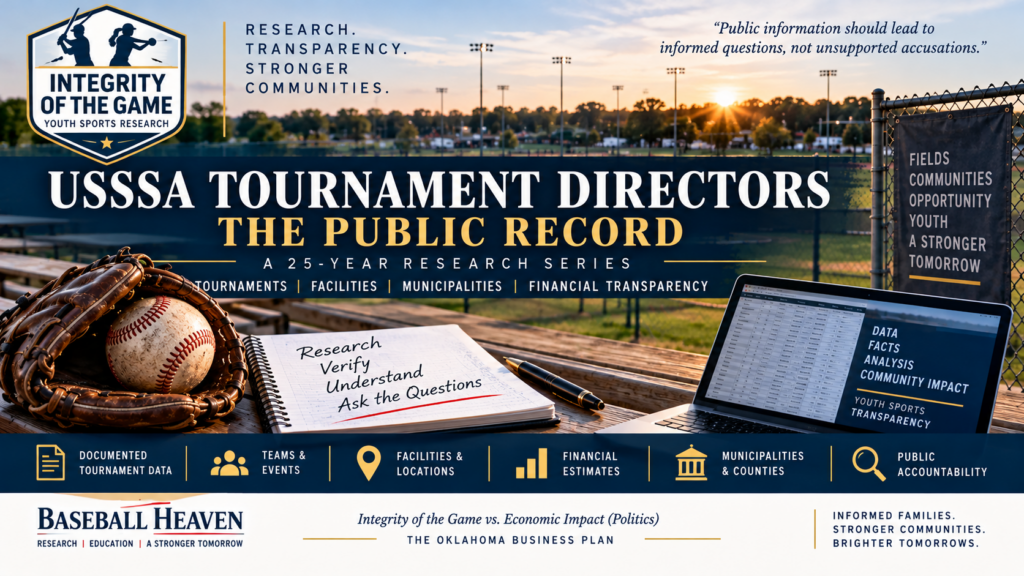
USSSA Tournament Directors — The Public Record
Introducing a historical research series on tournament operations, public facilities, financial modeling, and the questions that public records can—and cannot—answer.
Every youth baseball and softball tournament leaves a public record. Teams register, fees are advertised, games are scheduled, facilities are used, and families invest time and money. How much of that activity can be reconstructed from publicly available evidence?
That is the purpose of USSSA Tournament Directors — The Public Record, a daily informational series within Baseball Heaven's Hidden Valley — Integrity of the Game historical research initiative and Integrity of the Game vs. Economic Impact (Politics): The Oklahoma Business Plan.
Why examine tournament directors?
The plaintiffs' Second Amended Complaint in Wegman and Horrom v. United States Specialty Sports Association, Inc., et al., Case No. 6:23-cv-01637-RBD-RMN, filed April 17, 2024, describes USSSA directors as independent contractors rather than employees when discussing one model of event operation (paragraph 10, page 5). Paragraph 36 and footnote 27 (page 19) describe state and local representatives as typically independent contractors and discuss possible revenue from event entry fees, admission, and concessions.
These statements appear in a party's pleading, not in a judicial finding about any director featured in this series. Specific individuals' contractual and employment classifications require person-specific evidence. The filing offers context for understanding the organizational structure, not a basis for assuming misconduct.
Read the federal complaint (PDF) | Read the related Leverage filing (PDF)
What each daily profile will examine
Director names and original USSSA profiles, historical activity years, baseball and softball events, divisions, entered teams, dates and advertised fees.
Facility names, verified addresses, municipalities and counties, with public or private ownership identified only when supported.
Calculated gross entry-fee volume, modeled minimum games and officiating assignments, estimated gate admissions and concession proceeds—with equations and limitations.
Our historical data sources
The working Hidden Valley — Integrity of the Game CSV provided for this launch contains 20,305 event/division records: 14,558 baseball and 5,747 softball rows. The historical research spans 2001–2026. These are dataset rows, not a count of distinct tournaments. The separate director reference file contains 249 inventory records, including profile links and earlier calculations; its scope is different from the event-level file.
Data precedence: When a director inventory total differs from the latest Hidden Valley event-level calculation, the latter controls the research presentation after reconciling years, sports, tournament/division identifiers, duplicates and missing data. Each profile will identify its dataset version and explain material adjustments. Historical event listings do not by themselves prove that all scheduled games occurred.
| Profile section | What will be documented |
|---|---|
| Director and affiliation | Published name, sport, supported role, original USSSA profile and source dates. |
| Historical activity | First and last documented years, unique events, divisions, participating teams and event dates. |
| Facilities | Venue, verified address, municipality, county and public-facility relationship where established. |
| Game and officiating models | Published game guarantees, modeled minimum games and official assignments; not verified payroll. |
| Financial calculations | Entry-fee arithmetic and separately identified gate and concession estimates. |
| Evidence and limitations | Original USSSA profile, event and season records, PDFs, unknowns and correction notes. |
How to read the financial figures
1. Team entry fees
Illustration: 40 teams × a $350 published entry fee = $14,000 in scheduled gross entry-fee volume. This is not proof of payment received, net profit, personal compensation or bank-account ownership. Refunds, discounts, unpaid entries, fees and contractual distributions may change actual receipts.
2. Games and officials
A minimum-game guarantee is an advertised commitment, not a verified completed-game count. A basic illustrative schedule calculation is teams × guaranteed games ÷ 2, subject to tournament format and cancellations, because each game ordinarily involves two teams. Modeled umpire assignments require a separate supported umpires-per-game assumption; assignments are not unique individuals or confirmed wages.
3. Gate admissions
Where actual gate records are unavailable, a model may use estimated paid admissions per day × event days × admission charge. The research will disclose assumptions concerning spectator counts, admission rules, repeat entry, free admission and weather. Estimates are not verified receipts.
4. Concessions
Estimated transactions × average purchase provides a possible gross-sales model. Estimated net concession operating proceeds require subtracting food, labor, supplies and other applicable costs or applying a disclosed, supported net-margin assumption. Neither measure identifies the person or entity entitled to the proceeds.
What the public record cannot determine
Published event data generally cannot establish whether payments were ultimately deposited into a director's account, tournament business account, nonprofit user-group account, municipal account or county account. Nor does it establish actual profits, tax reporting or legal compliance. Such questions may require agreements, payment records, accounting ledgers and appropriately authorized access to protected financial records.
Why public-facility oversight matters
When taxpayer-owned fields are used, residents and governing bodies can reasonably ask who approved the use, what rental or lease terms applied, who was authorized to collect fees, what maintenance and insurance obligations existed, and what benefit the community received. These are legitimate questions about management of public assets, not allegations against the tournament director.
We encourage elected and appointed officials to review relevant agreements and accounting controls within their lawful authority, document their findings and make appropriate improvements when supported by evidence.
Read the research and follow the series
- Daily USSSA Tournament Directors — The Public Record archive
- Hidden Valley — Integrity of the Game
- Directors & Organizations research directory
- Federal Second Amended Complaint (PDF)
- Related Leverage filing (PDF)
Upcoming posts will examine one director's documented tournament history at a time, with original-source links and transparent calculations. The intent is to help families, public officials, facility managers and researchers understand what the records show—and identify what further documentation would be needed to answer open questions.
Research notice, limitations and corrections
Director names, event dates, venues, advertised entry fees, team counts and minimum-game guarantees are compiled from publicly available USSSA material and historical source records where identified. Games and officials derived from guarantees are modeled figures unless actual completed-game or staffing records are available.
Gate and concession amounts are research-based estimates, not audited receipts. Their reliability depends on the stated assumptions, which can vary across years and venues. Estimated concession net proceeds are not verified personal earnings. Historical calculations may be revised as additional evidence becomes available.
The research does not establish the ultimate recipient, deposit account, ownership or distribution of tournament funds. It does not allege or establish wrongdoing, tax violations or improper conduct by any featured director, organization, municipality or facility. No reader should infer misconduct merely from the existence of a financial estimate or an unanswered question.
Individuals and organizations may submit verifiable corrections, original documents or clarifying information for review. Material corrections should be reflected transparently in updated posts. Local officials are encouraged to evaluate public-facility agreements and financial controls using their own records and lawful oversight processes.
Public information should lead to informed questions, not unsupported accusations.