
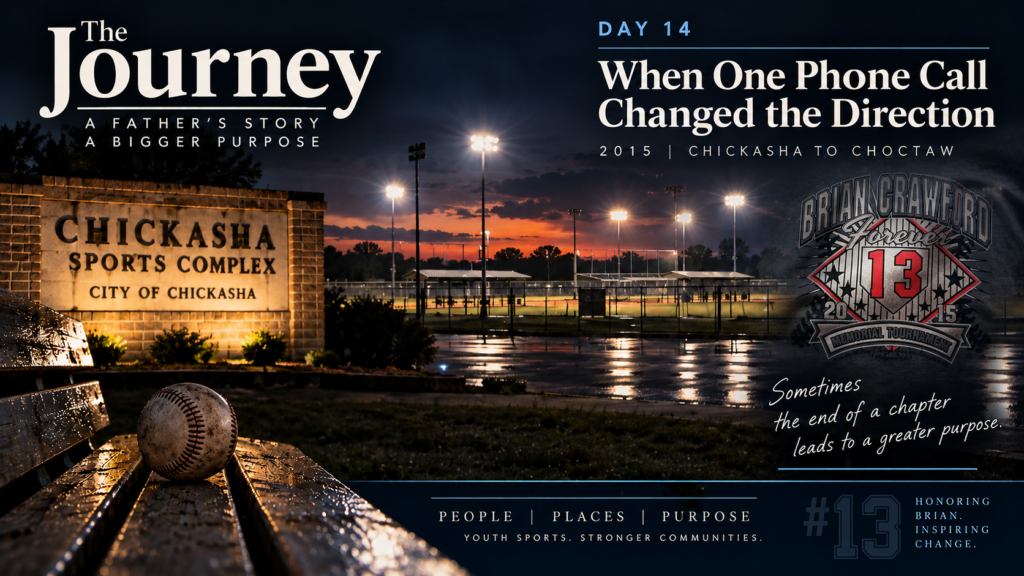
The Journey · Day 14
When One Phone Call Changed the Direction
Journey Marker: 2015 | Chickasha to Choctaw — Approximately September 2015
The 2015 Brian Crawford Memorial Tournament went forward at the Chickasha Sports Complex.
At the time, I didn't know it would be our last one there.
The tournament itself wasn't where the direction changed.
That came later.
By then, Wayne Burns had left Chickasha. Steve had served as the bridge in Parks and Recreation during his final year before retirement. Another administrative transition was underway.
Then, sometime around September 2015, I remember receiving a phone call.
From the Historical Record
The surviving USSSA-derived record identifies the 2015 Brian Crawford Memorial at the Chickasha Sports Complex as beginning March 27, 2015. It records 34 teams and $7,354 in listed team-entry fees. The later historical reconstruction calculates a minimum of 64 games.
Those figures document the tournament that was played. They do not establish the exact date or details of the phone call that came later in the year.
The Call
Firsthand Memory
My recollection is that the caller was Matt Barnard, and that I understood him at the time to be associated with the new Parks and Recreation administration.
He asked whether we planned to bring Brian's tournament back in 2016.
Of course I did.
Then came the number:
$10,000.
And the word that mattered even more to me:
Nonrefundable.
I remember being told that we would need to provide a $10,000 nonrefundable payment or check to secure the Chickasha Sports Complex for the 2016 tournament.
That is my firsthand recollection of the conversation.
It does not, by itself, establish Barnard's precise title or authority at that moment, whether the requirement had been formally adopted as city policy, or how it applied to other facility users.
Those are questions that have to be answered through contemporaneous records.
Why “Nonrefundable” Changed Everything
The problem wasn't simply that $10,000 was a lot of money.
We had already learned what Oklahoma weather could do.
Rain. Snow. Wind. Tornado-related disruptions. Power problems. Cancellations.
The 2012 tournament had barely started before overnight rain left the fields unsafe. We cancelled the remainder and, according to my recollection, refunded the teams that hadn't played.
That experience had already caused me to redesign the tournament in 2013.
So when I heard $10,000 nonrefundable, I wasn't hearing only a facility charge.
I was hearing risk.
This was Brian's memorial fundraiser.
I couldn't justify putting that amount of memorial money at risk before knowing whether Oklahoma weather would even allow us to play.
For me, the answer was simple.
I needed another place.
From a Problem to an Opportunity
At that point, I wasn't conducting research.
I wasn't studying municipal governance.
I wasn't thinking about writing Integrity of the Game.
I was trying to solve the same kind of problem I had been solving throughout this journey:
Where can we play?
That search began pointing me toward Choctaw.
A new sports complex was being developed there on land associated with the Bouse family.
I started hearing about the project.
Conversations developed.
What would I do with the infields?
I preferred artificial turf.
What about backstops?
I liked netting.
Then the opportunity became bigger than finding fields for one weekend.
There was a Parks and Recreation position connected to what Choctaw was building.
I applied.
Looking Back
This is one of those moments that looks completely different from the other side of time.
Years later, I can draw a line:
But I couldn't see that line while I was living it.
I saw a problem.
Then I saw another possible field.
Then another conversation happened.
Then another door opened.
Integrity of the Game would eventually make me think deeply about facility control, written agreements, financial risk, public administration and transparency.
But those ideas came later.
In approximately September 2015, I wasn't trying to understand the youth-sports system.
I was trying to protect Brian's tournament.
And that practical decision was about to put me on the other side of the facility relationship.
Instead of being the tournament director asking a city for fields, I was moving toward becoming one of the people responsible for operating the public facility itself.
“I thought I was looking for another place to hold Brian's tournament. I didn't realize I was walking toward the other side of the table.”
Question for the Reader
When the terms of a long-standing partnership change enough that you can no longer accept the risk, how do you know whether to keep negotiating—or recognize that the disruption may be pointing you toward a different opportunity?
Next on The Journey
The chronology now begins moving quickly.
The Chickasha call most likely occurred around September 2015.
Then came Choctaw.
An application.
Interviews.
Ideas about turf, backstops and how a new sports complex could operate.
By October 23, 2015, the chronology reaches a dated Choctaw proposal, followed by an October 30 presentation.
Those records give the next part of The Journey something increasingly important:
contemporaneous documentation.
Next on The Journey: When Looking for a Tournament Site Put Me on the Other Side of the Table.
The Journey is a continuing first-person series tracing the path from family, baseball and memorial work to research, public accountability and youth sports reform.