
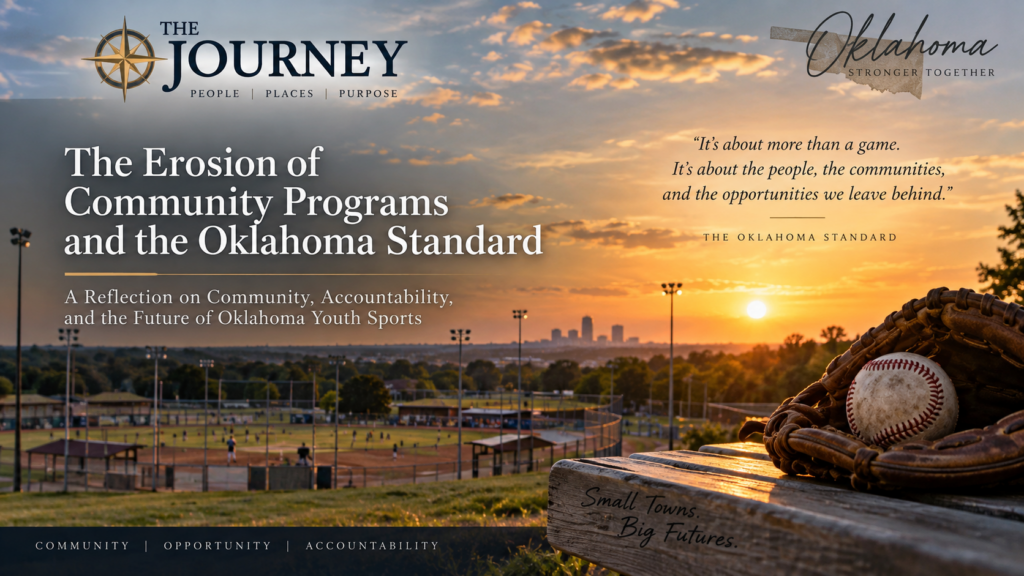
The Erosion of Community Programs and the Oklahoma Standard
A personal reflection on community, accountability, and the future of Oklahoma youth sports.
Over the past 25 years, I have witnessed a significant transformation in Oklahoma youth sports. What once centered around community-based programs, volunteer coaches, neighborhood ballfields, local businesses, and families coming together has increasingly evolved into a sophisticated commercial industry.
Youth sports has changed dramatically. Unfortunately, I question whether the municipal governments responsible for overseeing taxpayer-funded recreational facilities have evolved at the same pace.
My concern goes far beyond baseball and softball. It reaches into the very foundation of what we call the Oklahoma Standard.
What Community Sports Once Represented
For generations, community recreation provided something far more valuable than wins, losses, trophies, or economic impact. It brought classmates together, developed friendships, connected families, supported local businesses, encouraged volunteerism, and created traditions that helped define our communities.
These programs were part of the social fabric of Oklahoma.
Economic Impact Versus Community Opportunity
Today, municipalities frequently emphasize sports tourism, tournament revenue, hotel occupancy, sales-tax collections, and economic development when evaluating their recreational facilities.
Economic development certainly has its place. However, I believe we must ask whether the pursuit of economic impact has gradually overshadowed the original community purpose of these taxpayer-funded facilities.
The Responsibility of Municipal Oversight
Another concern involves municipal leadership and oversight.
Modern youth sports operations require specialized knowledge of tournament economics, facility management, scheduling, organizational structures, public-private agreements, and community recreational programming.
Yet I question whether the individuals entrusted with overseeing these operations consistently possess, seek out, or apply the operational experience and expertise necessary to protect the public interest.
When municipalities lack meaningful oversight, transparent financial reporting, clearly defined public-purpose objectives, or accountability measures, opportunities arise for questionable practices, preferential arrangements, and potential misuse of public resources.
These concerns deserve careful, evidence-based examination. Inadequate oversight alone does not establish fraud, but it can create conditions in which misconduct becomes more difficult to identify or prevent.
The Loss That Cannot Easily Be Measured
Perhaps the greatest loss, however, is one that cannot easily be measured financially.
What happens when classmates no longer grow up playing together in their hometown leagues?
What happens when volunteer coaches, civic organizations, and local businesses lose their connection to community recreational programs?
What happens when families must travel farther, spend more money, or participate in commercial organizations simply to access opportunities that once existed within their own communities?
And what happens to community identity when those shared experiences begin disappearing?
These are not merely questions about sports. They are questions about community relationships, public stewardship, civic responsibility, and the opportunities we leave for future generations.
Following More Than the Money
My research through The Oklahoma Business Plan, Hidden Valley — Integrity of the Game, and Oklahoma's Fields of Accountability has increasingly focused on the financial and operational relationships between municipalities, sports organizations, and taxpayer-funded facilities.
But I now believe an equally important dimension deserves attention:
That is also why I believe the Better Together — Oklahoma Youth Sports Community Opportunity initiative is important.
The objective should not simply be to identify problems, assign blame, or criticize commercial youth sports. It should be to understand how we arrived at this point and explore how municipalities, nonprofit organizations, schools, businesses, sports organizations, volunteers, and families can work together to strengthen community-based opportunities.
Commercial tournaments and healthy local recreational programs do not have to be competing interests. With responsible leadership, transparency, appropriate expertise, and meaningful public accountability, both can contribute to stronger communities.
The Oklahoma Standard Is a Daily Responsibility
The Oklahoma Standard should be reflected not only in how we respond when tragedy strikes, but also in how we care for our communities every day.
It should be reflected in how we manage public resources, how we treat families, how we provide opportunities for children, and how we preserve the institutions and traditions that bring neighbors together.
Ultimately, I believe we need to ask a question that reaches beyond the economics of youth sports:
That is a question worth researching, discussing, and answering.
Because the true measure of a community sports facility should not simply be how much money moves through its gates.
It should also be how many opportunities, relationships, and lasting community connections are created within them.
The Journey • October 10, 2026
Editor's note: This is a dated personal reflection within The Journey, not a numbered chapter. It does not advance the chronological narrative or replace the additional oral-history recordings planned for subsequent chapters. Questions raised here are research propositions, not findings of fraud or misconduct.