
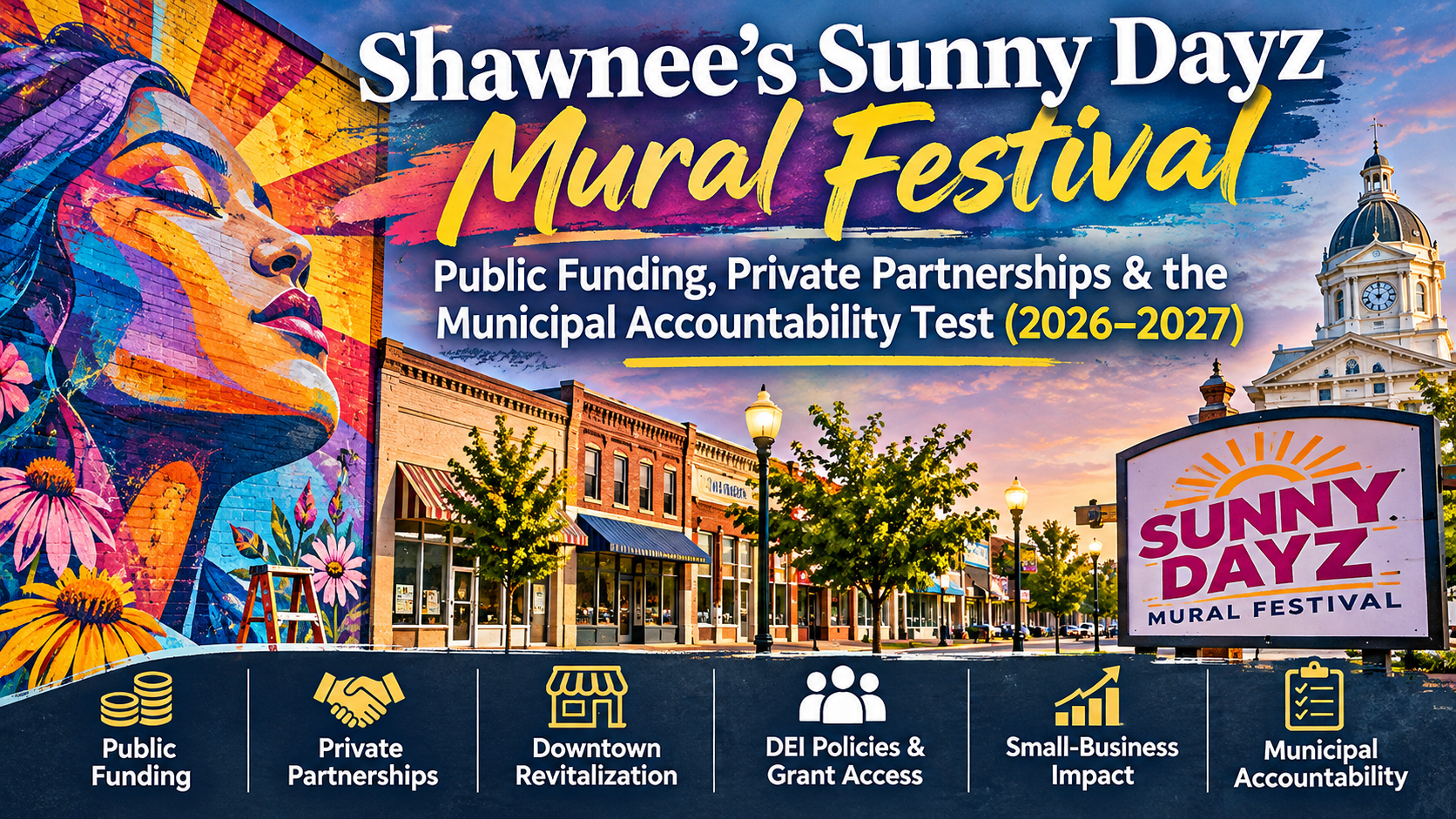
Shawnee’s Sunny Dayz Mural Festival
Public Funding, Private Partnerships & the Municipal Accountability Test (2026–2027)
Executive Overview & Scope
Sunny Dayz Mural Festival is scheduled to take place in Shawnee, Oklahoma, on June 5, 2027, with mural activity proposed for downtown Shawnee and the historic Dunbar Heights neighborhood. The organizer has identified Visit Shawnee and Dunbar Heights Community Center as collaborators. This case study examines how hosting decisions, public expenditures, nonprofit partnerships, site approvals, artist and vendor opportunities, and projected local benefits can be documented and independently evaluated.
Our approach is evidence-first: distinguish official festival policy, organizer-reported claims, public agency records, independent reporting, and unresolved questions. The aim is accountability without presuming wrongdoing.
1. Documented Timeline & Event Background
| Date / period | Event or representation | Evidence status |
|---|---|---|
| 2026 Claremore festival | Organizer reports 37 artists, 26 murals, more than 7,500 square feet of public art, and more than $300,000 in estimated public-art value. | Organizer-reported; not independently audited |
| November 2, 2026 | Executive Director Kristen Milburn emails a request to introduce Sunny Dayz to Shawnee Lions Club members; identifies Visit Shawnee and Dunbar Heights Community Center as collaborators. | Documented in forwarded correspondence |
| May 29–June 6, 2027 | Festival FAQs describe an artist lodging/painting period around the event. | Published organizer information |
| June 5, 2027 | Public festival scheduled in Shawnee, 12–8 p.m. per organizer FAQs. | Published organizer information |
Primary correspondence: “Fwd: Sunny Dayz is coming to Shawnee!” (November 2, 2026; two-page email chain retained in research files). The email is evidence of outreach and statements made, not proof of a municipal contract.
2. Hosting Model, Funding Sources & Public Financial Exposure
The Sunny Dayz published host-community request for proposals for 2028 and 2029 describes an $80,000–$100,000 host-community financial commitment, stated to represent approximately one-third of total festival costs and to support muralist stipends. The same materials describe assistance with site permissions, logistics, permitting, barricading, security, waste services, a headquarters, and lodging options.
Records required to establish financial exposure
- Shawnee's 2027 host proposal, selection materials, agreement, amendments and authorization.
- All proposed, approved, obligated and disbursed City, County, tourism, hotel-motel tax, economic-development, state or federal contributions.
- Cash sponsorships versus in-kind contributions, including labor, barricades, police, traffic management, utilities, insurance, facilities and maintenance.
- Grant applications, award letters, restricted-use conditions, reimbursement requests and post-event reporting.
- Budget-to-actual reconciliation, payments to artists, sponsorship revenues and independent fiscal sponsorship or pass-through arrangements, if any.
Financial reporting rule: Do not combine pledged funds, approved appropriations, actual expenditures, estimated in-kind value and projected economic impact into one figure.
3. Governance, Public Authority & Private Partnerships
The organizer’s November 2 outreach describes work with Visit Shawnee and Dunbar Heights Community Center. Their precise legal roles, funding arrangements and authority to commit public resources must be established from source records. A collaboration announcement does not, by itself, establish public expenditure or official approval.
- Identify each host, contracting party, sponsor, fiscal agent, public agency and private property owner.
- Determine which officials or governing bodies reviewed and approved any commitments and whether actions appear in public agendas, minutes or budgets.
- Examine conflicts-of-interest disclosures, procurement requirements, sponsorship recognition, fundraising chair assignments and decision criteria.
- Document public consultation, including residents, downtown merchants, mural-site owners and Dunbar Heights stakeholders.
4. Artist Eligibility, DEI Policies & Fair Access to Publicly Supported Opportunities
Sunny Dayz’s 2027 FAQs state that muralist applicants must identify as female or a gender minority. They also describe a selection panel of 10–15 arts and community professionals, a target of 50–70% Oklahoma artists, and compensation of $13.50 per mural square foot. These are published organizer policies; they should not be conflated with municipal grant eligibility rules.
The committee application separately states that demographic responses do not affect committee selection and are used internally for grant reporting and planning. Committee membership, paid muralist selection, youth mentorship, vendor selection and public grant awards are different programs requiring separate analysis.
Questions for documented review
- Do public funds, if any, finance a program with identity-based eligibility criteria? What award conditions and applicable legal requirements govern those funds?
- Are scoring rubrics, reviewer qualifications, recusal practices, appeals and application outcomes documented?
- What opportunities are available to Shawnee residents and Pottawatomie County artists, including youth mentorship?
- Do publicly funded vendor, small-business or economic-development programs have separate eligibility criteria? If so, who establishes them?
5. Downtown Revitalization, Main Street & Small-Business Impact
Public art may attract visitors, support local spending, enhance building facades and increase community engagement. Possible downsides—traffic disruption, unequal access to opportunities, rising rents, or displacement—must be evaluated with local evidence rather than inferred from general discussions of DEI.
Recommended baseline and post-event measures
- Downtown storefront occupancy, business openings/closures, and commercial rents before and after the festival.
- Merchant surveys and documented consultation, including businesses adjacent to murals and festival routes.
- Visitor counts, hotel-room nights, sales-tax trends and merchant-reported incremental sales, with attribution limitations clearly stated.
- Local versus nonlocal vendor, artist and contractor spending, plus actual payments made.
- Traffic, parking, accessibility, street closures, property-owner consent, and ongoing maintenance costs.
The two submitted Google searches about DEI, grant access and Main Street growth are included in the research register as questions for investigation, not evidence that a Shawnee business has been pushed out or denied funding.
6. Mural Sites, Property Rights, Maintenance & Creative Control
For each proposed mural, request the street location, ownership, signed permission, permit, scope, artist agreement, insurance, maintenance schedule, preservation requirements and responsibility for future removal or repair. The organizer’s RFP states that Sunny Dayz manages content review and retains the creative selection role, while the host assists in locating walls and securing owner permissions. The terms applicable to Shawnee remain to be verified.
Public buildings, public rights-of-way and privately owned buildings may present different approval and funding requirements. No mural location should be described as publicly owned without a property record or agency confirmation.
7. Prior Festival Claims, Media Reporting & Comparable Host Models
The forwarded email attributes to the 2026 Claremore festival 26 murals, 37 artists, more than 7,500 square feet of art and over $300,000 in estimated art value. These are promotional metrics and should not be described as audited spending, local tax revenue or net economic impact. The KFOR article raises a separate question about an earlier funding loss; it does not establish a Shawnee-specific budget gap. Review the original article and underlying grant documentation before asserting an amount or cause.
Compare actual hosting agreements from previous communities with Shawnee’s eventual records, accounting for differences in year, size, source of funds and in-kind services. A proposal or agenda item is not equivalent to a final approval or payment.
8. Recommended Oklahoma Open Records Act Request
Proposed date range: January 1, 2025 to the date each request is processed, with subsequent follow-up requests as needed.
- All host applications, proposals, presentations, evaluation materials, letters of support, negotiations and executed agreements involving Sunny Dayz.
- Communications between City personnel, elected officials, Visit Shawnee, Dunbar Heights Community Center, festival representatives and other identified partners concerning the 2027 event.
- Budget worksheets, appropriations, hotel-motel/tourism-tax allocations, economic-development funds, invoices, purchase orders, checks, reimbursements, donations and in-kind service estimates.
- Grant applications, award conditions, fiscal sponsorship arrangements and financial or performance reports.
- Mural-site maps, owner permissions, public property licenses, permits, traffic plans, insurance, indemnity and maintenance agreements.
- Selection and eligibility policies, scoring criteria and contracts for artists, vendors, contractors and publicly funded opportunities, subject to lawful redaction of private information.
- Economic-impact projections, methodology, baseline studies, merchant consultation and any planned post-event measurement.
Request searchable electronic copies where available. Ask each agency to identify records held by separate entities and to provide the applicable records custodian. This is a proposed request scope; no Sunny Dayz records request is represented here as submitted.
9. Public Records & Communications Tracker
| Entity / record group | Current documented status | Next evidence needed | Updated |
|---|---|---|---|
| City of Shawnee — host approvals and finances | Not yet documented as requested | Submit records request; retain confirmation/reference number | Nov. 2, 2026 |
| Visit Shawnee — partnership and funding | Named by organizer as collaborator | Identify legal structure, contracts, funding sources and records custodian | Nov. 2, 2026 |
| Dunbar Heights Community Center | Named by organizer as collaborator | Clarify roles, facilities, financial/in-kind support | Nov. 2, 2026 |
| Pottawatomie County | No County contribution verified | Determine whether any County funds or resources are involved | Nov. 2, 2026 |
| Sunny Dayz organization | Public FAQs, RFP and committee application reviewed | Obtain Shawnee-specific hosting terms, budgets and response to questions | Nov. 2, 2026 |
| Shawnee Lions Club outreach | November 2 email invitation documented | Record any subsequent presentation, discussion or commitments | Nov. 2, 2026 |
10. Public Questions for Officials & Organizers
- Who submitted or approved Shawnee’s host application, and when?
- Is there an executed agreement for 2027? Who signed it and under what authority?
- What is the complete cash and in-kind cost to the City, County and publicly supported partners?
- Are hotel-motel, tourism, economic-development or grant revenues involved?
- Which agencies or nonprofits will collect, hold, disburse and audit event funds?
- What are the selection criteria for murals, mural sites, artists, vendors and sponsors?
- How do any public grant conditions interact with organizer eligibility policies?
- How were downtown and Dunbar Heights residents and businesses consulted?
- Who will own and maintain the murals, and what are the long-term obligations?
- How will benefits and costs be measured, independently reported and compared with pre-event conditions?
11. Source Register & Supporting Research Links
Sources are listed by evidentiary role. Organizer statements establish published positions, not independently verified outcomes. General civic-policy articles and search queries are contextual leads, not proof of a local event or wrongdoing.
| Source / open link | What it supports — and limits |
|---|---|
| Executive Summary PDF (Nov. 2, 2026) | Baseline synthesis and outstanding questions; preliminary, not an audit. |
| Forwarded email: “Sunny Dayz is coming to Shawnee!” (Nov. 2, 2026) | Researcher-held primary correspondence; organizer’s proposed dates, sites, partners and reported Claremore metrics. No public URL supplied. |
| Festival 2027 FAQs | Organizer policy: dates, artist eligibility, compensation, selection and lodging |
| Host-community RFP (2028–2029) | Organizer proposal: prospective host contribution and logistics; not a Shawnee contract |
| 2027 committee application | Committee roles, fundraising, permits, volunteer expectations and demographic statement |
| Festival host application | Application referenced in preliminary research; confirm present availability |
| KFOR funding coverage | Reporting lead about earlier festival funding; not evidence of Shawnee expenditure |
| Rockefeller Institute: Dr. Robert Richards | Background on civic participation; no demonstrated Shawnee festival connection |
| Google research question: DEI and grant access | Research question only, not a source proving displacement |
| Google research question: DEI and Main Street | Research question only, not proof of effects |
12. Research Updates & Corrections Log
| Date | Update | Evidence classification |
|---|---|---|
| Nov. 2, 2026 | Opened case study based on forwarded organizer correspondence, festival policies, host RFP and external research leads. | Primary correspondence + published organizer sources |
| Nov. 2, 2026 | Published executive summary and established questions for future public-records review. | Research synthesis |
| Future | Agency submissions, responses, agreements, financial exhibits and corrections will be added with document dates and source links. | Pending |