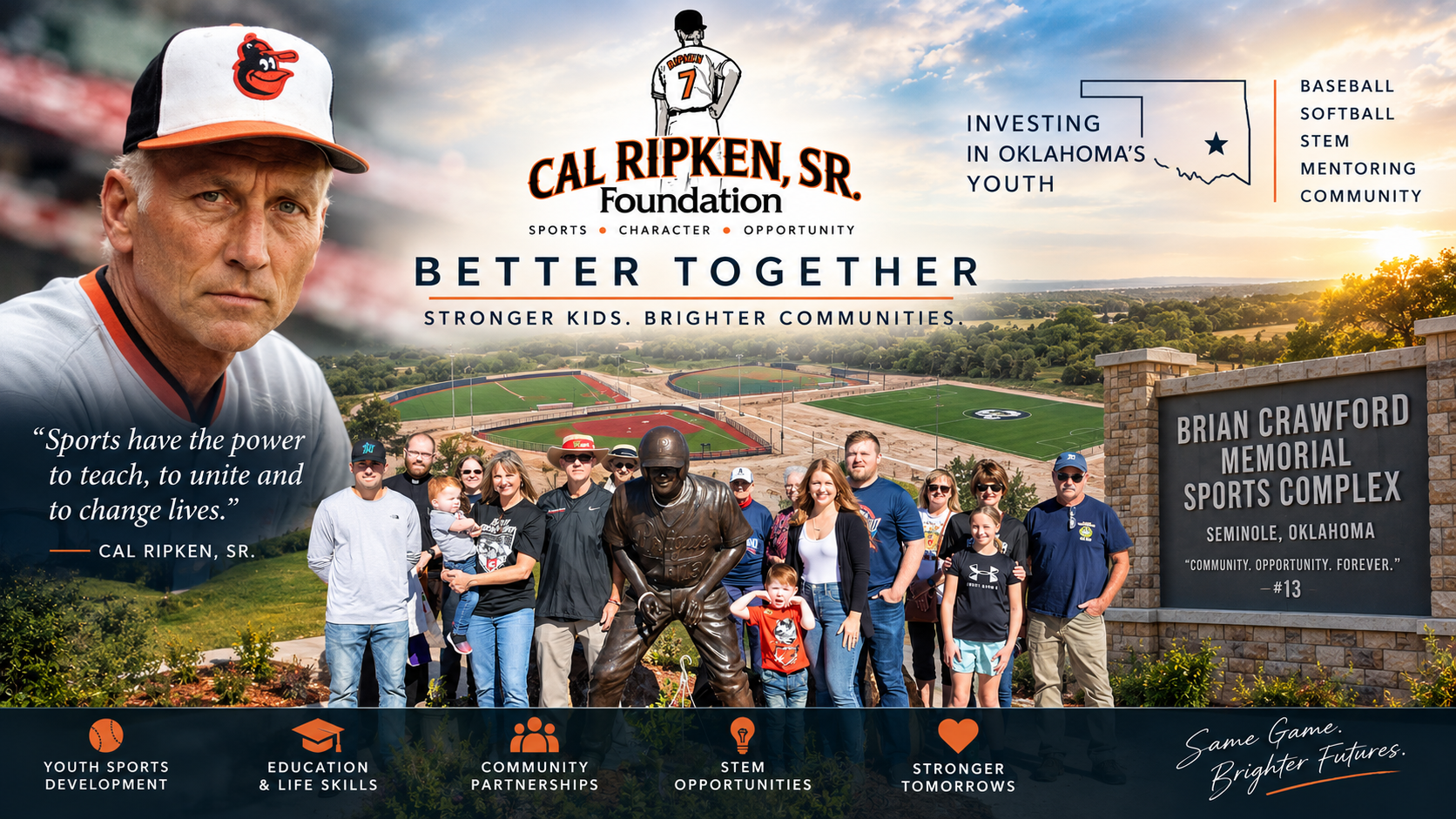
Cal Ripken, Sr. Foundation
Oklahoma Youth Sports Community Opportunity
A living institutional research profile examining the Foundation's youth-development model, its documented Oklahoma footprint, the Brian Crawford Memorial Sports Complex partnership, and what the evidence may teach Oklahoma about philanthropy, facilities, baseball, softball and community collaboration.
Explore Oklahoma ResearchEvidence Standard
This is not a case for or against the Cal Ripken, Sr. Foundation.
Better Together asks what role a national nonprofit is best equipped to perform, what local institutions must contribute, what barriers appear when a project moves from vision to construction, and what Oklahoma can learn from both successes and unresolved portions of the record.
A living profile with visible evidence boundaries.
Documented facts, organizational statements, research findings, first-person recollections, hypotheses and unresolved questions are kept separate.
More than a baseball-field organization.
The Foundation describes three major pillars: youth mentoring, Youth Development Parks and STEM Centers. Its park model combines infrastructure with programming and continuing community support.
Youth Mentoring
Sports and activity-based character, life-skills and mentoring programs.
Youth Development Parks
Baseball, multipurpose and adaptive facilities paired with youth-development programming.
STEM Centers
Hands-on educational access through schools and youth-serving organizations.
The Foundation already had an Oklahoma footprint.
A 2019 Foundation Oklahoma summary documented activity well beyond one facility project.
16,027 Youth
Reported reached in seven Oklahoma communities in 2019.
Baseball + Softball
Bartlesville programming included a no-fee baseball or softball Instructional League.
Youth Development Parks
Oklahoma parks included Duncan, Bartlesville and Southeast High School facilities.
37 STEM Centers
Reported across four Oklahoma communities, reaching 11,720 youth in 2019.
Historical source: Cal Ripken, Sr. Foundation — Oklahoma One Pager (2019).
From introduction to active project development.
The available documents show a relationship that advanced well beyond an introductory conversation.
The relationship begins
Foundation Vice President Chuck Brady told SSC President Emeritus Jim Utterback that the project appeared to align with the Foundation's mission and described possible value from conceptual design through construction, resource development and program development. Brady also proposed involving Fields, Inc. President Brian Storm.
A — Documented FactA proposed working framework
Brady transmitted a non-binding memorandum of understanding intended to explain how the Foundation could work with the proposed Seminole State College Foundation project and recommended finalizing it after SSC became comfortable with Fields, Inc.
A — Documented FactSite realities emerge
Property, easement, survey, possible well, water and sewer questions appear in contemporaneous project correspondence. These issues matter because facility development involves infrastructure beyond the playing surface.
A — Documented FactFundraising and project presentation
Photographs from the Brian Crawford Memorial fundraiser kickoff show presentation material referencing Cal Ripken, Sr.'s legacy, the Cal Ripken, Sr. Foundation / Fields partnership and Sports Force Parks concept imagery. Later correspondence refers to the January presentation in project-development efforts.
A + D — Records & Historical ContextSSC publicly announces formal arrangements
Seminole State College announced a $7.25 million first phase and stated that formal arrangements had been made with the Cal Ripken, Sr. Foundation and Fields, Inc. The published scope included a Trojan stadium, training facility and a youth multi-use field for baseball, softball or soccer, with additional youth baseball/softball and soccer fields contemplated later.
A/B — Public Record & Organizational StatementGroundbreaking
SSC's public record identifies Cal Ripken, Sr. Foundation Senior Vice President Chuck Brady and Fields, Inc. CEO Brian Storm among participants in the November 7 groundbreaking. More than 250 people were reported in attendance.
A — Documented FactDesign and infrastructure work advances
Project records document architectural and civil-design work, sewer routing, easements, geotechnical work, traffic analysis, ODOT coordination and other preconstruction activity. The record therefore supports a development relationship, not merely a ceremonial affiliation.
C — Research Finding Based on Project RecordsSomething changed. The evidence does not yet establish one reason why.
This is where Better Together deliberately separates a documented transition from a causal conclusion.
What is documented
Fields correspondence states that work ceased at Jim Utterback's direction in March 2020. Subsequent records show alternate pricing being pursued while Chuck Brady helped identify or transfer project materials.
Structural pressures
Financing deadlines, project budget, roadway/ODOT requirements, sewer, utilities, easements, geotechnical work and other site-development demands are all part of the contemporaneous record.
What is not established
The current record does not establish that politics, contractor performance, COVID-19, local control, tournament interests or any single factor caused the transition.
Questions to test—not conclusions to defend.
- Financing and budget pressure, including the loan/New Markets Tax Credit timetable.
- Roadway, traffic, sewer, utility, easement and site-development costs.
- Alternative contractor/project-delivery pricing.
- Schedule and regulatory requirements.
- COVID-era effects, but only if contemporaneous evidence connects them to the decision.
- Governance or local-control considerations, if supported by decision records.
- Any contractor-performance issue, if notices, disputes or closeout records establish one.
The Ripken relationship did not simply end in 2020.
2021 correspondence documents continued Foundation involvement through pledge/accounting administration and assistance with child-protection policy. Current Foundation records also list the Brian Crawford Memorial Sports Complex as a completed Youth Development Park project.
2021 — Pledge Administration
Correspondence indicates the Foundation continued carrying an original project pledge and used documentation of qualifying project expenditures in administering the balance. The exact pledge amount remains under research.
2021 — Child Protection
Chuck Brady supplied the Foundation's child-protection policy for possible adaptation to local complex needs.
Current Recognition
The Foundation's current park list identifies the Brian Crawford Memorial Sports Complex in Seminole as a completed baseball Youth Development Park project.
A multi-use complex serving more than college baseball.
Seminole State College currently describes the BCM Sports Complex as a seven-field facility that includes soccer and an adaptive field. Its booking materials describe lower fields configurable for baseball or softball.
College / High School Baseball
Baseball remains a central facility use.
Youth Baseball & Softball
Multiple lower fields are described as configurable for both sports.
Adaptive Opportunity
The Avedis Adaptive Field provides a multipurpose accessible playing space.
Soccer
The completed complex includes soccer within the broader multi-sport facility.
An incomplete record is not a conclusion.
These questions do not prevent the documented history from being presented. They define the next stage of the research.
Agreement & Pledge
Was the May 2018 MOU executed? What was the exact CRSF pledge amount, restriction, payment mechanism and final amount applied?
Fields Transition
What contractual relationship governed Fields, Inc., what documented reasons were given for work stopping, and how was work product transferred or reused?
Replacement Delivery Structure
What bids or alternate pricing were considered, and what agreement brought Penns/Pennington Athletic Fields or other replacement contractors into the project?
Final Financial Reconciliation
What were the final sources and uses, final project cost by component, and actual treatment of the anticipated CRSF funding shown in internal project records?
Original Vision vs. As-Built
Which architectural, civil, traffic, sewer and site-development elements carried from the Ripken/Fields work into the completed facility?
Post-Opening Outcomes
What baseball, softball, adaptive, soccer, mentoring and youth-development programming has occurred, and how is community access measured?
A comparison to be completed—not presumed.
Better Together will compare the 2018–2019 plans with the final facility component by component as the underlying agreements, invoices and as-built records are reconciled.
- College baseball stadium and training facilities.
- Youth baseball and softball fields.
- Adaptive recreation.
- Soccer and multi-use capacity.
- Parking, road access and traffic improvements.
- Sewer, utilities, geotechnical and site-development work.
- Funding sources, project costs and long-term operations.
The value of the Seminole case is the number of systems that had to work together.
Memorial philanthropy, a college foundation, a national nonprofit, specialized sports-development expertise, schools, public infrastructure, local donors, contractors and community sports all intersected in one project.
Facilities Need More Than Fields
Roads, utilities, drainage, sewer, easements, financing and long-term maintenance can determine whether an athletic vision is feasible.
Programming Matters
The Foundation's Oklahoma record demonstrates a model that can combine facilities with mentoring, no-fee participation, softball, adaptive access and STEM.
Roles Should Be Defined Early
National expertise, local ownership, philanthropy, public investment and operations are different functions. Better Together asks how those roles can complement rather than duplicate one another.
What could each side contribute?
What a National Nonprofit Can Contribute
Facility-development experience, fundraising relationships, youth-development curriculum, mentoring frameworks, adaptive-design experience, equipment access, program evaluation and a network of successful community models.
What Oklahoma Communities Must Contribute
Local leadership, land and infrastructure planning, sustainable operations, transparent governance, community access, maintenance capacity, local fundraising and a willingness to measure outcomes beyond tournament traffic.
Version 1.0 — Published while research continues.
The public profile will be updated when material new records become available. Missing documents will not be treated as evidence of wrongdoing, and later records may strengthen, narrow or change current interpretations.
Documented
2018 relationship formation, 2019 public development activity, substantial preconstruction work, 2020 structural transition and continuing Ripken involvement.
Under Reconciliation
Project-management data, invoice PDFs, pledge accounting, contractor transition and final component costs.
Open for Correction
Organizations and participants are invited to provide records that correct, clarify or materially change the chronology.
Help complete the record.
Better Together welcomes source documents, corrections and additional context from the Cal Ripken, Sr. Foundation, Seminole State College and its Educational Foundation, Fields, Inc., contractors, donors, public agencies, participants and community members.
Part of the Better Together framework.
This institutional profile should be read alongside Baseball Heaven's broader research into public facilities, community investment, youth-sports organizations, tournament economics and the Brian Crawford Memorial history.
Better Together Master HubBaseball Heaven Research Hub