
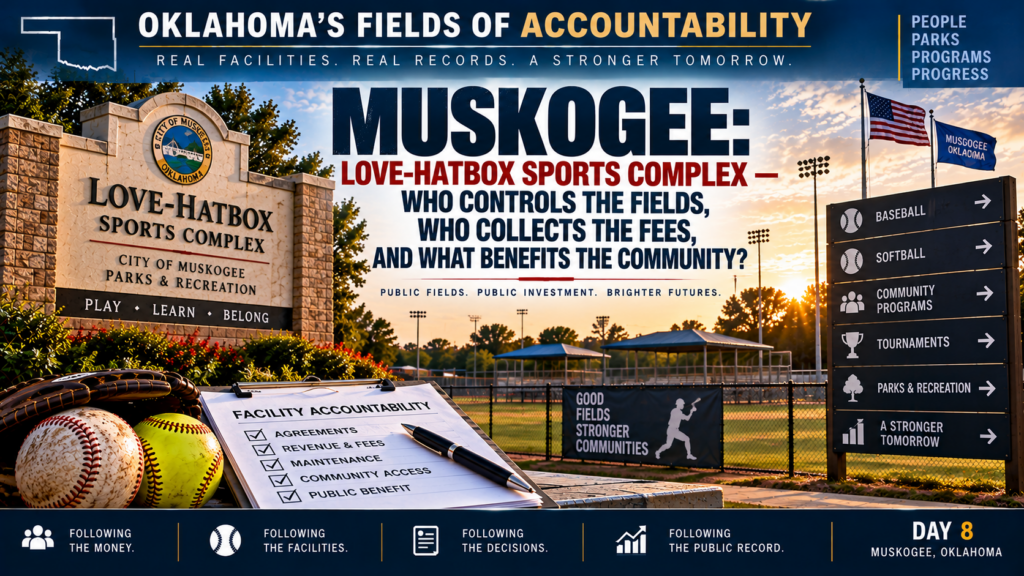
MUSKOGEE — LOVE-HATBOX SPORTS COMPLEX
Public fields. Documented agreements. Community opportunity. A record-based examination of who controls the fields, who collects the fees, and what families receive.
Oklahoma’s Fields of Accountability — Day 8
Muskogee: Love-Hatbox Sports Complex — Who Controls the Fields, Who Collects the Fees, and What Benefits the Community?
Publication date: October 14, 2026
Jurisdiction: City of Muskogee, Muskogee County, Oklahoma
Facility: Love-Hatbox Sports Complex / Love Hatbox Field, 3601 Arline Avenue, Muskogee
Study periods: Municipal management and budgeting, especially FY2017–FY2026; historical Hidden Valley/USSSA research window 2001–2026 (direct facility seasons displayed through 2017).
Editorial standard: Research-first. This investigation does not allege wrongdoing by the City, former operator, tournament directors, or local leagues.
The public-benefit question: When a city returns a sports complex to municipal management, reserves fields for outside tournaments, and collects its own facility-related fees, what records demonstrate that local families, leagues, volunteers, and taxpayers receive lasting value?
Executive finding: the management record is more informative than speculation
Muskogee provides an unusually instructive comparison to other Oklahoma facilities. The City's adopted FY2018–2019 budget reports that its contract with Sports Facilities Management ended during FY2017–2018 and that operation of Love-Hatbox returned to the City of Muskogee Parks and Recreation Department. The record establishes a management transition. It does not state why the contract ended, specify any dispute, or establish that either approach performed better. [S1]
The February 9, 2022 Parks and Recreation Advisory Board agenda packet includes an operating proposal, a policy labeled effective January 1, 2022, and blank sample field-use documents. The proposed framework addresses scheduling priority, written approval, staff responsibilities, concessions, fee collection, insurance, safety, and tournament administration. Because the materials are in an agenda packet, the investigation does not equate every draft provision with a fully executed agreement or prove that it applied to every historical tournament. Adopted policies, the relevant meeting minutes, and executed event agreements are still needed. [S2]
The November 24, 2025 City Council minutes, reproduced in the December 8, 2025 packet, report a discussion of operations and partnerships at Love-Hatbox. Staff described improvements; residents thanked the City for upgrades and raised concerns about communication. The item was marked “No Action”: it documents a discussion, not a Council vote to change an operating agreement. [S3]
The City's FY2025–2026 adopted budget separately identifies Hatbox Sports Complex enterprise-fund activity: $276,000 budgeted revenue, $275,300 budgeted expenditures, and a $700 projected closing balance. Those are budget figures, not independently verified year-end results. [S4]
1. Facility, ownership, and jurisdiction
Love-Hatbox is a City of Muskogee sports facility, not a Muskogee County lease or a Muskogee Public Schools property. The City's budget describes a former-airfield site of approximately 60 acres, with 10 lighted baseball fields, eight lighted softball fields, two lighted football fields, 13 soccer fields, a 3.1-mile trail, and a skate park. These are municipal inventory descriptions, not an assertion that all fields are available, open, or in identical condition today. [S4]
The principal governing body for municipal budgets and policies is the Muskogee City Council. Day-to-day scheduling, maintenance, concessions, and event coordination are administrative functions of Muskogee Parks and Recreation, subject to adopted policy and delegated authority. Tournament hosts may have separate contractual responsibilities, but field use alone does not establish private control of the underlying public asset. [S1][S2][S4]
Boundary: The nearby former Hatbox airfield/event grounds, River Country Water Park, and other city recreation accounts are distinct components. Figures labeled Hatbox Sports Complex, Fund 545, should not be casually combined with those other operations. [S4]
2. Documented decisions: a timeline
| Date or period | What the available record establishes | Classification / limitation |
|---|---|---|
| FY2017–2018, reported in the City-approved FY2018–2019 budget | Sports Facilities Management's operating contract ended; operation returned to Muskogee Parks and Recreation. | Documented management change. Underlying contract, termination terms, final reconciliation, and decision-level minutes were not verified for this episode. [S1] |
| February 9, 2022 | Parks and Recreation Advisory Board agenda requested a presentation on the 2022 Hatbox Operation Proposal; the packet included policy and sample user/tournament agreements. | Agenda/administrative proposal, not proof each blank form was signed or every recommendation adopted. The identified presenter was Parks Director Mark Wilkerson, an administrative official, not a Council voter. [S2] |
| November 24, 2025 | Council discussed improvements, maintenance, and partnerships for baseball, softball, and soccer. Parks Assistant Director Brooke King presented improvements; Sheila Rippy expressed appreciation; Nichole Bowling and Josh Cotten also described communications concerns. | Collective public discussion; no action. The minutes are included in the December 8 agenda packet. No individual Council vote on this item is identified. [S3] |
| FY2025–2026 | Adopted Hatbox Sports Complex Fund 545 budget lists $276,000 revenue and $275,300 expenditure estimates. | Collective municipal budget framework, not actual year-end cash receipts or an audit. [S4] |
A common research error would be to turn the 2022 agenda proposal into a confirmed, universal lease. Another would be to treat the November 2025 discussion as a disciplinary action or finding of noncompliance. Neither inference is supported by these sources.
3. What the 2022 proposed field-use framework actually says
Local-league priority and written scheduling
The policy in the February 2022 packet says the City approves field schedules and requires written approval before use; unused slots can return to a common pool. It gives local leagues that call Love-Hatbox home priority for their regular games and practices, while evaluating tournament requests partly by event volume, expected teams, and potential visitor/hotel activity. This is evidence of a proposed balancing mechanism between neighborhood play and regional events, not evidence of how every requested slot was awarded. [S2]
Who collects which money?
The packet's blank tournament/event agreement states that a tournament/event director would retain team-entry fees and registrations, while paying field-rental charges to the City. The 2022 policy also says City Parks and Recreation manages concessions; the sample agreement places gate personnel, umpires, awards, balls, registration, and entry-fee collection with the event director. These are different revenue and expense channels, and the sample does not establish the final gate-proceeds split for a particular event. [S2]
The fee appendix is headed “Charges for sporting events – 2020 Field Use Fees,” despite appearing inside 2022 materials. It lists $10 per game for home-league games and home-league tournaments, $20 per game for private tournaments, and a $250 reservation/security deposit subject to specified weather provisions. The same appendix lists separate costs for lights, field crews, portable fencing, and camps. Do not represent these figures as verified 2026 rates without the current fee schedule and individual executed contracts. [S2]
The agreement documents that would reconcile actual activity include reservation requests, signatures, game schedules, payment records, concessions reports, maintenance worksheets, and final invoices. The publicly available packet includes blank examples of several of these forms; it does not itself supply signed copies for individual USSSA events. [S2]
Safety and accountability provisions
The proposed framework calls for insurance naming the City as an additional insured, background-check responsibilities, codes of conduct, scheduling controls, and the ability of City staff to make safety and weather decisions. The template also requires advance team counts and event schedules. These are substantive oversight mechanisms if executed and enforced; whether they were implemented consistently is an evidence question, not a conclusion based on a template. [S2]
4. Hidden Valley/USSSA historical activity — direct records first
The independent Love Hatbox Field facility report measures publicly recorded event participation multiplied by publicly posted team-entry fees. The published research window is 2001–2026, but its direct, stand-alone annual chart displays seasons 2001–2017. Later USSSA activity not shown in the direct chart cannot be presumed nonexistent. The study does not equate each observed season with identical operating rules. [S5][S6][S7]
| Direct/stand-alone metric | Research result |
|---|---|
| Calculated team-entry fees | $1,018,614 |
| Baseball calculated entry fees | $943,318 |
| Softball calculated entry fees | $75,296 |
| Team entries | 6,520 |
| Minimum games | 14,926 |
| Modeled minimum officiating assignments | 26,869 |
| Distinct listed director categories | 3 |
| League-team entries, within the reported direct population | 498 |
| Calculated league-team entry fees, included within the report's direct measures | $7,235 |
| Verified count of age-division rows | Not available from the published facility summary |
Division distinction: The 2022 City reservation form offers age-category choices such as U6 and U8–U18 for prospective youth events. Those form categories are not evidence that the Hidden Valley dataset recorded an event in every category, nor are they a reliable distinct division-row count. To publish that number, we need the underlying facility-filtered event/division export and a rule for counting divisions without duplicates. [S2][S6]
Annual context: The published chart's highest calculated total is 2008: approximately $145,870. It displays $0 in 2001 and 2014; a public $0 posted entry fee does not prove no play, no locally assessed charge, or no financial activity. The report identifies baseball as the dominant category by calculated value. [S5][S6]
Director attribution: In the direct facility report, the largest calculated activity grouping is associated with Marie Gassaway (approximately $957,781), followed by Neil Hays (approximately $44,700) and Ted Cox (approximately $16,140). A director's association with calculated entry-fee activity is not evidence of that person's receipts, wages, profits, tax treatment, or wrongdoing. [S5][S7]
Multi-facility event records remain separate
A different set of records lists “Love Hatbox Field, Sallisaw Sports Complex.” That combined-location event population carries $3,885 in calculated softball entry fees, 18 team entries, 47 minimum games, and 94 modeled official assignments. It is not allocated entirely to Muskogee. The broad combined activity footprint is $1,022,499, but the defensible standalone Muskogee facility estimate remains $1,018,614. Association is not allocation. [S5][S6]
Why these financial figures cannot be substituted for City receipts
Calculation: team entries × posted event entry fee = calculated team-entry fee activity. This metric measures what the public event records imply, not actual cash collected. Discounts, refunds, cancellations, missing historical prices, fees paid elsewhere, and mixed-site tournaments can change realized receipts. It also does not include gate receipts, concessions, municipal rental fees, municipal operating costs, or tournament profits. [S6]
5. City budget figures: a different type of financial evidence
Muskogee's adopted FY2025–2026 Fund 545 budget projects $276,000 in revenue and $275,300 in expenditure, leaving a $700 projected year-end balance given the budget's displayed starting assumptions. These are not realized 2025–2026 totals; the final ledger and audit would be needed to establish actuals. [S4]
The revenue side separates categories including baseball and softball operating lines, baseball and softball concessions, baseball and softball fees, and football/soccer fees. The expenditure side contains regular wages, contract services, utilities, concession purchases, and maintenance. For example, the budget includes $40,000 for contractual services, $25,000 for utilities, $15,000 for building and grounds, and $6,000 for softball-field maintenance. These are budgeted line items, not proof that these amounts were spent, or that particular tournaments were charged or credited. [S4]
Especially important: the FY2025 budget column shows a $265,000 transfer from the general fund, while the FY2026 proposed/adopted column shows no comparable general-fund transfer budgeted. That is a budgeting difference; it does not by itself prove that the facility is self-sustaining, that no other public support exists, or that actual collections matched projections. [S4]
What would reconcile the two systems? A per-event schedule of city field-use receipts, concessions/admission receipts, revenue by general-ledger account, event host receipts where legally obtainable, deposit refunds, crew/lights charges, repairs, facility utilization, and audited annual enterprise-fund statements. A cumulative USSSA analytical estimate cannot be compared directly with one year's City budget as though they measured the same period or recipient.
6. Elected officials, administrative actions, and structural conditions
Collective governing-body responsibility: The City Council sets budgets and acts on matters formally brought to it. The FY2018–2019 budget and FY2025–2026 budget are public records of municipal operating policy. This review has not established individual named votes on the 2018 operator transition, and it does not invent them. [S1][S4]
Administrative actions: The February 2022 packet identifies Parks Director Mark Wilkerson as presenter of the operating proposal. The November 24, 2025 minutes identify Assistant Parks Director Brooke King as presenting reported improvements and City Manager Kendal Francis as associated with the discussion agenda item. Their recorded roles are not synonymous with elected votes or independent legal findings. [S2][S3]
A documented public discussion: On November 24, 2025, people speaking about Love-Hatbox described improvements while also discussing a need for better communication. The Council's item recorded no action. These are attributed meeting statements, not an independent audit of field conditions or program effectiveness. [S3]
Structural conditions: Field capacity, weather, groundskeeping, seasonal staffing, the competing needs of local leagues and tournament organizers, and the City's chosen revenue framework can affect outcomes without necessarily reflecting an individual official's decision or a policy violation.
7. How Public Decisions Shape a Healthy Community-Based Program
A publicly owned complex can serve local children and welcome outside tournaments. The question is how those objectives are measured and reconciled, especially when scheduling and financial arrangements affect families.
Affordability. A municipal field-fee policy influences the costs a league or tournament passes on to families. The historical 2022 proposal differentiates home-league and private-tournament fees, but family-level registration charges and actual fee waivers remain to be verified. Measure all-in season costs, including registration, uniforms, travel, admissions, and volunteer fundraising. [S2]
Local league stability. The 2022 proposal explicitly prioritizes local home-league games and practices, a design that could protect consistent schedules. Whether the priority was honored in practice requires season calendars, conflict logs, rainout reports, league registration and retention trends. [S2]
Volunteers. Stable access, defined insurance duties, background-check procedures, and responsive City coordination may reduce demands on volunteer coaches and boards. But any administrative burden or volunteer-hours benefit must be measured rather than presumed. [S2]
Equitable access. Written scheduling criteria are valuable only if consistently available to different neighborhoods, age groups, girls' softball, recreational teams, competitive programs, disability-inclusive activities, and unaffiliated community users. Publish accessible rate sheets and field-availability information, with privacy protections for minors.
Transparency. Muskogee publishes unusually detailed historical documents, including a 2022 operating proposal and an enterprise budget. The next step is a traceable event-level public-record chain from request, approval and signed terms through schedule, invoice, payment and public reporting. [S2][S4]
Reinvestment. The 2022 proposal says rental revenue would support field development and improvement. A useful annual public report would show field-specific spending, capital projects, repairs and maintenance backlogs, along with the revenue actually available for reinvestment. [S2]
Fair competition. Clear, consistently applied reservation rules allow different tournament and league organizers to understand access costs and bid for dates. Whether any organizer received special terms is not established here; executed agreements, waivers and published criteria are the correct evidence.
Player development. A strong program offers predictable practice time and appropriate age-division progression, not just tournament weekends. Measure recurring practice hours, coach education, player retention, local school/league cooperation, and safe field availability.
Sustainability. The City's 2018 management change and FY2026 enterprise budget provide legitimate benchmarks, but sustainability requires multiyear actual revenue, maintenance liability, capital replacement plans, facilities condition, and local participation outcomes—not a single projected operating balance. [S1][S4]
Community voice. The November 2025 minutes demonstrate that residents brought both appreciation and communication concerns into an official meeting. Timely, published responses and routine user-group consultation would make such participation more consequential. [S3]
Research conclusion: Municipal accountability is not synonymous with proving a scandal. It is the ability to trace a decision, a contract, a facility-use calendar, a payment and a result—and to see whether public opportunities endure after the event ends.
8. Evidence-status ledger
| Category | Finding / boundary |
|---|---|
| Documented facts | City budget reports return to municipal operations in FY2017–2018; 2022 packet contains proposed operating documents; 2025 minutes describe discussion and no action; FY2026 budget is published. [S1][S2][S3][S4] |
| Calculated research figures | $1,018,614 direct calculated entry fees, 6,520 entries, 14,926 minimum games, 26,869 modeled official assignments, plus separate $3,885 multi-site association. [S5][S6] |
| Statements attributed to participants | November 2025 meeting included appreciation for upgrades and concerns about communication; these statements should not be converted into adjudicated findings. [S3] |
| Allegations of wrongdoing | None advanced in this episode. No reviewed record supports a fraud, corruption, illegality, or individual official-failure allegation. |
| Unanswered questions | Executed event agreements, updated rates, historical operator contract and termination records, direct revenue reconciliations, 2022 Board action, division-level extract, and measurable community outcomes. |
| Provisional conclusion | The governance framework is partly documented, but its event-by-event implementation and effectiveness require further primary records. |
9. Records Still Needed
This list identifies outstanding research evidence. A formal City of Muskogee Open Records Act request was submitted by email on October 14, 2026. Submission is documented; acknowledgment, processing, production, or denial has not yet been established. See the separate records-request section below.
- The original Sports Facilities Management operating contract, renewals, termination/expiration notices, transition memoranda, final financial reconciliation, and Council/board minutes establishing the FY2017–2018 change.
- February 9, 2022 Parks Advisory Board meeting minutes, final adopted operating policy, the governing fee schedule for each year, and any subsequent amendments through 2026.
- Executed field-use agreements, amendments, insurance certificates, permit approvals and reservation ledgers for relevant tournaments and user groups, including USSSA events.
- Event-level fields reserved/used, team counts, division lists, game schedules, weather cancellations, and staff assignments, sufficient to match the historical Hidden Valley entries against municipal use.
- Itemized City receipts, deposits, final invoices, rate waivers, concession reports, utility/light/crew charges, and relevant payment records; explain whether separate gate fees are retained by hosts or the City under each agreement.
- Year-end Fund 545 general ledgers, trial balances, audited enterprise schedules and internal controls, including actual FY2025–2026 collections, transfers and expenditures. Review the City's FY2023–2024 audit schedule rather than assuming its contents from Council acceptance minutes.
- Capital plans, field-condition inspections, insurance claims, parks maintenance logs, ADA/accessibility reports, and remaining replacement needs.
- League affordability, registration, scholarship or waiver policies, local participation and retention, volunteer support, and the number of community versus travel-team field-use hours.
- The 2025 staff improvement presentation, written response or follow-up to public communication concerns, and any subsequent user-group agreements or calendars.
- The facility-filtered Hidden Valley event/division-row extract with stable event identifiers and sport/year counts to validate the precise division total.
Public Records Request — Submission and Continuing Status
Update dated October 14, 2026. Kenneth R. Crawford submitted a formal Oklahoma Open Records Act request to the City of Muskogee concerning Love-Hatbox Sports Complex and other City-owned or controlled youth sports facilities. The request seeks existing municipal records for January 1, 2001 through October 14, 2026, under 51 O.S. § 24A.1 et seq. The submission is documented by the sent-email record and attached official City request form. Sending the request does not establish that the City has acknowledged it, assigned a tracking number, produced records, or taken a position on any question.
- Sent: Wednesday, October 14, 2026, at 9:24 a.m. (time shown on the supplied sent-email record).
- Submitted by: Kenneth R. Crawford, Baseball Heaven — Integrity of the Game Research Initiative / Brian Crawford Memorial / BCM Sports.
- Addressed to: Tammy L. Tracy, City Clerk, cityclerk@muskogeeok.gov.
- Subject: Formal Oklahoma Open Records Act Request — Love-Hatbox Sports Complex & Youth Sports Facilities (2001–2026).
- Submission document: Four-page packet comprising the completed official City request form and comprehensive research attachment.
- Requested format: Electronic records, including searchable PDF and existing spreadsheet/CSV exports where available.
- Fee instruction: Itemized estimate and written authorization before charges exceeding $75.
- Current documented status: Email submitted; acknowledgment, request number, fee estimate, and responsive records not yet documented in the materials reviewed.
What records were requested?
The attached request organizes the search into the following 14 sections:
- Facilities and property: ownership, redevelopment, construction, capital plans, and funding.
- Leases, agreements, and management authority: signed contracts, amendments, scheduling rights, and delegated duties.
- Reservations, scheduling, and access: applications, event calendars, field-use fees, priorities, and refunds.
- City revenues and expenditures: ledgers, invoices, deposits, concessions, operating costs, and capital spending.
- Tournament directors and sanctioning organizations: permits, insurance, contracts, payment terms, and authorized revenue collection.
- Historical Love-Hatbox USSSA events: event dates, approved directors, rental charges, municipal receipts, and multi-venue arrangements.
- Concessions, gate admissions, and vendors: collection authority, agreements, policies, and reconciliations.
- Tourism and economic development: grants, incentives, hotel/motel tax allocations, impact reports, and audits.
- Maintenance, safety, and insurance: budgets, inspections, repairs, closure notices, and risk requirements.
- Governance and oversight: Council and Parks Board records, approvals, reports, and compliance reviews.
- Community opportunity and participation: aggregate participation, accessibility, scholarships, local league priorities, and partnerships.
- Targeted communications: decision-related correspondence about contracts, fees, scheduling, and facility operations.
- Production sequence: proposed phased delivery to make the historical request more manageable.
- Electronic format, fees, and exemptions: preferred formats, cost notice, withholding explanations, and acknowledgment.
Requested three-phase production process
| Phase | Requested records | Purpose |
|---|---|---|
| 1 — Core operating record | Management agreements, field-use policies, fee schedules, annual financial summaries, transaction and event registers. | Establish documented authority, field access, and municipal revenue. |
| 2 — Historical and capital record | Earlier contracts, construction, grants, tourism, governance and related historical documents. | Reconstruct decisions and public investments over time. |
| 3 — Supporting documentation | Invoices, receipts, deposits, targeted correspondence, inspection and supporting records. | Reconcile event-level activity with actual City records. |
This proposed sequence is the requester's suggested approach, not a production schedule agreed to by the City. The request seeks existing records and does not ask the City to create a new analysis.
Continuing public records status log
| Date | Documented event | Status / next evidence needed |
|---|---|---|
| October 14, 2026 | Formal request emailed to City Clerk; completed official form and detailed attachment included. | Submitted. Awaiting documented acknowledgment, tracking number, custodian assignment, or production plan. |
Future updates: This log will be expanded as documented responses arrive, including acknowledgment dates, request numbers, clarification correspondence, estimates, payments if authorized, production dates, withheld-record explanations, and findings derived from released documents. New findings will be distinguished from unverified research questions.
Public documentation: The original submission packet and sent-email confirmation are retained in the research archive. Once a public-facing PDF URL is available, a direct download link can be added here. Contact details in publicly posted correspondence may be redacted as appropriate.
Editorial safeguard: A pending request is not evidence that responsive records exist, that records have been improperly withheld, or that any public official, organization, or tournament director engaged in misconduct. Responses and corrections will be attributed and dated.
10. Right of Response
Before converting any unanswered issue into a contested factual assertion, this series welcomes written clarification and primary supporting records from the City of Muskogee; City Council and Parks and Recreation officials; former contract operator Sports Facilities Management; current or former youth baseball and softball organizations; named historical USSSA tournament directors; coaches, families and other affected users.
Relevant responses include signed agreements, invoices and receipts, rate and scheduling policies, missing context for the 2018 transition, factual corrections to data, and evidence that the City's program improved access or reinvestment. Corrections and substantive responses should be attached to this public research record with source attribution and a revision date. No absence of response is treated as an admission.
Research correspondence: Kenneth@BCMSports.net
Research home: Baseball Heaven
11. Primary evidence and source register
- [S1] City of Muskogee, FY2018–2019 Final Budget (approved May 21, 2018) — Parks and Recreation narrative on contract ending and return to City operations, printed page 80 / PDF page 80.
- [S2] Muskogee Parks and Recreation Advisory Board, February 9, 2022 agenda packet — 2022 operations proposal; field-use policies; template license and tournament agreements; fee appendix and worksheets. Agenda attachments are not automatically proof of execution or adoption.
- [S3] Muskogee City Council, November 24, 2025 minutes, reproduced in December 8, 2025 agenda packet — Item 18, Love-Hatbox discussion marked “No Action,” printed minutes page 8.
- [S4] City of Muskogee, FY2025–2026 Adopted Budget — enterprise Fund 545 Hatbox Sports Complex, budget revenues/expenditures and line items, printed pages 89–90.
- [S5] Baseball Heaven — Love Hatbox Field historical USSSA facility profile — interactive research narrative and direct-versus-multi-facility boundaries.
- [S6] Hidden Valley — Love Hatbox Field complete facility report (PDF) — direct and associated data, annual charts and methodology.
- [S7] Hidden Valley — Love Hatbox Field professional facility summary (PDF) — concise documented activity figures and interpretive limits.
Records-request update (October 14, 2026): The formal request was submitted by email at 9:24 a.m.; the City response remains pending in the reviewed materials. The separate records-request section documents the scope and continuing status.
Editorial note (October 14, 2026): All conclusions are limited to records reviewed for this episode. A posted document may be a proposal, a template, an adopted budget, minutes, or an executed contract; those are not interchangeable. Corrections will preserve prior wording in a transparent revision history when feasible.
Following the money. Following the facilities. Following the decisions. Following the public record.