
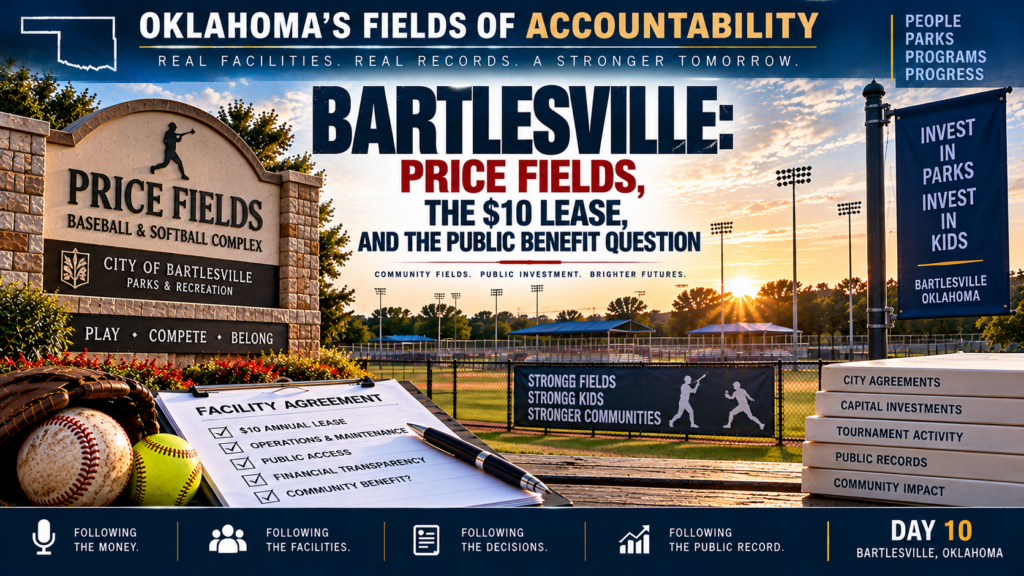
Oklahoma’s Fields of Accountability — Day 10
Bartlesville: Price Fields, the $10 Lease, and the Public Benefit Question
Published for research review: October 16, 2026
Municipality: Bartlesville, Washington County, Oklahoma
Primary facility: Price Fields Baseball & Softball Complex, Tuxedo Boulevard at Young Avenue
Public asset owner / governing jurisdiction: City of Bartlesville; City Council
Current published operator: Arrowhead LLC (the publicly posted lease draft names Arrowhead Sports Group, LLC)
Public-decision study period: 2009–2026, with key agreements and management transitions in 2022–2025
Hidden Valley/USSSA research window: 2001–2026, 14 represented seasons, not continuous annual operations
Central question: When taxpayers finance and own youth sports facilities, while an outside organization operates leagues and tournaments, what records demonstrate affordable access, organizational stability, responsible maintenance, financial transparency, and durable community benefit?
Executive findings
The City's Parks and Recreation listing describes Price Fields as a City-owned complex and identifies Arrowhead LLC as the organization overseeing programming and maintenance. The City lists four lighted 200-foot softball fields, four lighted 200-foot baseball fields, five lighted 300-foot baseball fields and one 350-foot field, along with batting cages, concessions, restrooms and a playground. The posted count describes fourteen fields across the facility, but it does not establish available tournament capacity on any particular date. S1
The public record documents more than a single contract. It tells a sequence: the City and Richard Kane YMCA shared operational roles in 2022; the Council selected 4F Sports in early 2023; that operator's agreement expired in December 2024; and the Council approved an agreement with Arrowhead at its February 21, 2025 special meeting. These are documented transitions, not evidence that a particular organization acted improperly. S2 S3 S4 S6
The February 21, 2025 Council vote passed 5–0. Vice Mayor Trevor Dorsey moved for approval; Councilmember Larry East seconded; Councilmembers Tim Sherrick and Aaron Kirkpatrick, Vice Mayor Dorsey, Councilmember East, and Mayor James S. Curd Jr. voted in favor. City Manager Mike Bailey presented the item administratively. An ad hoc committee evaluated five RFQ responses and recommended Arrowhead; that recommendation was not the Council vote. S5 S6
The version of the agreement posted in the advance agenda packet describes $10 annual base rent, a nominal-rent arrangement paired with substantial operator obligations and City support. The City confirmed a three-year, declining schedule of actual electricity reimbursements capped at $20,000 in 2025, $15,000 in 2026 and $10,000 in 2027. The maximum mathematical sum is $45,000, but actual payments and approved invoices have not been verified; caps are not expenditures. S5 S7
In 2022, the City reported $8.8 million in voter-approved capital improvements accumulated over several phases. Voters then approved the February 10, 2026 City propositions; the City’s project list includes a $1.2 million proposed artificial-turf project for four Price Fields baseball fields. The latter amount is an authorized project description, not evidence of $1.2 million already spent or turf already installed. The earlier $3.6 million Phase 3 allocation is part of the reported $8.8 million historical total, not an additional expense to add again. S2 S8 S9
The jurisdictional line: one city-owned asset, different kinds of decisions
Price Fields is a City of Bartlesville public facility; the relevant elected governing body is the Bartlesville City Council. The 2026 bond proposition was approved by voters. Staff members execute administrative steps, and outside user groups conduct programming under applicable arrangements. The 2025 RFQ committee recommended a vendor; the Council, as a collective body, approved an agreement. None of these decisions can be reduced to personal responsibility for all later program outcomes.
This is a distinct jurisdiction from Tulsa, the inaugural installment of the statewide series. As with the Tulsa case, facility ownership, operating control, money flows, and the governing authority must not be conflated. S1 S5 S6
A chronology of decisions and documentary evidence
| Date / period | Record-supported decision or event | Decision-maker / evidence level | What remains to verify |
|---|---|---|---|
| 2009–2022 | Multi-phase Price Fields improvements were recommended and financed through voter-approved bond programs; City reported $8.8 million approved by October 2022. | Voter authorizations and City staff description; S2 | Bond issuance, project-level contracts, encumbrances, actual paid invoices and final asset ledger. |
| Oct. 25, 2022 | City announced an RFQ seeking comprehensive third-party operating responsibility, citing coordination of field decisions and maintenance. Prior model involved the Richard Kane YMCA and City maintenance. | Administrative procurement initiative, not a documented individual Council vote in this release; S2 | Prior signed YMCA/user agreements, costs, service metrics and Council action records. |
| Jan. 3–4, 2023 | Council approved an operating arrangement with 4F Sports after an evaluation process. | Collective Council approval documented by City's announcement; S3 | Signed agreement, extensions/amendments and historical financial reports. |
| Dec. 31, 2024 | City's reported 4F Sports management contract expiration; City initiated new RFQ process for 2025. | Contract term / administrative action, not proof of cause-based termination; S4 | Original expiration terms and transition letters, fee/refund and equipment reconciliation. |
| Feb. 2025 | Five RFQ submissions considered; committee including Mayor Curd, Councilmember Kirkpatrick and staff recommended Arrowhead. | Committee recommendation, not final governing-body vote; S5 | All five submissions, scoring sheets, conflict-of-interest disclosures if any, final evaluation memorandum. |
| Feb. 21, 2025 | Council approved Arrowhead agreement 5–0. The minutes say a revised instrument was distributed after review. | Individual motion/second and collective recorded vote; S6 | Signed final lease with changes, appendices, and approved amendments. |
| Feb. 10, 2026 | Voters passed five city propositions, including a G.O. bond program listing Price Fields turf. | Citywide electoral decision; S8 S9 | Bond issuance schedule, appropriation, bid award, actual contract payments and project completion. |
What the 2025 posted agreement says—and what it does not establish
The February 21, 2025 publicly accessible Council packet includes a detailed document titled Athletic Facility Agreement and Land Lease. It names both Price Fields and Arutunoff Fields as premises. It is a draft/packet copy: the signature/date areas were not completed and the minutes expressly reference a revised version distributed at the meeting. The current City facility directory confirms an Arrowhead management relationship; it does not by itself authenticate the exact wording of every posted draft clause. S1 S5 S6
| Posted-draft feature | Provision / stated position | Accountability question |
|---|---|---|
| Term | Draft commencement Jan. 1, 2025; initial expiry Dec. 31, 2027; year-to-year continuation language. | Do signed commencement, renewals and termination provisions match? |
| Base rent | $10 per year, not a market-value facility appraisal. | What non-cash services, improvements, and access commitments form the whole public bargain? |
| Operating control | Exclusive athletic-facility use for the operator, subject to contract and applicable rules. | Which community leagues and independent user groups can obtain fields, and by what published criteria? |
| Operating costs | Tenant ordinarily bears field operations; City retains specified upkeep, utilities and temporary support. | What was spent by each party, in each contract year, and on which line items? |
| Capital improvements | Operator improvements are contemplated in lieu of market rent; posted City summary says operator capital requirements were waived for the first two years. | Which improvements were due in 2025, 2026 and 2027, and what written approvals document them? |
| Annual review | Posted draft calls for a comprehensive annual financial-operating review by October 31, for public notice/transparency and reconsideration of cost allocation. | Is the 2025 completed review available, and what documentation should accompany the upcoming 2026 review? |
| Subleasing / scheduling | Posted draft allows subleasing field use for reasonable athletic purposes, but detailed rate and access schedules have not been verified. | Who pays what, who receives tournament/concession/gate revenue, and how is local access protected? |
| Insurance | Posted draft includes liability and risk-allocation requirements. | Can City verify current certificates and vendor compliance without disclosing unnecessary private information? |
Critical nuance: nominal rent is not inherently a giveaway or a failure of oversight. Under a service-based arrangement, a nonprofit or private operator can deliver value through programming, maintenance, capital improvements and public access. Conversely, low rent alone does not demonstrate that these benefits occurred. The right evidence is the executed lease plus operating and financial records. S5 S6 S7
Price Fields in the Hidden Valley/USSSA research archive
The following are research-dataset calculations for the exact facility label “Price Baseball-Softball Fields.” They come from the September 20, 2026 Hidden Valley facility inventory. The exact-label approach avoids inflating site totals with other Bartlesville names or multi-venue events.
| Historical activity indicator | Value | What this figure means—and does not mean |
|---|---|---|
| Research period | 2001–2026 | First and latest season represented; not 26 consecutive active seasons. |
| Distinct years represented | 14 | Seasons appearing under this exact facility label. |
| Event identifiers | 42 | Events counted according to the workbook’s de-suffixed tournament-ID method. |
| Division-level rows | 76 | Rows, not 76 verified unique age divisions. |
| Named directors / organizations | 12 | Dataset associations, not verified signatories to City contracts. |
| Team entries | 368 | Cumulative registrations/entries across event rows, not 368 different clubs or 368 local-resident teams. |
| Calculated tournament team-entry fees | $59,007 | Research model; not bank receipts, operator income, taxpayer money, or City revenue. |
| Minimum games, as exported | 952 | Dataset-derived aggregate containing a flagged invalid negative row. |
| Modeled officiating assignments, as exported | 1,793 | Calculated staffing positions; not distinct paid individuals or confirmed payroll. |
| Minimum games after excluding one invalid 2017 record | 953 | Sensitivity adjustment only, pending source-row verification. |
| Modeled officiating assignments after excluding one invalid 2017 record | 1,795 | Sensitivity adjustment only; no proof the original model is otherwise complete. |
Important data-quality disclosure: The inventory contains a 2017 row showing one event, zero teams, zero fees, −1 minimum games and −2 modeled officiating assignments. These negative game/official values are not operationally possible. Rather than quietly suppressing them, we report the published totals 952 / 1,793 and the simple exclusion test 953 / 1,795. This is a research-methodology anomaly, not an allegation regarding the City, Arrowhead, 4F Sports, prior operators, or any tournament director. The original source row and formula should be audited before the figures are used in a sworn or official financial submission. R1
Selected recent exact-label rows: 2024: 8 events, 78 team entries, $25,593 modeled entry fees, 298 modeled minimum games, 569 officiating assignments; 2025: 1 event, 13 team entries, $3,887, 37 games, 74 assignments; 2026: 2 events, 33 team entries, $7,525, 78 games, 156 assignments. These figures are not operator revenue reports and should not be interpreted as full annual programming or an operator-performance comparison. The dataset does not supply a verified age-division taxonomy or audit-level split by City field. R1
Facility-alias and multi-venue controls
The inventory also identifies “Bartlesville Youth Baseball” (2004–2012: 22 events, 276 team entries, $43,943 calculated entry fees) and the distinct misspelled label “Bartlesvillle Youth Baseball” (2016: four events, 22 team entries, $13,860 calculated entry fees). Both share an address near Price Fields in the dataset, which is a location clue, not enough evidence to merge them into the $59,007 Price Fields count. Other entries combine Price Fields with stadiums or venues in several municipalities. Those multi-facility numbers are deliberately excluded from the exact-label Price Fields totals because the whole event cannot be allocated to one park without field-level scheduling records. R1
These controls matter. A state dataset can help formulate questions, but a municipality-specific financial claim needs event lists, actual site assignments, contracted operators, settlement statements, and payment documentation. No row in this research summary demonstrates that the City collected the modeled entry fees.
Public investment: distinguish authorization, budget and payment
As of October 2022, the City reported $8.8 million in voter-approved historical Price Fields improvements across multiple phases. Its reporting placed approximately $3.6 million of Phase 3 within that cumulative amount. The City's May 2022 audit news release separately discussed spending on Phase 3; the underlying audit schedules, invoices, and capital-asset accounting should be reconciled before stating a final paid-to-date figure. S2 S12
In February 2026, voters approved a new citywide bond proposition. The City's published project list identifies $1.2 million for installing artificial turf on four baseball fields, with expected benefits of playing through rain and attracting additional tournament activity and related local spending. A project amount and an election result are not a paid invoice, procurement award, or completion certificate. The City has indicated projects can be scheduled in stages rather than immediately funded. S8 S9
| Money stream | Current evidentiary status | Public-benefit test |
|---|---|---|
| Historical public capital improvements | City-reported $8.8 million voter-approved by 2022, not reconciled final expenditure. | Condition, useful life, inclusive access, maintenance and measurable youth participation. |
| Proposed 2026 turf project | $1.2 million identified in voter-approved bond project materials; implementation status unverified. | Rainout recovery, local field hours, disability access, costs and incremental local benefit. |
| Draft 2025–27 rent | $10/year proposed contractual base; final executed wording pending. | True in-kind obligations, delivered services, fair access and community affordability. |
| 2025–27 electricity support | $20k / $15k / $10k annual ceilings, a $45k total maximum, subject to actual eligible bills. | Actual reimbursements, contract compliance and expected step-down. |
| Event fees / gate / concessions | Not independently documented by City, operator bank records or settlement statements here. | Published participant rates, event terms, revenue allocation and reinvestment. |
| Model entry fees | $59,007 calculated from exact-label dataset over 2001–2026. | Not a financial receipt; use as a lead for date-specific reconciliation only. |
How Public Decisions Shape a Healthy Community-Based Program
Affordability. A City-owned field can reduce the overhead that would otherwise be passed to families—but that effect requires evidence. Compare local-league registration prices, need-based scholarships, volunteer offsets, umpire charges, gate policies and equipment costs against actual public support. A $10 ground lease alone is not a family price guarantee. The Council can request an accessible annual fee schedule without dictating every coaching decision.
Local league stability. City communications documented families' concerns in January 2025 during the operator transition. Preserving consistent spring registration, honoring season commitments, communicating rainout policies and retaining institutional knowledge are measurable goals. Arrowhead's representatives told the Council they planned recreational and competitive programming and to employ some previous program personnel; this is a documented proposal and statement, not independent proof of subsequent delivery. S4 S6
Volunteers. A well-run facility can protect volunteer coaches, scorekeepers, field crews and boards from unclear duties. Publication of field-preparation rules, insurance responsibilities, reimbursement practices and accessible complaint channels can strengthen recruitment and reduce burnout. We have not verified the number or demographics of Price Fields volunteers.
Equitable access. Exclusive management rights and field subleasing can coexist with community benefit if field-priority rules, disability accommodations, reasonable fees, public registration and dispute resolution are clearly defined. We have not yet obtained a signed 2025–26 facility-use schedule or independent public-access measurement. The key question is whether local recreational children receive reasonable access alongside travel tournaments. S5
Transparency. The advance draft's October 31 annual-review mechanism is unusually consequential. An annual report could compare operator income and costs, municipal subsidies, tournament days, local-league registrations, pricing, capital improvements and complaints. The 2025 review has not been located in this research, which is not proof that it was never conducted. The 2026 deadline, October 31, 2026, has not yet occurred as of publication. S5
Reinvestment. If City land is rented at a nominal rate partly in exchange for services and improvements, the public record should identify which improvements are operator-funded, taxpayer-funded or donated, and when each is delivered. Account separately for ordinary maintenance, new construction and operational subsidies. Do not add the 2018 Phase 3 allocation to the City's 2022 cumulative $8.8 million again. S2 S5 S7
Competition. Tournaments can bring visiting teams and revenue to nearby businesses, yet may compete with local recreational leagues for field time. Neither tournament expansion nor low field rents alone determines success. A balanced public policy measures event mix, resident eligibility, field hours, fee equity and scheduling transparency. The City's 2026 turf rationale expressly mentions more frequent and larger tournaments; outcomes remain to be measured. S9
Player development. Consistent field conditions, practice slots, age-appropriate rules, qualified officials, coaching support and accessible recreational competition matter as much as tournament volume. The Hidden Valley dataset's 368 team entries cannot show how many individual Bartlesville children gained development opportunities. R1
Long-term sustainability. Sustainability combines reserve funding for turf replacement, lighting, restrooms, drainage and equipment; reliable operator staffing; a fair transition plan; and transparent annual municipal review. The City's staged electricity support suggests an intended glide path toward greater operator responsibility, but whether it was implemented can only be tested with invoices, annual assessments and final lease terms. S5 S7
Decision-level distinction: Council approval of a lease is a collective policy decision; a Councilmember's motion or vote is an individual recorded action; preparation of an RFQ, selecting staff and processing utility bills are administrative actions; a voter-approved bond is a public electoral authorization; dependence on volunteers, aging infrastructure and revenue seasonality are structural conditions. None automatically establishes a legal violation or an individual's failure.
Evidence classification and provisional conclusions
Documented facts: City owns Price Fields; municipal notices trace operational transitions; Council approved an Arrowhead agreement 5–0 on February 21, 2025; a posted draft describes $10 base rent and annual review; City announced capped electricity support; City identified voter-approved capital programs. S1 S2 S3 S4 S5 S6 S7 S8 S9
Research calculations: The September 20, 2026 exact-label Hidden Valley inventory reports 368 team entries, 76 division-level rows, $59,007 modeled team-entry fees, 952 dataset minimum games, and 1,793 modeled official assignments, subject to the explicit 2017 negative-row anomaly. R1
Reported statements or policy expectations: The City expects turf to improve rain resilience and tourist activity; Arrowhead representatives expressed an intention to offer both recreational and competitive programs. Those are documented rationales and commitments, not independently verified measured outcomes. S6 S9
Allegations: No allegation of fraud, corruption, unauthorized personal enrichment or misconduct is made here. The public-source record reviewed for this episode is insufficient to support one.
Evidence gaps: Signed final Arrowhead lease and all exhibits, completed annual reviews, relevant event and concessions agreements, comprehensive cost allocation, public access/scholarship policy, operator revenue reports, procurement scoring records, and paid-to-date capital project schedules have not been assembled for this article.
Provisional conclusion: Bartlesville has established a publicly documented governance model with a real Council vote, detailed proposed contract controls, and meaningful capital commitments. The strongest next investigative step is not speculation; it is a document-to-document test of whether the final executed contract, annual reviews, financial statements, field calendars and bond spending reflect the stated public priorities.
Records Still Needed
- Executed February 21, 2025 Arrowhead LLC agreement, including revised meeting-day version, signature pages, exhibits, Council-approved edits, extensions and amendments. Compare each substantive paragraph with the public packet version.
- 2025 comprehensive annual financial/operational review and supporting submissions under any final counterpart of the draft October 31 clause; subsequent 2026 review when completed, including public notice and cost-allocation changes.
- 2022–2024 signed YMCA/4F Sports contracts, revisions, early termination/expiration notices, fees, renewal decisions, equipment inventories and final settlements. Do not assume an allegation concerning the old operator is proven by an administrative press release.
- 2025 RFQ file: complete solicitation, five responsive submissions, scoring matrix, committee recommendations, evaluation criteria, any legally responsive ethics disclosures, legal review and revised final vote packet.
- 2025–2026 City support ledgers: invoices and reimbursements for electricity (against $20,000 and $15,000 yearly ceilings), water/sewer/trash in-kind value, mowing, spraying, fertilizer, restrooms, irrigation, safety-net repairs, drainage and equipment.
- Operator field calendars / facility-use agreements for 2023–2026: schedules, rental/sublease rates, local league priority, external tournament booking, gate/concession sharing, refundable deposits and season cancellation procedures.
- Affordability and access measures: posted registration fees, scholarships and hardship assistance, number of resident recreational players, practice access, volunteer rosters in aggregate (avoid personal identifying data), disability accommodations and grievance channels.
- Bond and construction accounting: historical $8.8 million project funding trace, Phase 3 costs, City audited schedules, 2026 bond issuance/phasing, $1.2 million turf engineering, bids, purchase orders, change orders, final paid invoices and acceptance records.
- Source-data verification: original 2017 division row creating −1 game/−2 official values, event IDs, 76 row-level division labels, tournament-site allocations, 2024–2026 field assignment logs, and address/alias reconciliation before aggregating neighboring stadium or Bartlesville Youth Baseball labels.
- Periodic public reporting: governing body's adopted criteria for public benefit, actual annual report or a written explanation if available records use a different reporting mechanism.
Record-request posture: The research priorities above informed the formal October 16, 2026 Open Records Act submission. The separate tracking section below documents what was actually sent and will record subsequent City communications. The City's public meeting archive S10 remains available for independent verification.
Formal Oklahoma Open Records Act Request — Submission and Public Tracking
Research process update — October 16, 2026: A formal Oklahoma Open Records Act request has now been submitted to the City of Bartlesville. This section separately documents the request, the scope of records sought, and future City communications. It will be updated as records or responses are received.
What was requested
The completed City request form and its two-page Attachment A seek existing City-held documents concerning Price Fields and related municipal baseball/softball facilities. The ten categories cover: (1) ownership, leases and operating agreements; (2) Council authorization and governance; (3) public capital and operating expenditures; (4) rents, fees and financial rights; (5) field scheduling, tournaments and public access; (6) maintenance, safety and liability; (7) public benefits and performance; (8) procurement and contract compliance; (9) targeted search terms and likely City custodians; and (10) electronic production, fees and clarification procedures.
Specific verification priorities: the final executed 2025 Arrowhead agreement and any revisions to the public packet draft; the reported $10 annual rent provision; prior operator agreements; electricity reimbursement invoices; annual operating reviews; City expenditure records; field-use schedules; and records supporting public-benefit assessments. The request does not presume wrongdoing or treat draft lease terms as executed contractual obligations.
Submission record and correspondence timeline
- October 16, 2026 — Request prepared. The completed municipal form was paired with Attachment A, identifying the requested records and 2001–2026 period.
- October 16, 2026, 8:14 a.m. — Request emailed. The sent email is addressed to clpullins@cityofbartlesville.org, with the combined request PDF attached. The email asks for written acknowledgment, any tracking number, and confirmation of the appropriate custodian.
- City response — Awaiting documentation. No acknowledgment, tracking number, fee estimate, records production, or determination appears in the materials reviewed for this update. A sent email documents submission, not confirmed receipt or acceptance by the City.
Documents and public access
Submitted document: Bartlesville Records Request Form and Attachment A 2026-10-16.pdf (three pages). Submission evidence: sent email dated October 16, 2026, at 8:14 a.m. These documents are retained in the research archive. Public PDF links: to be added after the files are uploaded to a publicly accessible location; no public document URL is asserted at this time.
Fee and production terms: Electronic production was requested where available. The submission asks for an itemized estimate and written approval before charges exceed $25; this is a requester authorization threshold, not a claim that the City has accepted a $25 fee cap. Clarification or phased production was expressly welcomed.
Next updates to this record
Future entries will identify the date and source of each City acknowledgment, request number, clarification, estimate, payment authorization, partial release, denial, or final production. Any substantive findings will be linked to the actual released documents and evaluated separately from the research questions above.
Transparency standard: The October 16 email and attachment establish what was requested and sent. They do not establish that the City has responded, that a particular record exists, or that any disputed arrangement was unlawful. This chronology will distinguish documented correspondence from interpretation.
Right of Response
This research welcomes documented corrections or records from the City of Bartlesville City Clerk/City Manager's Office, Arrowhead LLC / Arrowhead Sports Group, former operations representatives of 4F Sports, the Richard Kane YMCA, local baseball and softball organizations, volunteers, parents and coaches. Relevant replies can address the exact signed lease, registration fees, local field access, participant scholarships, operating costs, site-specific event records and whether annual reviews were completed. Statements will be clearly attributed and verified before incorporated into the historical record. No response is assumed merely because no direct outreach is established in this episode.
Source register and methodology
The following official City materials are primary municipal evidence. R1 is a separately held research inventory, not a City accounting document. In the article above, brackets such as S5 point to the documents below.
[S1] City of Bartlesville — Price Fields Baseball & Softball Complex (ownership, amenities and operator). Open source
[S2] City of Bartlesville — October 25, 2022 management review and historical $8.8 million voter-approved capital program. Open source
[S3] City of Bartlesville — January 4, 2023, Council approval of 4F Sports management arrangement. Open source
[S4] City of Bartlesville — January 23, 2025 spring season and management transition update. Open source
[S5] City Council special meeting packet, February 21, 2025: staff memorandum and publicly posted DRAFT athletic facility agreement. Open source
[S6] City Council February 21, 2025 minutes as reproduced in March 3, 2025 packet (PDF pp. 14–15). Open source
[S7] City of Bartlesville — February 21, 2025 approval announcement and transitional cost-sharing overview. Open source
[S8] City of Bartlesville — February 10, 2026 election result and bond program description. Open source
[S9] City of Bartlesville — proposed $1.2 million Price Fields turf project and policy rationale. Open source
[S10] City of Bartlesville — City Council agendas and public meeting packets archive. Open source
[S11] City of Bartlesville — financial document archives. Open source
[S12] City of Bartlesville — May 2022 audit news release discussing Phase 3 capital work. Open source
[S13] Baseball Heaven — statewide USSSA financial operations research and methodology (research context, not municipal accounting). Open source
[R1] Internal research baseline: Hidden Valley/USSSA — HVIOG_9-20-2026_Sports_Facilities_Inventory.xlsx, sheets “Facility Master Inventory”, “Facility by Year”, and “Methodology & Notes”; source dataset identified in workbook as “AIUSSSA - HVIOG 9-20-2026.csv” (research archive, September 20, 2026).
Editorial principle: Separate public assets from private program revenue; distinguish an authorization from a paid expenditure; separate a draft from the signed instrument; and treat missing records as questions requiring follow-up, never automatic proof of wrongdoing.
Following the money. Following the facilities. Following the decisions. Following the public record.