
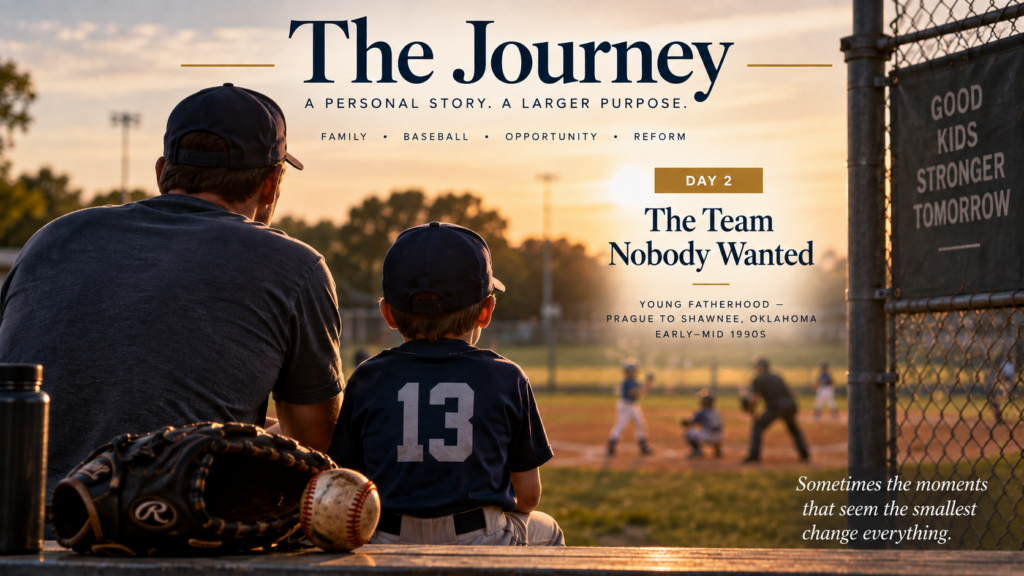
The Journey · Day 2
The Team Nobody Wanted
Journey Marker: Young Fatherhood — Prague to Shawnee, Oklahoma | Early–Mid 1990s
There are moments in life that seem ordinary when they happen. You make a decision. You agree to help. You show up because somebody needs you. Years later, you look back and realize that one seemingly small decision changed the direction of your life.
For me, one of those moments began with my sons and a youth baseball team that didn't have a coach.
I wasn't looking to become a baseball coach.
I was trying to be a dad.
Watching My Boys Discover the Game
Brian was our oldest son.
When we lived in Prague, Oklahoma, he played T-ball. I remember his team going two seasons without winning a game.
And Brian was fine.
That memory still makes me smile because a few years later, after we moved to the Shawnee area, I began seeing an entirely different side of him.
Brian was seven years old and playing machine pitch on an eight-and-under team. They won their first seven games.
Then they lost.
Brian was catching, and I remember him crying afterward because he wanted to win so badly.
That was probably one of the first times I really recognized how competitive he was becoming.
His younger brother Brad was coming along behind him.
Brad was four years younger than Brian and started T-ball young. From my perspective as his father, I believed he was developing faster than the level where he was playing.
I wanted him challenged.
I believed then—and still believe today—that development requires some struggle. When everything comes easily, you don't always learn how to respond when it doesn't.
But being a young father also meant I made decisions I can evaluate differently today.
I wanted Brad to play in an older age division. My recollection is that I listed him as older on the application after understanding that was what I would have to do to get him into that division. League officials and coaches knew he was younger.
Later, it became an issue.
I remember being called into a meeting and being strongly criticized for what I had done.
I'm including that because The Journey isn't supposed to be a story where I rewrite my own history to make myself right every time.
I was a young parent trying to create what I believed was an opportunity for my son.
Today, after decades around youth sports, I understand much more clearly why rules, communication, consistency and transparency matter.
That's hindsight.
At the time, I was simply trying to navigate youth baseball as a parent.
I Didn't Want to Coach
Something else was happening in my life.
I had recently become a Department of Defense firefighter.
I was working 24-hour shifts, going through training, attending EMT school and thinking about where emergency medicine might eventually take me.
I specifically avoided coaching.
My thinking was pretty simple: if I was going to demand commitment from kids, I needed to be able to give them that same commitment in return.
At that point in my life, I wasn't sure I could.
So I was perfectly content being Dad.
Then the next baseball season arrived.
Brad was registered.
Teams were already practicing.
But nobody had called us.
The preseason tournament was getting closer, so I finally drove out to the Lions Club Ballfields to find out what was going on.
I learned Brad had been drafted onto a team.
There was just one problem.
The team didn't have a coach.
Then came the question that would change far more than I could possibly have understood at the time:
Would I coach them?
The Shawnee Braves
I remember thinking about the irony.
Not long before, I had been told I shouldn't be involved.
Now they needed somebody.
So I said yes.
That team became the Shawnee Braves.
We had one practice before the preseason tournament.
And we got hammered.
I'm talking about twenty-to-nothing type games.
We weren't very good.
But we practiced.
The kids started learning.
They began understanding the game.
Most importantly, they started becoming a team instead of simply a group of kids wearing the same uniform.
By the end of the season, something had changed.
The teams that had been running us off the field weren't doing that anymore.
I remember an opposing coach eventually looking over at me and telling me I had done a really good job with those kids.
I've never forgotten that.
Not because it meant I had suddenly become some great baseball coach.
It meant the kids had improved.
And somewhere along the way, without planning it, I had become their coach.
Looking Back
Today, I can see that season as one of the quiet turning points in my life.
At the time, there was no Oklahoma Braves organization.
There was no Brian Crawford Memorial.
There were no memorial tournaments.
There was no sports complex.
There was no Hidden Valley research.
There was no Integrity of the Game.
And there certainly wasn't a youth-sports reform effort.
There was a father.
There was a son who wanted to play baseball.
And there was a team of kids who needed somebody willing to show up.
What started as helping Brad became helping all of them.
That distinction matters to me today.
Because when I eventually began studying youth sports as a system—its economics, facilities, governance, rules and accountability—I was studying something I had first experienced from almost every other direction.
I had been the kid who needed somebody to get him to the field.
Then I became the parent trying to create opportunities for my own children.
And now I was becoming the coach responsible for somebody else's kids.
I didn't know where any of it was leading.
Sometimes you don't recognize the beginning of a journey while you're standing in it.
You recognize it years later when you turn around and see how far one decision carried you.
For me, one of those decisions was simply saying:
Yes. I'll coach them.
“Before there was a mission, a memorial or a research project, there was simply a team nobody wanted—and somebody had to coach them.”
Question for the Reader
When does helping your own child become something larger—a responsibility to help other kids who may simply need someone willing to show up?
There may not be one right answer.
But I think it's a question worth asking.
Next on The Journey
The Shawnee Braves had survived their first season.
But something was beginning to happen.
The kids were improving. I was learning. Parents were becoming part of the experience, and competition was beginning to shape my ideas about coaching, development and opportunity.
Next, we'll follow how that little team began evolving—and how the Shawnee Braves eventually became the Oklahoma Braves.