
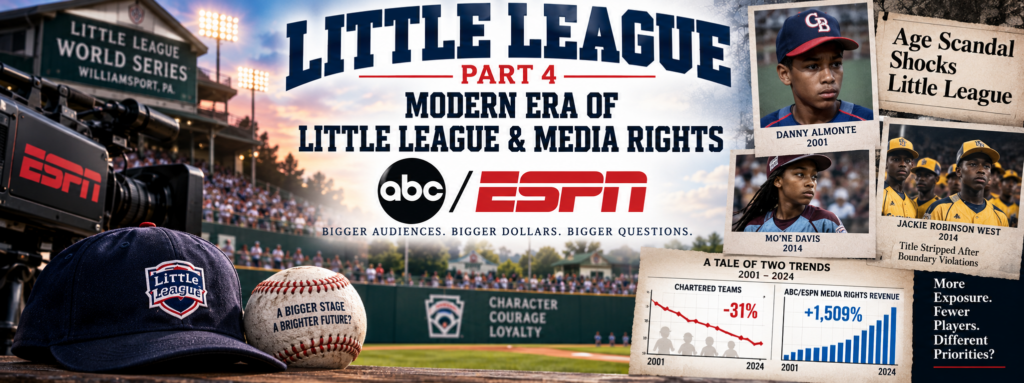
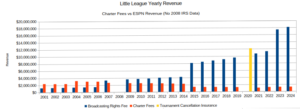
In June of 2000, Little League signed a groundbreaking 6 year Media Rights extension to their already historic contract with ABC/ESPN. Little League would begin receiving increasing amounts of revenue year over year from ABC/ESPN beginning with $1.2 Million dollars in 2001. This allowed Little League to augment the Williamsport infrastructure with an additional stadium, Volunteer Stadium, and adding housing to accommodate 16 teams instead of the 8 teams that the infrastructure was built for.
As of 2001, Little League’s main sources of revenue were Charter Fees (fees assessed to each league for each regular season team at $13 per team) and the ABC/ESPN Media Rights contract. According to IRS filings in 2001, Little League generated $1.2 Million dollars in revenue from the new Media Rights contract and $2.4 Million dollars in revenue from Charter Fees meaning that Little League’s own leagues were supporting the financial needs of little league twice as much as ABC/ESPN was.
With increased revenue, came increased exposure on ABC/ESPN with Danny Almonte being broadcast playing for a team from the Bronx, NY, dominating the competition. It was later found that Danny Almonte was 14 years old, not 12 years old, the maximum age to compete in the Majors division of Little League making for the biggest Little League scandal to date. Little League would change many policies and procedures to prevent this from happening in the future, however not until after Danny’s age was uncovered by a private investigator and local officials in the Dominican Republic.
Despite the 2001 scandal, ABC/ESPN continued to extend 8 year Media Rights contract extensions with little league in 2006, 2014 and 2022 making the contract the 2nd longest running Media Rights contract for any sport. Second only to the CBS contract to broadcast The Masters golf event. The major difference between the two contracts is that CBS does not have to pay to broadcast The Masters, whereas ABC/ESPN have paid exponentially increasing fees to Little League over the course of the contract.
In order to increase revenue, Little League increased Charter Fees from $13/team to $18/team in 2004. However, with the increase in revenue from the subsequent ABC/ESPN Media Rights extensions, Little League reduced Charter Fees to $16/team in 2007 and then again to $10/team in 2015 where it remains today.
In yet another Media Rights contract extension year, 2014, Little League and ABC/ESPN experienced a massive increase in media coverage that included a story about Mo’ne Davis from Taney Youth Baseball as the first dominating female pitcher in the Little League World Series, and Jackie Robinson West, a feel good story about a team of players escaping Chicago’s south side violence for the lights and cameras of the Little League World Series on ESPN.
Jackie Robinson West would eventually be disqualified on February 11th, 2015, six months after the Little League World Series for intentionally falsifying their boundary map to make it look like all of the players on the team lived within the boundaries. Prominent politicians and lawyers would get involved to try to restore the stripped championship from Jackie Robinson West, however the lawsuits would be settled out of court in 2021 and the story would eventually disappear.
What is clear is that Little League participation at the regular season level, where Little League generates it’s Charter Fees from has been in steady decline since 2001, and ABC/ESPN Media Rights revenue has been on an exponential increase in the same time frame.
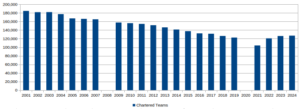
From 2001 to 2024, Little League lost 31% of it’s chartered teams showing a drastic decline in participation at the local level, yet has seen a 1,509% increase in ABC/ESPN Media Rights revenue over the same time period. This includes the $12 Million dollar insurance payout that Little League received in 2020 for “Tournament Cancellation Insurance”. While local leagues folded and suffered from the COVID pandemic in 2020, Little League remained solvent with this insurance policy which no local leagues received benefit from.
So, the question now is, does Little League care anymore about local league operations and health, or does Little League only care about the ABC/ESPN broadcasts that now equate for the majority of Little League’s yearly revenue?
This is part 4 of the story of Little League and their Media Rights contracts with ABC/ESPN/Disney. Stay tuned for further posts regarding how this story of money and media rights continue to plague Little League.