
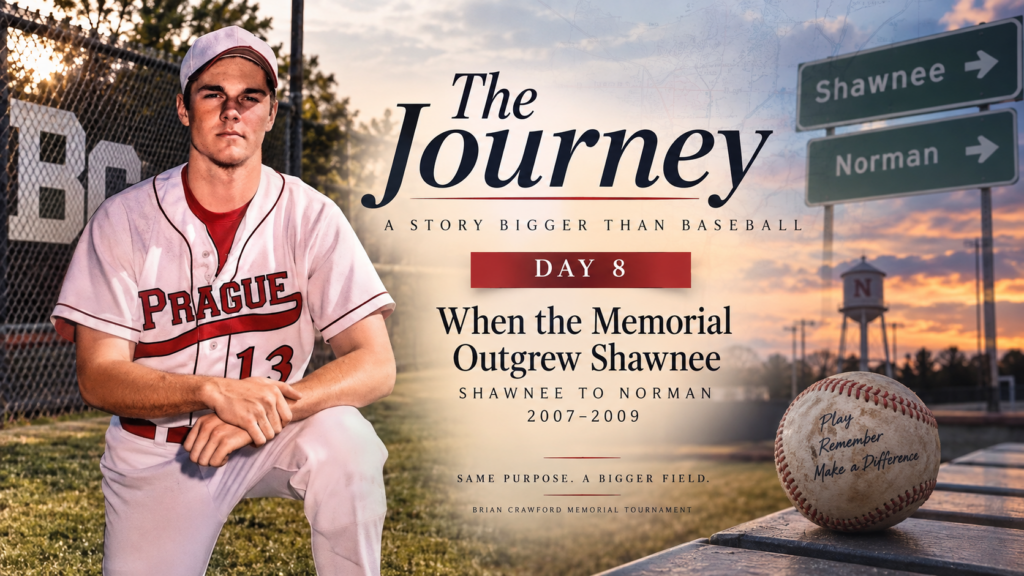
The Journey · Day 8
When the Memorial Outgrew Shawnee
Journey Marker: 2007–2009 | Shawnee to Norman
The first Brian Crawford Memorial Tournament in 2006 proved something to me.
We could keep Brian's name alive through baseball.
So we did it again.
And then we did it again.
For three years, the memorial tournament stayed in Shawnee. After that came one year in Norman, followed later by the years in Chickasha and Choctaw. That sequence is how I remember the tournament growing over time.
In those early years, I wasn't thinking about youth-sports governance.
I wasn't thinking about public-private partnerships.
I wasn't thinking about who controlled revenue streams at a sports complex.
I was trying to raise money and keep Brian's memorial moving forward.
But the tournament was getting bigger.
And bigger tournaments require bigger places.
We Had Outgrown Home
Shawnee had given us a beginning.
The Lions Club Ball Fields were where the memorial tournament learned how to walk. But after three years, we needed more capacity.
So for the fourth annual tournament, we moved to Norman.
I remember it as a significant step.
We were no longer simply putting together a small hometown fundraiser. Families were committing an entire Memorial Day weekend. Teams were traveling. Hotels were being booked. Schedules had to work across several days.
My recollection years later was that we had somewhere around forty to forty-eight teams.
That felt big.
From the Historical Record
Years later, the surviving USSSA portal data gave me something valuable: a numerical record I could compare against my memory.
The 4th Annual Brian Crawford Memorial is recorded as beginning May 22, 2009, at Reaves Park in Norman. The historical dataset identifies 34 teams. The later Hidden Valley reconstruction calculates a minimum of 81 games from the published event structure.
That record is important because my memory years later was that we had somewhere around forty to forty-eight teams. The surviving record shows 34.
I don't think I should rewrite my memory to make the two match.
Both belong in The Journey: what I remembered from living it, and what the surviving record allows me to document years later.
The dataset also shows $0 in recorded team-entry fees for the 2009 event. I do not interpret that as evidence that teams paid nothing. It means the historical USSSA data used in this research does not provide a recorded entry-fee amount for that event.
And that is where I learned another lesson.
A Week Before the Tournament
I had been helping the group operating the Norman facility with things I knew how to do—websites, schedules, tournament information and posting scores.
It was one of those arrangements that felt normal in youth baseball.
People helped each other.
You traded knowledge.
You volunteered.
You built relationships.
Then, according to my recollection, about a week before Brian's tournament, the facility charge changed.
I remember expecting approximately $1,500.
I remember being told it would now be $3,000.
The teams were already committed.
Hotels had already been reserved.
Parents had planned their weekend.
What was I supposed to do—call everybody and tell them Brian's memorial tournament was cancelled?
So we moved forward.
My recorded recollection is that the tournament had been planned across the Friday-through-Monday Memorial Day window, but we finished play in three days.
I also remember a later disagreement involving what the facility operator believed it had lost in concession revenue because we did not play the fourth day, including a threat of legal action.
Those statements are my firsthand recollection. I am not presenting them as findings from an independently reviewed contract, financial record or court document.
At the time, I was frustrated.
But I did what I had learned to do.
Keep the tournament moving.
Keep the families playing.
Keep Brian's name on the field.
What I Did Not See Yet
Today, I can look back at Norman and see questions that I did not know how to ask in 2009.
Who actually controlled the facility?
What did the written agreement require?
When could a price change?
Who controlled concessions?
What obligations did the tournament operator have once teams had registered?
What protections did either side have?
Back then, those were not research questions.
They were problems that had to be solved before the first pitch.
That difference matters.
I do not want to rewrite my own history and pretend I understood the entire youth-sports system at the time.
I didn't.
I was learning it one weekend at a time.
Looking Back
Years later, Integrity of the Game would give me language for questions I couldn't articulate in 2009.
Even a modest tournament required fields, schedules, entry fees, officials and records. As events grew, so did the number of relationships and responsibilities involved.
That is hindsight.
The formal research came much later.
In 2009, I simply learned that the success of a tournament could depend on something I did not own:
the fields.
You could recruit the teams.
You could build the website.
You could organize the schedule.
You could bring families into a community.
But if somebody else controlled the facility, that person or organization controlled a very important piece of your future.
I didn't yet know where that lesson was going to lead.
I was about to find out.
“I thought my job was to fill the tournament. I was beginning to learn that who controlled the fields could matter just as much as who brought the teams.”
Question for the Reader
When families and teams have already committed time, travel and money to an event, what responsibilities should exist between the tournament organizer and the organization controlling the facility?
Who carries the risk?
When should the terms be established?
And how much should families be able to rely on those arrangements once they have committed to participate?
For me, those questions came much later.
In 2009, I just needed another place for Brian's tournament.
And then another door opened.
Next on The Journey
After Norman came Chickasha.
And this is where the surviving historical record begins to add another dimension to the story.
The 2010 5th Annual Brian Crawford Memorial is recorded at the Chickasha Sports Complex with 102 teams, $17,747 in listed team-entry fees, and a later calculated minimum of 246 games.
Those numbers don't tell the whole story.
But they tell us something happened.
Chickasha became more than another place to put baseball games. It became a relationship that lasted for years—and a place where I began seeing more clearly what a large youth tournament could mean to a community.
Next on The Journey: Chickasha—when Brian's memorial found a home, and when “economic impact” started becoming more than just a phrase.
The Journey is a continuing first-person series tracing the path from family, baseball and memorial work to research, public accountability and youth sports reform.