
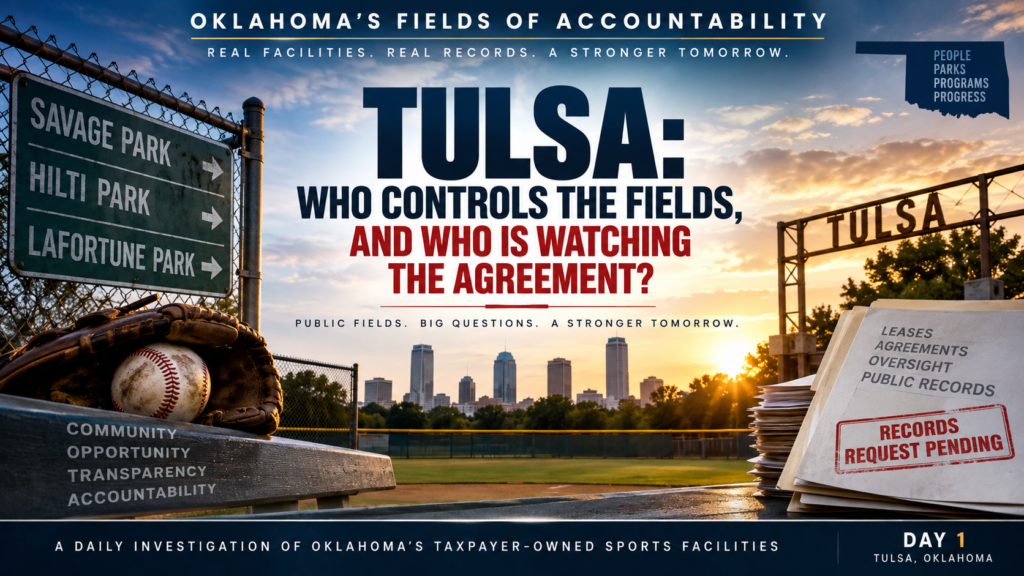
Tulsa: Who Controls the Fields, and Who Is Watching the Agreement?
Public fields. Private management. Tournament economics. Community opportunity. An unresolved records request—and questions taxpayers should be able to answer from the public record.
Tulsa provides an important opening case study because the central issue is not whether youth baseball or softball is valuable. The question is how government documents, measures and oversees relationships when private youth-sports organizations manage taxpayer-supported recreational property.
Two City of Tulsa facilities sit at the center of today's analysis: Hilti Park and Savage Park. Tulsa Parks currently identifies Tulsa Little League as the manager/contact for these user-group-managed complexes.
The 2021 Policy Change
In November 2021, Tulsa Parks announced management changes affecting Hilti, Savage, Patrick and Bales sports complexes. Contemporary reporting attributed the restructuring to Tulsa Parks and Parks Director Anna America and described two major public objectives: expanding organized-sports opportunities for young people and reducing costs to taxpayers.
At Savage Park, America described annual City utility and maintenance costs of roughly $40,000 to $50,000 while the City was receiving roughly $1,500 per year in rent. She estimated the broader sports-complex management changes could save Tulsa approximately $100,000 annually.
If Tulsa changed management of taxpayer-owned sports complexes to save public money and expand youth opportunity, where is the public report card showing whether those goals were achieved?
Who Made the Decision?
Accountability requires precision. The public sources reviewed attribute the 2021 selection and restructuring to Tulsa Parks. They do not establish that a particular mayor or individual City Council member personally selected Tulsa Little League or cast a recorded vote approving that specific management decision.
The appropriate elected-official oversight questions are therefore: What information did elected officials receive? What financial and performance controls existed? Were promised taxpayer savings measured? Were agreements renewed or amended? Were community-access outcomes reported? What continuing oversight did the City's governing structure exercise?
The Outstanding City Records Request
A City of Tulsa public-records request seeking leases, agreements or related records involving Tulsa National Little League/Tulsa Little League and the City's sports facilities remains unfulfilled as of this installment.
The governing documents should help answer basic questions: What authority did the managing organization receive? What is the term and renewal process? What rent or consideration applies? Who pays utilities, maintenance, insurance and capital costs? Who controls scheduling and rental rates? Can other organizations obtain meaningful access? Who receives concessions, rentals or tournament-related facility revenue? What reports must be provided to the City? How does Tulsa measure whether the arrangement remains beneficial to taxpayers?
Tulsa by the Numbers — Hidden Valley
The Hidden Valley research estimates the scale of historical USSSA activity associated with taxpayer-supported facilities. Here, the conservative approach uses direct stand-alone facility records rather than assigning all multi-facility activity to one location.
Savage Park — City of Tulsa
10,877 team entries
34,305 minimum games
65,815 minimum umpire assignments
Hilti Park — City of Tulsa
4,187 team entries
8,435 minimum games
15,581 minimum umpire assignments
Economic Impact Is Only Half the Equation
Oklahoma communities often pursue tournaments because traveling teams generate economic activity. That is a legitimate public objective. But economic impact cannot be the only measurement of successful youth-sports policy.
There is another measurement: community impact. Did local participation increase? Did participation remain affordable? Did recreational leagues remain healthy? Did girls receive equitable opportunities? Could multiple organizations obtain fields? Were volunteers supported? Were facilities maintained? Was tournament activity used to strengthen community recreation? Could taxpayers understand how the system worked?
How Public Decisions Shape a Healthy Community-Based Program
Government decisions shape youth sports even when elected officials never coach a team or schedule a tournament. Public policy determines how taxpayer-owned fields are managed, who receives priority access, what private organizations must contribute, what reporting is required, whether competing organizations can obtain dates and whether management arrangements are periodically reviewed.
Those choices can influence affordability, local-league stability, volunteer participation, equitable facility access, transparency, reinvestment, competition, player development and long-term sustainability.
A healthy management arrangement can reduce taxpayer expense while mobilizing volunteers and providing affordable programs. It can allow tournament activity to coexist with recreational baseball and softball. But the public needs enough information to determine whether those benefits are actually occurring.
Tulsa's 2021 policy was publicly described in terms of increased participation and reduced taxpayer expense. The next step is not accusation. It is measurement.
If the City saved money, publish the savings. If participation expanded, publish the participation. If access became more equitable, publish the reservation data. If private organizations invested in the facilities, document those improvements. If tournament activity helped reduce taxpayer subsidy, show taxpayers how.
Savage Park and the Softball Question
Tulsa Girls Softball Federation had used Savage Park for decades before the 2021 management transition. Contemporary reporting documented concerns about continued opportunities for girls when Tulsa Little League became the primary manager. Tulsa Parks responded that facilities would remain shared and that no current user group would have complete control.
That creates measurable questions today: How many Savage dates have gone to softball since the transition? How many to baseball? How many tournaments were hosted? How many outside organizations received access? What rates were charged? Did girls' participation grow, decline or remain stable? Those answers should come from records rather than assumptions.
What a Healthy Community Program Can Look Like
Accountability also requires acknowledging evidence of community benefit. Current Tulsa National program materials describe a volunteer-driven program accepting players across ability levels, using mandatory-play principles and offering youth divisions at comparatively modest published registration prices. The organization also describes free practice-field reservations for participating teams and says league families are not charged separate gate or umpire fees.
The policy question is not whether Tulsa Little League provides a youth service. It does. The question is whether the public-private management arrangement is sufficiently transparent, measurable and accessible to the broader community.
A Separate Government: LaFortune Park
LaFortune Park is Tulsa County property. In March 2015, the Tulsa County Board of County Commissioners entered into a written lease with Tulsa Little League Baseball, Inc. The agreement established a nominal base rent of $10 per year, while separately assigning substantial responsibilities involving operations, utilities, maintenance, insurance, improvements and other obligations. The $10 figure therefore cannot responsibly be presented in isolation as the entire economic value of the agreement.
The 2026 Tulsa County Litigation
In March 2026, Tulsa County filed Board of County Commissioners of the County of Tulsa v. Tulsa Little League Baseball, Inc., CJ-2026-1049. The County made claims concerning obligations under the lease, and Tulsa Little League Baseball disputed the County's position and asserted defenses.
The docket reflects that proceedings were stayed in connection with related litigation rather than resolved on the merits.
Why LaFortune Matters to the City Story
LaFortune is relevant because Tulsa Parks publicly cited Tulsa Little League's experience managing LaFortune when explaining the 2021 City management transition. The later Tulsa County dispute does not retroactively establish that the City made a poor decision in 2021.
It reinforces a governance principle: due diligence should not end when an agreement begins. Public-private management arrangements benefit from periodic compliance reviews, clearly documented responsibilities and transparent measurements of public benefit.
The Elected-Official Accountability Question
The available evidence does not justify assigning the 2021 administrative selection personally to individual Tulsa elected officials merely because they held office at the time.
The stronger institutional questions are: Did elected officials receive periodic reports? Was projected taxpayer savings compared with actual results? Did the City Council or relevant committees review agreements or amendments? Did elected officials receive information about community access, maintenance and capital investment? What mechanisms allowed the governing body to determine whether the arrangement continued serving the public interest?
Records Still Needed
The Tulsa City research remains incomplete without the actual Hilti and Savage agreements; competing 2021 proposals; selection criteria and scoring records; amendments or renewals; utility and maintenance costs before and after the transition; field-rental revenue; reservation histories; tournament-use records; capital investments; insurance documentation; concession arrangements; outside-user pricing; and reports measuring the approximately $100,000 annual taxpayer savings discussed in 2021.
We also need to know what reports, if any, reached the Mayor's Office and City Council after the policy change.
Until those records are obtained, the appropriate conclusion is not that elected officials failed. The appropriate conclusion is that the available public record is not yet sufficient to measure the program against the City's own stated goals.
Right of Response
Tulsa Parks should be invited to produce the governing agreements and explain how it measures taxpayer savings, access and performance. Tulsa Little League should be invited to document maintenance, facility investments, league participation, volunteer contributions, scholarships, field access and other community benefits. Tulsa Girls Softball Federation should be invited to document its post-2021 experience at Savage.
Tulsa County and Tulsa Little League Baseball should be allowed to present their positions through the pending judicial process without this project treating either side's allegations as adjudicated fact. Elected officials should likewise be encouraged to provide oversight records not yet identified.
If credible new evidence changes the record, this research should change with it.
Day 1 Conclusion
The Tulsa story does not begin with a verdict. It begins with a standard.
Taxpayer-owned fields can be managed in partnership with private nonprofit organizations. Those partnerships can reduce government expenses, mobilize volunteers, improve facilities and create excellent programs for children. But public assets require public accountability.
Tulsa said its management transition would save taxpayer money and expand youth opportunity. The records should allow taxpayers to measure both.
That is not an attack on youth sports. It is how healthy public-private partnerships become stronger.
Primary Sources & Research
Review the public materials underlying this Day 1 case study:
City of Tulsa — Youth Sports 2021 Management Announcement Savage Park Transition Tulsa National Little League Oklahoma Diamonds Facilities OSCN — CJ-2026-1049 Oklahoma Open Records ResourcesFollowing the money. Following the facilities. Following the decisions. Following the public record.