
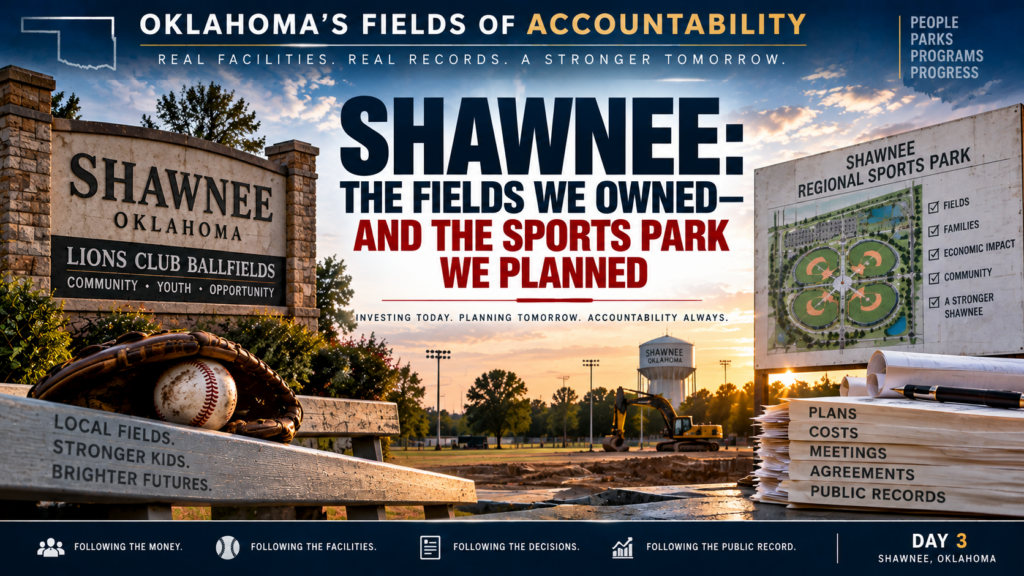
Oklahoma's Fields of Accountability — Day 3
Shawnee: The Fields We Owned—and the Sports Park We Planned
October 9, 2026 · Shawnee, Pottawatomie County, Oklahoma · Municipal facility and governance case study
Shawnee's youth-sports history contains two very different public-policy stories. One concerns Lions Club Ballfields, a real City-owned community baseball and softball facility with documented maintenance, programming and user-group agreements. The other concerns a proposed Regional Sports Park: a decades-long municipal planning effort, an approximately 160-acre land purchase, a professional master plan and a 2011 economic-impact study.
The two projects were not the same property. They should not be described as if one physically replaced the other. They belong in the same policy discussion because elected officials and administrators had to consider existing recreational infrastructure alongside a larger regional sports-tourism ambition.
The central question for Day 3 is: How did Shawnee document responsibility for the fields it already owned, and how did it compare community needs with the economic promises surrounding the new sports park?
Evidence standard: This installment distinguishes City statements, the terms of historical agreements, calculated tournament activity, citizen concerns and matters that still need records. It makes no finding of fraud, unlawful conduct or individual culpability.
An Existing Public Facility: Lions Club Ballfields
The 2013 City–YMCA agreement identifies the City of Shawnee as owner of Lions Club Park and articulates a recreational purpose involving the health, safety and welfare of residents. The City's earlier minutes research traces public investment in Lions Club infrastructure, including a $55,780 West Softball Field lighting award on March 6, 2000.
The facility's history matters because investment decisions were not simply hypothetical. Children were already using public fields, and user groups already depended on the City's operating arrangements.
Source: Lions Club Ballfields facility research. Official 2014 Commission packet containing a City–YMCA agreement.
A Management Change in 2013
The historical record documents a transition from the Shawnee Youth Athletics Association (SYAA) to the Troy and Dollie Smith Family YMCA.
In an August 14, 2013 memorandum to the Mayor and City Commissioners, Director of Operations James Bryce said the City's youth-baseball agreement with SYAA dated to January 2009. The City had issued a letter revoking the prior arrangement. That letter cited six categories of concern: maintenance, backstops, grounds and trash service, limited league-game use, communication, and requested financial information.
These are documented assertions by the City, not independently adjudicated findings. The available research packet does not include SYAA's reply, complete field-use logs, verified financial statements or an independent determination that every allegation was accurate.
Bryce recommended an agreement with the YMCA. The original 2013 agreement began on August 19, 2013, ran through the end of that year and contained automatic annual renewal language, subject to its termination provisions. Terms summarized in the documentary research included the following:
- Rent and financial responsibility: a $1 annual lease payment; City responsibility for specified utilities and major repairs; YMCA responsibility for day-to-day field and facility work.
- Public safeguards: $1 million general-liability insurance; City approval requirements for capital improvements; recreation, education and skill-development use restrictions.
- Oversight: semiannual financial statements/business-activity reports; the City's discretionary financial-review authority; complaint procedures and access-to-records provisions.
The $1 annual rent does not establish that the facility was provided without cost. Government-paid utilities and major repairs, nonprofit maintenance duties, volunteer labor, programming and other contributions must be evaluated together. The published 2014 Commission packet includes a further City–YMCA agreement; the full chain of amendments, renewals and present terms remains to be assembled.
The material oversight question is whether the contract provisions were implemented and monitored over time—not merely whether they appeared on paper.
Hidden Valley: What the Historic USSSA Records Show
The September 2026 Hidden Valley comparison reports 41 historical Lions Club USSSA event records in the 2002–2008 period. The separate statewide facilities index identifies the following associated totals:
| Historical measure | Lions Club Ballfields |
|---|---|
| USSSA event records | 41 |
| Team entries | 869 |
| Calculated team-entry fees | $98,842 |
| Baseball portion | $94,211 |
| Softball portion | $4,631 |
| Minimum games | 1,943 |
| Minimum officiating assignments | 3,479 |
| Verified division-row total | Not established in this edition |
These are historical event-model calculations, not audited cash collections. The calculated fees do not establish who received money, what the City earned, an organization's net profit, an individual's compensation or a tax or legal violation. The figures also do not describe current facility activity; they predate the 2013 management transition.
Data-quality disclosure: One upper summary panel on the published Lions Club facility page displays inconsistent team/game tiles, while the dedicated statewide facility index and the September 2026 research study consistently report the 869 / 1,943 / 3,479 totals used here. That discrepancy must be reconciled against original event records before the values are treated as final audited counts. The available evidence does not provide a verified division-row total.
Hidden Valley statewide facilities index · Lions Club facility profile.
The Other Decision: A Regional Sports Park
Shawnee's separate Regional Park effort began long before the 2011 economic-impact study. Municipal-minutes research documents planning discussions, advisory bodies, site selection, possible leases, grant approaches and infrastructure priorities beginning in the early 2000s.
By 2009, City materials described the acquisition of approximately 160 acres for around $800,000. A Jacobs Engineering planning process later produced a roughly $19.5 million sports-park concept. The proposal included baseball, softball, soccer and related facilities, with phased construction and operating costs still to be addressed.
In December 2011, the City presented an Oklahoma State University Extension economic-impact analysis prepared by Dave Shideler and Joe Benton. The OSU research modeled 17 baseball tournaments and two soccer tournaments in its higher-activity annual scenario; the baseball peer sample averaged about 13 tournaments and 35 teams per tournament. The report estimated potential spending associated with out-of-town visitors.
Crucially, OSU did not provide a feasibility study or benefit-cost analysis. It modeled possible economic effects if appropriate facilities, marketing, maintenance and tournament demand were in place. A public discussion of 30 potential tournaments reflected municipal expectations, not an OSU projection.
The December 5, 2011 official Commission minutes identify Mayor Linda Peterson as presiding and record Commissioner Pam Stephens asking about the OSU economic-impact study amid capital-project deliberations. That documents her inquiry; it does not establish her support for every scenario or assign personal responsibility for later outcomes.
By March 2016, the recorded policy discussion had shifted toward whether to sell all, sell part or retain the 160-acre Regional Park property amid access, utility and development-cost hurdles. The available record establishes a changed project trajectory, not one decisive cause.
Regional Sports Park research case study · Official December 5, 2011 Commission minutes.
What Happened in the Tournament Market?
The Hidden Valley retrospective reports zero 2011-forward USSSA baseball event URLs under the Shawnee municipality classification. This is a bounded data observation, not proof that Shawnee had no baseball, no other sanctions or no youth recreation.
The nearby but separate FireLake Ballfields profile reports 182 direct USSSA events, 4,588 team entries, $1,432,005 in direct calculated team-entry fees, at least 14,851 games and 28,971 minimum umpire assignments. FireLake activity must not be attributed to the municipal City of Shawnee or used as a proxy for Shawnee City's financial returns.
The contrast supports a research question rather than a verdict: tournament demand appeared in the regional market, but what facility, financing, access, marketing and operating conditions determined where that activity developed?
The OSU model and the later Hidden Valley dataset do not measure the exact same thing. One projects conditional visitor economic activity; the other reconstructs a subset of observed USSSA events and calculated entry fees. They cannot be equated dollar for dollar.
How Public Decisions Shape a Healthy Community-Based Program
Existing-field stewardship. The 2013 operator transition changed responsibility for daily programming and maintenance at Lions Club. Clear roles can help volunteer programs survive and protect playing conditions; weak documentation can make problems hard to trace. The actual performance of either operator requires complete records and responses from the organizations involved.
Transparent public costs. When a nonprofit pays nominal rent but the City supplies utilities and major repairs, a transparent annual statement should show both public expenses and public benefits. Rent alone is a misleading measure of subsidy or value.
Affordable opportunities. A healthy facility supports entry-level youth baseball and softball alongside advanced competition. Public agreements can specify equitable reservation standards, scholarships, accessibility, recreational-use priorities and open pathways for different legitimate user groups.
Community reinvestment. Tournament economics can complement local recreation if facility-use fees, capital needs and maintenance commitments are documented and reviewed. Historical calculated entry-fee activity is not proof that any operator was required to share revenue with the City. That obligation would need to appear in an applicable contract.
Safety and infrastructure. The policy challenge is not simply whether Shawnee should have built a larger park. It is how governing bodies balanced new capital ambitions with upkeep of the fields children already used. In public feedback collected for the City's 2024–2028 strategic-planning process, a resident raised a Lions Club Ballfields public-safety concern. That is citizen input, not a verified engineering finding. It should be followed by inspection, maintenance and repair records rather than assertions about present danger.
Measurable oversight. A practical public report card would track participation by program and age group, user-group field access, accessible facilities, fees and scholarships, maintenance work orders, inspections, public utility costs, partner contributions, capital investment and complaints resolved. That is how elected officials could compare economic impact with community opportunity.
A Second Records Gap: The 2011 OSU Study
A February 22, 2026 Open Records Request 26-99 sought the underlying study, summary and related documents. The City's reported April 14, 2026 response stated that an extensive review found no responsive records. Yet the December 2011 archived meeting shows City staff discussing the completed report and a one-page summary, and the researcher independently recovered the study.
This documents a gap between the contemporaneous historical record and a later records search. It does not establish why the City could not locate responsive records, whether a lawful retention period had expired or whether anyone acted improperly.
Regional Sports Park case study and archival meeting link.
Elected Officials and Administrative Responsibility
The evidence permits a distinction among three different levels of responsibility. City Commissioners and municipal authorities participated in documented planning, financing and land decisions for the Regional Park. Director of Operations James Bryce made the documented August 2013 administrative recommendation concerning Lions Club. The 2013 YMCA agreement established responsibilities for its named contracting parties.
The current packet does not establish the individual recorded votes for every aspect of the 2013 operating transition, nor does it prove that any particular elected official caused the later condition of Lions Club Ballfields. A full accountability history requires matching each decision to agendas, minutes, signed contracts and dated implementation reports.
Records Still Needed
To complete this case, the research needs the signed 2009 SYAA agreement, the City's termination notice and any SYAA reply; the original 2013 YMCA agreement and every subsequent amendment, renewal and replacement; all required semiannual financial reports and evidence of review; annual municipal utilities and major-repair expenditures; user-group programming and field-reservation logs; tournament-use policies and receipts actually belonging to the City; concession arrangements; 2022 Lions Club administrative-report exhibits; capital approvals; post-storm safety inspections, work orders and repair close-outs; the history and current disposition of the 160-acre Regional Park property; and records underlying the 2011 OSU study or its retention/disposition.
Those records could establish positive stewardship, identify gaps or change the interpretation of events. Without them, claims about financial misconduct or individual administrative failure would be premature.
Right of Response
The City of Shawnee, its Parks and Recreation administration, and the Board of City Commissioners should be invited to document current facility conditions, responsibilities, expenditures and reporting. The Troy and Dollie Smith Family YMCA and Shawnee Youth Athletics Association should have an opportunity to address the transition, programming and financial-reporting history. Former public officials can identify relevant votes and policy records, and separately governed Shawnee-area facilities can clarify their own arrangements.
Responses and newly obtained records should be added to the permanent case-study archive with dated corrections where warranted.
The Day 3 Question
Shawnee's record should not be reduced to the idea that a major proposed sports park was either an obvious mistake or a guaranteed economic opportunity. The OSU model was conditional, and the actual public choices were complex.
The more useful question is what the City can demonstrate about the facilities it already owned: who operated them, what those agreements required, what public money paid for, what children received and how elected officials measured performance.
The public should be able to see the agreement, the maintenance record, the safety record, the programming, the expenditures and the results.
Following the money. Following the facilities. Following the decisions. Following the public record.
Sources and verification links
- Lions Club Ballfields — historical facility profile and 2013 governance materials
- Hidden Valley — statewide sports-facilities index
- Shawnee Regional Sports Park — Promise vs. Actual Outcome
- The Shawnee Minutes — research-archive methodology
- Official Shawnee Commission minutes — December 5, 2011
- Official June 2, 2014 Shawnee Commission packet — City/YMCA agreement
- Official December 7, 2015 Commission packet — parks categorization
- City 2024–2028 Strategic Plan civic-feedback document
- City CivicWeb public-meetings portal
- Brian Crawford Memorial Tournament history — first recorded 2006 Lions Club event
Editorial note, October 9, 2026: This article is a research publication, not an audit, court finding or legal opinion. Historical counts are model measures; event-row data should be reconciled where source dashboard tiles conflict. Published sources do not establish a verified Lions Club division total in this edition.