
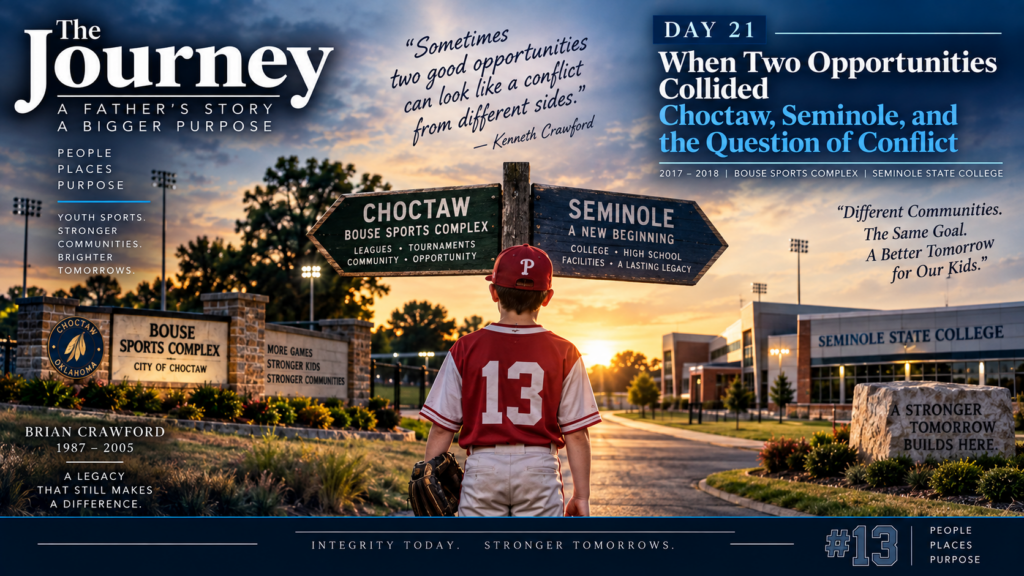
The Journey - Day 21
When Two Opportunities Collided - Choctaw, Seminole, and the Question of Conflict
Journey Marker: 2017-June 2018 | Bouse Sports Complex and Seminole State College - When One Door Opening Seemed to Close Another
Yesterday I wrote about the visit to Bouse Sports Complex that helped open a door in Seminole.
What happened next taught me something different.
Sometimes an opportunity that looks like growth from one side can look like a conflict from the other.
After the conversations with the Seminole State College Education Foundation developed, I was invited to apply for a Tournament Director position connected with the new sports-complex project.
I applied.
I was hired.
In my later oral history, I remembered the college publicly announcing that hiring.
I also remembered the City of Choctaw Parks and Recreation leadership viewing the Seminole position as a conflict with my role at Bouse.
That is my recollection of how those events connected.
It is important, however, to separate that recollection from what the documentary record can independently prove.
What I Thought I Was Building
Firsthand Memory
From my perspective at the time, I did not see Seminole as abandoning Choctaw.
I saw two different opportunities.
BCM Sports had spent years building leagues, tournaments, an officials program and relationships at Bouse.
Seminole was something different.
It was the possibility of helping develop a new sports complex from the ground up while also creating the permanent home for Brian's memorial that I had been searching for.
Those two things did not feel contradictory to me.
In fact, they felt connected.
Everything I had learned operating Bouse could help me understand what the Seminole project might need.
But institutions do not always see opportunities the same way the people inside them do.
The Difference Between What Happened and Why
From the Historical Record
The documented chronology establishes an important dividing line in the story: BCM Sports remained the field and program operator at Bouse through approximately June 2018. After BCM's departure, the City of Choctaw resumed operation of the complex.
Why the relationship ended is more complicated.
My oral history links the ending to the concern raised after my Seminole hiring became public.
I understood the City to view the two positions as a conflict.
That is my firsthand account.
It should not be transformed into a claim that every later decision, every person's motive or every action surrounding the transition has been independently proven.
There were other relationships, personalities and disagreements around youth sports in eastern Oklahoma County during those years.
I had opinions about some of them then, and I have interpretations today.
But an interpretation is not a document.
That distinction has become more important to me with every year of research.
Leaving Something We Had Built
Whatever the reason, June 2018 became the dividing line.
For more than two years, Bouse had consumed an enormous amount of my time.
We had scheduled games. Paid umpires. Worked gates. Built leagues. Hosted tournaments. Dealt with weather. Managed complaints.
Tried ideas that worked.
Tried some that did not.
And through all of it, we were trying to raise money and create something lasting in Brian's memory.
Then that chapter ended.
At the time, I was not thinking about it as a future case study in municipal governance.
I was thinking about the fact that something we had built was no longer ours to operate.
And at the same time, something much bigger in Seminole was beginning.
Looking Back
Years later, Integrity of the Game would intentionally separate personal disputes from systems analysis.
I eventually came to focus the research on structure, incentives, governance and documentation rather than turning individual disagreements into accusations.
The goal became clarity rather than confrontation.
Bouse helped teach me why that distinction matters.
When something happens to you personally, it is natural to ask:
Why did they do this?
Research asks a different question:
What can the records actually establish?
Those are not always the same question.
My memories matter because I was there.
The City's records matter because they document official action.
Later data matters because it can show what happened to the facility after I left.
None of those sources should be forced to say more than they can support.
That may be one of the biggest changes in me from the man operating Bouse in 2018 to the researcher looking back years later.
"Back then, I wanted to understand why it happened to me. Years later, I learned to ask what the records could actually prove."
Question for the Reader
When a community partnership ends, how should we balance the firsthand experience of the people involved with the official records that document what happened - but may not explain every reason behind it?
Next on The Journey
Leaving Bouse did not end the work.
It changed the location.
The lessons I carried out of Choctaw were about to follow me into a much larger project - one where we were not simply operating existing fields.
We were trying to build something new.
Next on The Journey: From Bouse to Seminole - Starting Over Without Starting From Scratch.
The Journey is a continuing first-person series tracing the path from family and memorial work through hands-on youth-sports operations and, eventually, toward research and reform.