
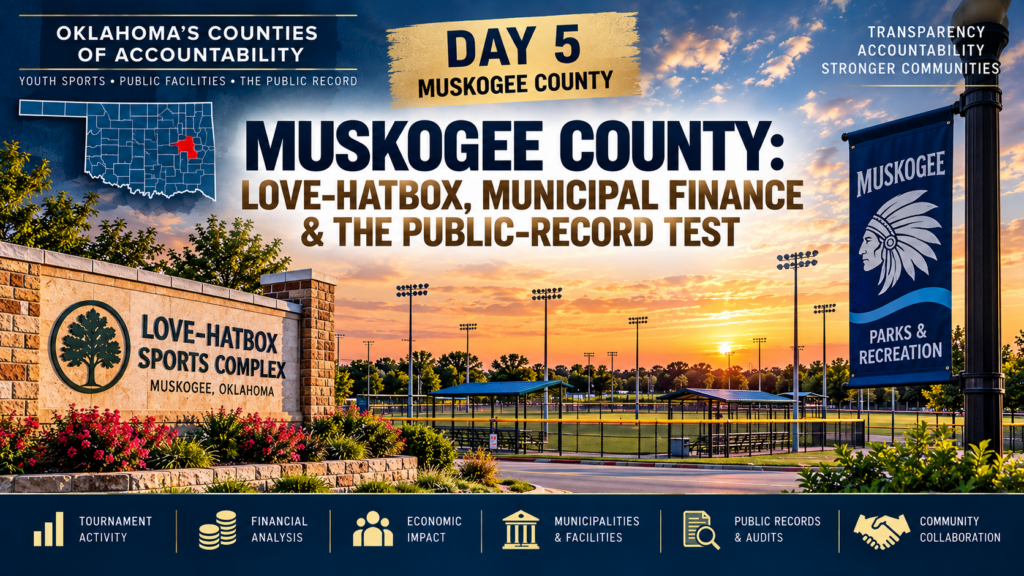
Oklahoma’s Counties of Accountability • Day 5 • October 20, 2026
Muskogee County: Love-Hatbox, Municipal Finance & the Public-Records Test
Muskogee • Haskell • Fort Gibson | Historical dataset activity: 2001–2017, within the statewide 2001–2026 research baseline
A public ballfield can be a community success story and still deserve a clear public ledger. Muskogee County offers a particularly useful test: one city-operated sports complex dominates the historical tournament records, while surrounding towns and independent youth organizations show why facility control, tournament scheduling, revenue collection and public ownership must never be treated as the same thing.
Research boundary — distinguish actual records from modeled scenarios. This article covers 990 single-county division rows labeled Muskogee in the authoritative September 20, 2026 dataset, with observable county seasons 2001–2017. The statewide source extends through 2026, but that does not mean these county records do. Three additional multi-county division rows remain on a geographic verification watchlist and are excluded. Figures below are historical dataset reconstructions and modeled assumptions, not audited fee collections, proven outside spending, misconduct findings, taxes, or facility profit.
1. Muskogee County: historical tournament and financial ledger
The research counts unique event listings by combining Seasonid with the base TournamentID after stripping a trailing division suffix. It sums money and workforce fields at the division-row level without multiplying a multi-division event’s expenses again.
| Metric | Historical data result |
|---|---|
| Distinct tournament/event listings | 252 |
| Division rows | 990 |
| Team participations (not unique organizations) | 6,543 |
| Calculated gross entry fees | $1,021,040 |
| Minimum games (source estimate) | 14,979 |
| Official assignment slots (not people) | 26,937 |
| Modeled umpire expense | $1,077,480 |
| Modeled gross gate | $3,392,600 |
| Modeled gross concessions | $1,696,300 |
| Illustrative net concessions at 50% margin | $848,150 |
| Modeled USSSA sanctions | $84,255 |
| Modeled day-trip impact | $637,205 |
| Modeled overnight impact | $2,605,624 |
| Total modeled visitor spending | $3,242,829 |
The source rows include 908 baseball divisions and 82 softball divisions. There are 119 rows with zero modeled entry-fee dollars but positive team counts; this does not establish that any venue received no compensation or that a tournament charged no other fees. No figure above is asserted to be a payment to the City of Muskogee or to an individual tournament director.
2. Municipality-level attribution: all operating fields reconciled
The county includes Muskogee, Haskell and Fort Gibson in source municipality labels. These are location groupings, not proof of legal title, municipal receipts, or the recipient of entry fees. Gross gate and concessions are modeled event scenarios, not audited ticket or concession receipts.
Municipalities — activity, workforce and fees
| Geographic grouping | Events* | Division rows | Team entries | Calculated entry fees | Minimum games | Officials slots | Modeled umpire cost | Modeled sanctions |
|---|---|---|---|---|---|---|---|---|
| Muskogee | 249 | 986 | 6,520 | $1,018,614 | 14,926 | 26,869 | $1,074,760 | $83,875 |
| Haskell | 2 | 3 | 22 | $2,310 | 52 | 66 | $2,640 | $295 |
| Fort Gibson | 1 | 1 | 1 | $116 | 1 | 2 | $80 | $85 |
| COUNTY RECONCILED TOTAL | 252 | 990 | 6,543 | $1,021,040 | 14,979 | 26,937 | $1,077,480 | $84,255 |
Municipalities — modeled gross receipts and economic impact
| Geographic grouping | Modeled gross gate | Modeled gross concessions | Scenario net concessions 50% | Day-trip impact | Overnight impact | Total modeled impact |
|---|---|---|---|---|---|---|
| Muskogee | $3,385,800 | $1,692,900 | $846,450 | $635,250 | $2,592,619 | $3,227,869 |
| Haskell | $6,600 | $3,300 | $1,650 | $1,870 | $12,716 | $14,586 |
| Fort Gibson | $200 | $100 | $50 | $85 | $289 | $374 |
| COUNTY RECONCILED TOTAL | $3,392,600 | $1,696,300 | $848,150 | $637,205 | $2,605,624 | $3,242,829 |
*Event counts: the countywide distinct-event count is computed independently. In this county subset, the three municipality groups happen to reconcile to the same distinct total; event counts are non-additive in general, especially when a listed tournament spans venues.
3. Facility-level ledger: Love-Hatbox dominates
Love Hatbox Field accounts for 986 of 990 county division rows and 249 of 252 distinct events in the dataset subset. The remaining three Haskell records and one Fort Gibson record are preserved, not folded into the Muskogee municipal tally. The source uses the specific label “Love Hatbox Field”; this is analytically associated with the city’s Love-Hatbox Sports Complex, but the label alone does not prove every division used an identical diamond or contractual arrangement.
Facility rows — activity and workforce
| Geographic grouping | Events* | Division rows | Team entries | Calculated entry fees | Minimum games | Officials slots | Modeled umpire cost | Modeled sanctions |
|---|---|---|---|---|---|---|---|---|
| Love Hatbox Field | 249 | 986 | 6,520 | $1,018,614 | 14,926 | 26,869 | $1,074,760 | $83,875 |
| Haskell City Park | 2 | 3 | 22 | $2,310 | 52 | 66 | $2,640 | $295 |
| Fort Gibson Youth Baseball | 1 | 1 | 1 | $116 | 1 | 2 | $80 | $85 |
| COUNTY RECONCILED TOTAL | 252 | 990 | 6,543 | $1,021,040 | 14,979 | 26,937 | $1,077,480 | $84,255 |
Facility rows — gate, concessions and modeled spending
| Geographic grouping | Modeled gross gate | Modeled gross concessions | Scenario net concessions 50% | Day-trip impact | Overnight impact | Total modeled impact |
|---|---|---|---|---|---|---|
| Love Hatbox Field | $3,385,800 | $1,692,900 | $846,450 | $635,250 | $2,592,619 | $3,227,869 |
| Haskell City Park | $6,600 | $3,300 | $1,650 | $1,870 | $12,716 | $14,586 |
| Fort Gibson Youth Baseball | $200 | $100 | $50 | $85 | $289 | $374 |
| COUNTY RECONCILED TOTAL | $3,392,600 | $1,696,300 | $848,150 | $637,205 | $2,605,624 | $3,242,829 |
Source geography matters. Love Hatbox Field is recorded at 3601 Arline Avenue in Muskogee. Haskell City Park is recorded on West Cedar in Haskell. The Fort Gibson record lists 600 E. Artillery, while the currently active Fort Gibson Youth Baseball Association lists a different address for its Carl Perry Memorial complex. These addresses must not be silently treated as identical facilities without a time-specific deed, permit, or field-reservation record.
4. Who schedules the fields, who operates concessions and who holds title?
Muskogee Parks & Recreation describes Love-Hatbox as a 60-acre public sports complex with 10 lighted baseball fields and 8 softball fields. Its public reservation instructions distinguish ordinary practice rentals from leagues and tournaments and explain that those events take priority over practice reservations. This is independently documented municipal operational management; it is not, on its own, a parcel-title opinion.
The city’s Sports Field Reservation Request form provides unusually concrete administrative controls. It requires user-group reservation applications; identifies Parks & Recreation as directing concessions; requires pre-approval for outside vendors; and describes a $250 reservation deposit applied to final payment. The form also distinguishes tourism grants as a separate application route. Those are the terms of the available form, not retroactively proven terms for every tournament from 2001–2017.
| Source facility | Public/private operating evidence | Research attribution |
|---|---|---|
| Love Hatbox Field — Muskogee | City Parks & Recreation manages the sports complex and published field reservation and concession rules. City Parks source | Muskogee municipality; city operational control documented; property title and yearly tournament contracts not independently confirmed. |
| Haskell City Park — Haskell | Municipal park is the source label; Haskell municipal contact | Assumed City of Haskell attribution pending legal parcel ownership and historic rental agreements. |
| Fort Gibson Youth Baseball — Fort Gibson | Fort Gibson Youth Baseball Association documents current nonprofit/community operations, not ownership of the 600 E. Artillery source address. | Fort Gibson municipality; title and source-specific operator unresolved; do not assume school or town ownership. |
For a full accountability record, one must separately establish: (a) legal owner and restricted-use instruments; (b) party controlling schedules and tournament approval; (c) concessions and gate operator; (d) merchant of record for entry fees; (e) public-paid utilities, lights, maintenance, insurance and improvements; and (f) benefits provided to local participants, not merely modeled visitor expenditures.
5. Countywide economic impact model — fully separated from receipts
The source fields DayTripRate, NightTripRate, DayStay, OverNightStay, DayImpact, OvernightImpact and TotalEconomicImpactPerEvent are stored on each division row. Despite its “PerEvent” name, the latter column is not one independent estimate for each deduplicated event. We sum source division rows, avoiding any additional event-level multiplication.
| Model component | County total | Source-column calculation |
|---|---|---|
| Day-trip modeled gross spending | $637,205 | Sum of DayImpact across 990 division rows |
| Overnight modeled gross spending | $2,605,624 | Sum of OvernightImpact across 990 division rows |
| Total modeled gross visitor spending | $3,242,829 | Sum of TotalEconomicImpactPerEvent = day + overnight |
Day-trip model =
TeamsEntered × DayTripRate × DayStay.Overnight model =
TeamsEntered × NightTripRate × OverNightStay.Total modeled spending =
DayImpact + OvernightImpact.Worked original-data example: in the 2002 “Muskogee World Qualifier” division row TournamentID 15000-1, the source lists 9 teams, a $85 day-trip rate, a $289 overnight rate, 1 day-stay unit and 2 overnight-stay units. Therefore 9 × $85 × 1 = $765; 9 × $289 × 2 = $5,202; together $5,967 modeled visitor spending for that division row.
Actual dataset rate variations and caution flags
The inputs are not a single universal daily spending rule: 880 rows use $85 day-trip and $289 overnight rates, whereas 110 rows use $25 day-trip and $0 overnight rates. DayStay varies from 1 to 34 in the county rows; OverNightStay ranges from 0 to 7. The calculations preserve all these row-level variations exactly as recorded.
Key limitation: 28 division rows have DayStay > 14 and collectively contribute $125,275 to the day-trip total. Their league-format duration assumptions do not prove 14–34 separate visitor trips or any actual tourism. The model also applies day and overnight terms to full participating-team counts without demonstrated local-versus-outside-team partitioning. Repetition, residency, spending displacement, substitution and leakage have not been independently measured.
Municipality and facility economic-impact reconciliation
| Facility / reporting municipality | DayImpact sum | OvernightImpact sum | TotalEconomicImpactPerEvent sum |
|---|---|---|---|
| Love Hatbox Field / Muskogee | $635,250 | $2,592,619 | $3,227,869 |
| Haskell City Park / Haskell | $1,870 | $12,716 | $14,586 |
| Fort Gibson Youth Baseball / Fort Gibson | $85 | $289 | $374 |
| COUNTY TOTAL | $637,205 | $2,605,624 | $3,242,829 |
Do not add modeled gate, entry fees, gross concessions or any “net” figure to modeled visitor spending. Those monetary concepts may already overlap. In particular, county visitor-spending estimates are not proven incremental economic impact, actual hotel receipts, sales-tax revenue, public return on investment, organizer profit or a statewide multiplier estimate. A true incremental assessment would need visitor origin surveys, length of stay, verified direct spending, counterfactual displacement, leakage and a defensible multiplier with uncertainty ranges.
6. How every number is reproduced from source columns
Dataset version: September 20, 2026 Hidden Valley / AIUSSSA CSV. Preserve all original division rows; filter exact County = Muskogee for this county’s high-confidence location-labeled baseline. A separate reconciled file has 3 rows provisionally assigned to Muskogee based on a first-listed venue/county; those rows are not included here because the primary tournament host is not yet independently established.
| Reported measure | Exact rule or treatment |
|---|---|
| Distinct events | Count unique (Seasonid, TournamentID with final numeric division suffix stripped); never sum individual-facility event subtotals when events overlap. |
| Division records | Count CSV rows retained by the geographic scope. |
| Teams and entry fees | Sum TeamsEntered; sum TotalTeamEntryFee (calculated team fees, not bank deposits). |
| Minimum games | Sum TotalMinimumGamesPlayed; source model counts potential minimum games, not certified completed contests. |
| Officiating and cost | Sum TotalEventUmpires and TotalEventUmpireFees; official slots/assignments are not distinct people or verified payroll. |
| Gate | Sum TotalEventGate; modeled gross admissions across event dates, not point-of-sale reports. |
| Concessions gross and net | Sum TotalEventConcession. Scenario net = 0.50 × gross; margin assumption only, not audited profit. |
| Sanction fees | Sum TotalUSSSASanctionFees; a model, not traced recipient payments. |
| Economic impact | Sum source DayImpact, OvernightImpact, TotalEconomicImpactPerEvent per division; confirm day + overnight = total. |
| Unresolved geography | Keep multi-county, multi-facility records in a separate watchlist until the primary host facility is verified. |
| Unverified ownership | Use single-municipality attribution only as an assumption where title unknown. Evidence for school, tribal, county or private ownership overrides any municipal guess. |
Accounting boundaries: TotalEventNet in the dataset is a different constructed financial field and is not the same as a 50% net concession scenario. The article does not combine them. Financial and visitor-spending columns reflect model outputs using historical fee/rate assumptions; the source's value is its reproducibility, not independent bank-ledger verification.
Reconciliation passed: the 3 municipality subtotals and the 3 facility subtotals independently equal the county’s 990 divisions and all additive financial, staffing and economic-impact source-column sums. A companion CSV provides the audit trail and 50% net-concession sensitivity assumption.
7. Historical trend: 2001–2017 records, not an invented 2026 count
The statewide research horizon is 2001–2026, but the Muskogee rows in this source subset end in 2017. The following rows preserve this difference; the absence of later county rows is a dataset coverage gap, not proof that tournaments stopped, operators changed, or the venue was inactive.
| Season | Distinct events | Division rows | Team entries | Calculated entry fees | Modeled visitor spending |
|---|---|---|---|---|---|
| 2001 | 10 | 51 | 461 | $0 | $321,249 |
| 2002 | 15 | 69 | 576 | $71,056 | $406,742 |
| 2003 | 13 | 71 | 459 | $67,179 | $275,706 |
| 2004 | 20 | 82 | 548 | $86,162 | $287,567 |
| 2005 | 34 | 100 | 590 | $76,677 | $235,589 |
| 2006 | 19 | 97 | 644 | $95,936 | $220,056 |
| 2007 | 19 | 84 | 525 | $103,477 | $204,943 |
| 2008 | 23 | 109 | 664 | $145,873 | $298,233 |
| 2009 | 22 | 88 | 538 | $103,221 | $218,343 |
| 2010 | 19 | 84 | 507 | $116,713 | $241,757 |
| 2011 | 15 | 46 | 286 | $56,996 | $129,399 |
| 2012 | 6 | 19 | 142 | $31,426 | $105,850 |
| 2013 | 7 | 20 | 184 | $21,512 | $98,623 |
| 2014 | 2 | 7 | 49 | $116 | $33,974 |
| 2015 | 6 | 14 | 102 | $9,522 | $49,708 |
| 2016 | 16 | 36 | 212 | $26,044 | $91,834 |
| 2017 | 6 | 13 | 56 | $9,130 | $23,256 |
| TOTAL | 252 | 990 | 6,543 | $1,021,040 | $3,242,829 |
8. Geographic quality control: three unresolved multi-county records
A cross-county reconciliation file provisionally labels the following 3 additional division records / 2 source event groups as Muskogee, but this is not a verified primary-host assignment. The 2019 record spans Tulsa-area and Muskogee-area school/park facilities; the 2023 entries name a Sallisaw One Day Event while listing both Love Hatbox and Sallisaw Sports Complex. It would be misleading to allocate them solely to Muskogee merely because its name comes first.
| Season / ID | Source event | Facilities listed | Combined county label | Location status |
|---|---|---|---|---|
| 2019 / 8315 | 14U OK-Texas Shootout 18th Annual | Berryhill High School, Hilldale High School, Indian Springs Sports Complex, Jenks Youth Baseball Complex, Owasso Park South, Prue High School | Muskogee, Osage, Tulsa | Provisional: first listed county; primary facility not verified |
| 2023 / 13936-1 | Sallisaw One Day Event – After The Storm | Love Hatbox Field, Sallisaw Sports Complex | Muskogee, Sequoyah | Provisional: first listed county; corroborating single-county facility rows |
| 2023 / 13936-2 | Sallisaw One Day Event – After The Storm | Love Hatbox Field, Sallisaw Sports Complex | Muskogee, Sequoyah | Provisional: first listed county; corroborating single-county facility rows |
Watchlist exposure, not included in county totals: 3 division rows, 80 team participations, $31,599 calculated entry fees and $42,636 modeled economic impact. A provisional first-listed location is a queueing flag, not a confirmed assignment. Do not split an event among counties unless evidence establishes separate event identities with verified hosts; allocate to its true primary facility county if determinable, otherwise leave it unresolved.
9. Public finance: what the city’s actual budget can and cannot prove
The City of Muskogee Financial Documents archive publishes municipal budgets going back to the 2000s and lists the adopted FY2026–27 budget and a 2024 city audit report. A publicly indexed FY2025–26 proposed budget includes separate enterprise funds for Hatbox Sports Complex and Hatbox Field Enterprise. These public accounts provide a useful document trail, but they cannot automatically be mapped to the Hidden Valley model’s gate or concessions amounts.
| Separate municipal record | FY2025–26 proposed amount | What it actually establishes |
|---|---|---|
| Hatbox Sports Complex (enterprise fund 545) | $276,000 projected revenues; $275,300 projected expenditures | Budget proposal for a city enterprise fund; not an event-by-event gate or tournament cash ledger. |
| Hatbox Field Enterprise (fund 555) | $185,600 projected revenues; $241,300 projected expenditures | Different fund name and figures; not automatically additive or interchangeable with sports-complex operating accounts. |
| County tournament-research source | $3,392,600 modeled gate over 2001–2017 | Scenario modeled from division data across many historical seasons, not the city’s FY2025–26 budget revenues. |
City budget figures above are from its FY2025–26 proposed budget, not audited expenditures and not a claim that those figures persisted unchanged in the adopted budget. The audit portal documents availability, not a verified tournament-specific audit opinion. City finance archive · FY2025–26 proposed budget PDF.
Municipal collaboration opportunity. Parks officials, youth leagues, tournament hosts, hotels and taxpayers could jointly publish a standard event-level statement: field days used, rental/deposit charged, source of cash collected, verified admissions and concessions, city-paid services, tourism-grant awards, scholarship/low-income access, volunteer contributions and public-benefit measures. The source LHBX field form already has an administrative starting point: host identity, dates, teams, spectators, deposits and outside-vendor approval.
Determining real public benefit requires the city’s actual revenue/cost schedules, supporting deposit/receipt registers, contracts, insurance and procurement records, and any restrictions from grants or land conveyances. A favorable modeled tourism scenario does not independently prove a contract was lawful or that the city earned the modeled receipts.
10. Courts, public duties and District Attorney jurisdiction
The Oklahoma State Courts Network is the appropriate starting point for docket-level confirmation of any named Oklahoma state case. The Muskogee County Court Clerk maintains court proceedings, while the Oklahoma District Attorneys Council listing identifies District 15 with responsibility in Muskogee County. A local district attorney handles matters within that office’s lawful criminal jurisdiction; the DA is not a routine city bookkeeper, general-purpose open-records adjudicator or a substitute for a civil audit.
Legal proceeding status (as of October 20, 2026): The present article does not identify a verified case number, judgment, settlement or court finding establishing wrongdoing in Love-Hatbox tournament operations. The absence of a named case in this research is not a representation that none exists. Generic litigation hyperlinks in a statewide tournament dataset must not be treated as county-specific judgments. If a case is later supported by its caption, filing, docket and actual outcome, this section will distinguish allegations, motions, orders, settlements and final rulings by date.
Possible land-use, lease, city-trust, school-district, tribal, state grant and federal funding questions implicate different custodians and bodies of law. Any allegation must be evaluated against authenticated instruments and the responsible jurisdiction. These model totals make no inference of fraud or criminal liability.
11. Oklahoma State Auditor, county audit and city audit are distinct evidence streams
The Oklahoma State Auditor and Inspector and the independently prepared city finance/audit materials serve different reporting entities. A published Muskogee County FY2016 audit is available in the state publications repository; it analyzes county-government financial statements, not an independent audit of the City of Muskogee’s Hatbox tournament receipts. A city FY2024 audit is listed in the city finance archive; its findings should not be summarized as a youth-sports verdict absent page-specific audit evidence.
| Audit / finance evidence | Reporting entity | What it can establish | What it cannot establish alone |
|---|---|---|---|
| FY2016 published county financial audit | Muskogee County government | County regulatory-basis financial statements, scope, opinions, and any county findings. | Whether Love-Hatbox tournament concession, gate or deposits were collected by the city. |
| City FY2024 audit, listed by finance archive | City of Muskogee | City financial statements and audit disclosures, after review of the original audit. | Which tournament host received historical registration payments unless specifically traced. |
| FY2026–27 adopted municipal budget, listed by city | City of Muskogee | Appropriation plans and city fund structure for the named budget year. | A retrospective audit of 2001–2017 model data. |
| Hidden Valley division-row scenario | Research dataset—not a municipal audit | Repeatable historical model estimates and source references. | Public receipt, contract settlement, actual economic impact, tax yields, fraud or profit. |
Audit research next step: compare annual Hatbox Sports Complex and Hatbox Field Enterprise fund activity and audit footnotes with reservation approvals, facility rental invoices, deposited receipts, vendor contracts, capital improvement payments and any city trust funds. Request supporting schedules before making any finding about reconciliation differences.
12. Open-records research tracker, right of response and corrections
The city’s official Request Open-Records page directs requesters to print/return a form through the City Clerk’s office; its Forms and Publications page lists the request form and fee schedule. No Muskogee open-records request is represented here as submitted or answered. The following is a proposed scope for a forthcoming request and should be marked as research pending until dated receipt evidence is saved.
| Proposed request group (2001–2017, plus later amendments as relevant) | Custodian / targeted records | Current status |
|---|---|---|
| Field reservations and contract authority | Muskogee Parks/City Clerk: event applications, deposits, approved dates, season calendars, leases, vendor and concession agreements, fee waivers, insurance certificates. | Not submitted; evidence requested. |
| Revenue custody and reconciliation | City Finance/Parks: invoice registers, deposit slips, gate and concessions merchant reports, settlement sheets, reimbursements, tax or grant allocations by event. | Not submitted; evidence requested. |
| Facility title and restrictions | County Clerk/City Attorney: deeds, parcel IDs, public trusts, grants, land-use restrictions, master plans, utility expense obligations. | Not submitted; verify responsible custodian. |
| Financial accountability and benefit | City Finance/Tourism: Hatbox fund schedules, annual audits, tourism grant applications and awards, sports-event visitor studies, local access rules. | Not submitted; evidence requested. |
| Haskell and Fort Gibson comparisons | Town/association/schools: ballfield legal owner, user agreements, city spending, host reservation and operating terms at relevant historical address. | Not submitted; evidence requested. |
Right of response: invite the City of Muskogee, its Parks and Recreation and Finance departments, Haskell officials, Fort Gibson Youth Baseball and affected tournament organizers to supply records, dates, responses or corrections. Publish the request date, tracking number, city acknowledgment, cost estimate, partial disclosures, any lawful withholding explanation and the final response only after those records actually exist. Preserve original datasets while logging any revised assumptions as dated changes.
Reader notice: Nothing in this article alleges wrongdoing by a named director, youth organization, city employee or local government. Tournament history, public-finance inquiry and hypothetical economic spending are distinct from evidence of misappropriation, private benefit or regulatory breach. Open questions should be resolved with records and opportunities to respond—not speculation.
13. Evidence list and reproducibility
Research update: October 20, 2026. Official public-source links and the locally preserved September 20 CSV are the controlling references. State, city and association sources have different reporting scopes and dates; no budget number is substituted for a tournament-specific bank record.
- September 20 Hidden Valley dataset. User-provided AIUSSSA - HVIOG 9-20-2026.csv; division-row source; source fields, filters and date scope documented in this article. No third-party verification of financial model inputs.
- Love-Hatbox Sports Complex — official Parks & Recreation. City sports-complex description and field-priority rules
- Love-Hatbox field reservation form — official city Parks. Sports Field Reservation Request (PDF)
- Muskogee finance documents and audits — official city. City budgets, FY2024 audit listing and related documents
- FY2025–26 proposed budget — official city. Source PDF, enterprise fund summaries
- Muskogee open records — official city. Request Open-Records; request form and fee schedule
- State Auditor–published county audit. Muskogee County financial audit, FY2016
- Oklahoma district attorney and state courts. District 15 office listing; OSCN dockets search
- Fort Gibson primary local organizational source. Fort Gibson Youth Baseball Association
- Haskell municipal contact. City of Haskell official contact
- Supplemental director research only. Baseball Heaven: Marie Gassaway research profile (geographic director record; not facility income or proof of wrongdoing).
Companion files: Muskogee_County_Day_05_HVIOG_Reconciliation.csv (county + each municipality + each facility) and Muskogee_County_Day_05_Primary_Facility_Watchlist.csv (3 unresolved cross-county divisions). Add download links to this WordPress article only after hosting the CSVs on an approved site or library.