
Thousands of Team Entries
The Choctaw dataset reflects approximately 9,000 team entries across the research period, demonstrating sustained tournament utilization of the community.

The Bouse Sports Complex study is a municipal-level case study within the Hidden Valley Oklahoma Research initiative examining USSSA baseball and softball activity attributed to Choctaw, Oklahoma, from 2001 through 2026.
The research evaluates participation, modeled tournament financial activity, public-facility utilization, estimated community economic impact and event-host relationships associated with the tournament activity reflected in the underlying dataset.
The Choctaw dataset reflects approximately 9,000 team entries across the research period, demonstrating sustained tournament utilization of the community.
Tournament entry fees, gates, concessions, umpire activity, event income and community impact illustrate a financial ecosystem extending well beyond the games themselves.
The scale of the activity supports serious examination of facility governance, operating agreements, public return, transparency and long-term stewardship.
The combined dashboard brings the major Hidden Valley measures together in one visual framework: participation, entry fees, baseball and softball distribution, gate activity, concessions, umpire costs, event income, event net, economic impact and event-host concentration.
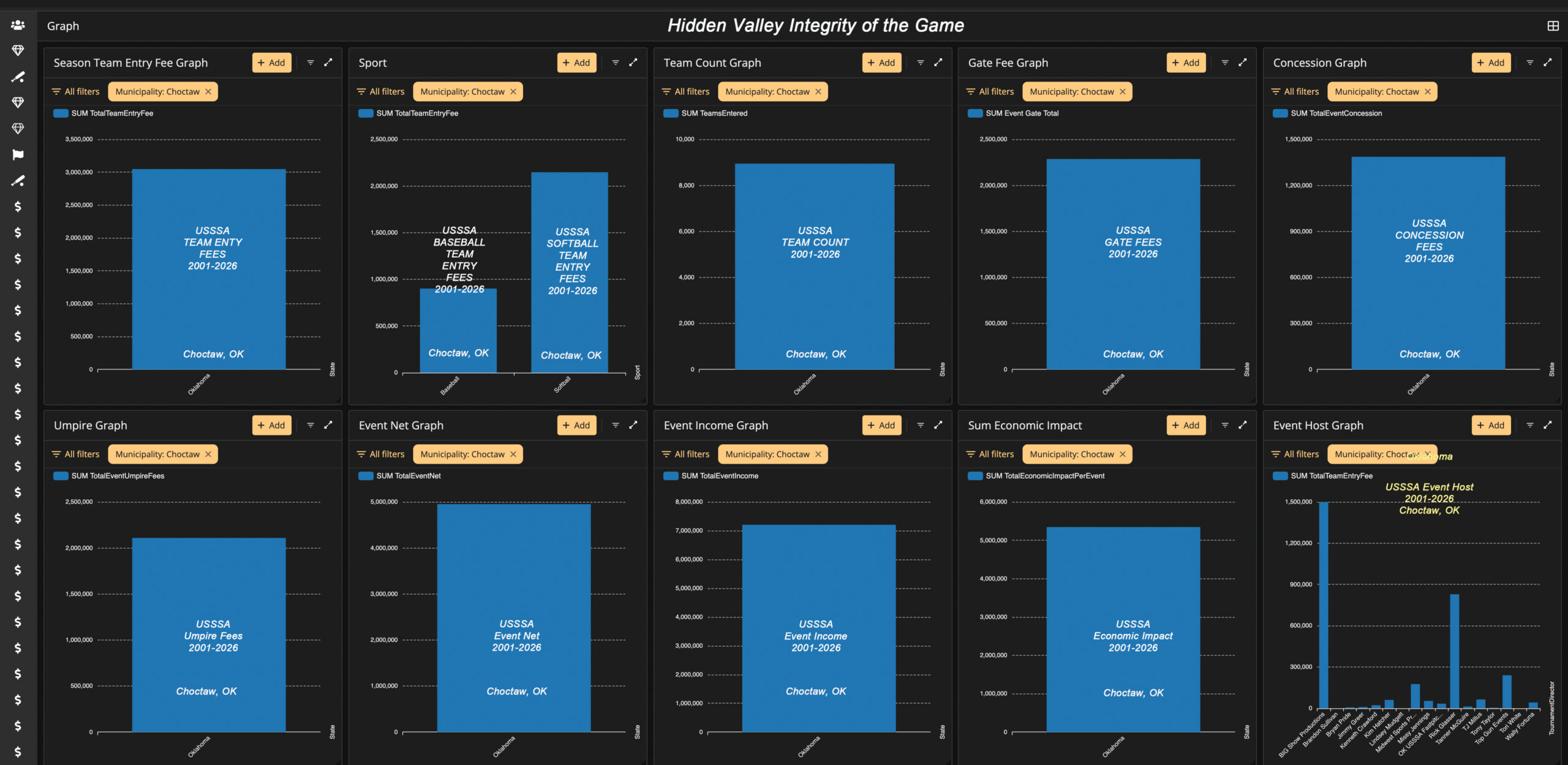
The updated executive summary consolidates the Choctaw dataset into one research document examining historical tournament growth, participation, tournament economics, community economic impact, event-host concentration and public-asset governance.
Cumulative totals show scale. Annual activity shows how that scale developed over time. Sport-specific analysis identifies the relative contribution of baseball and softball.
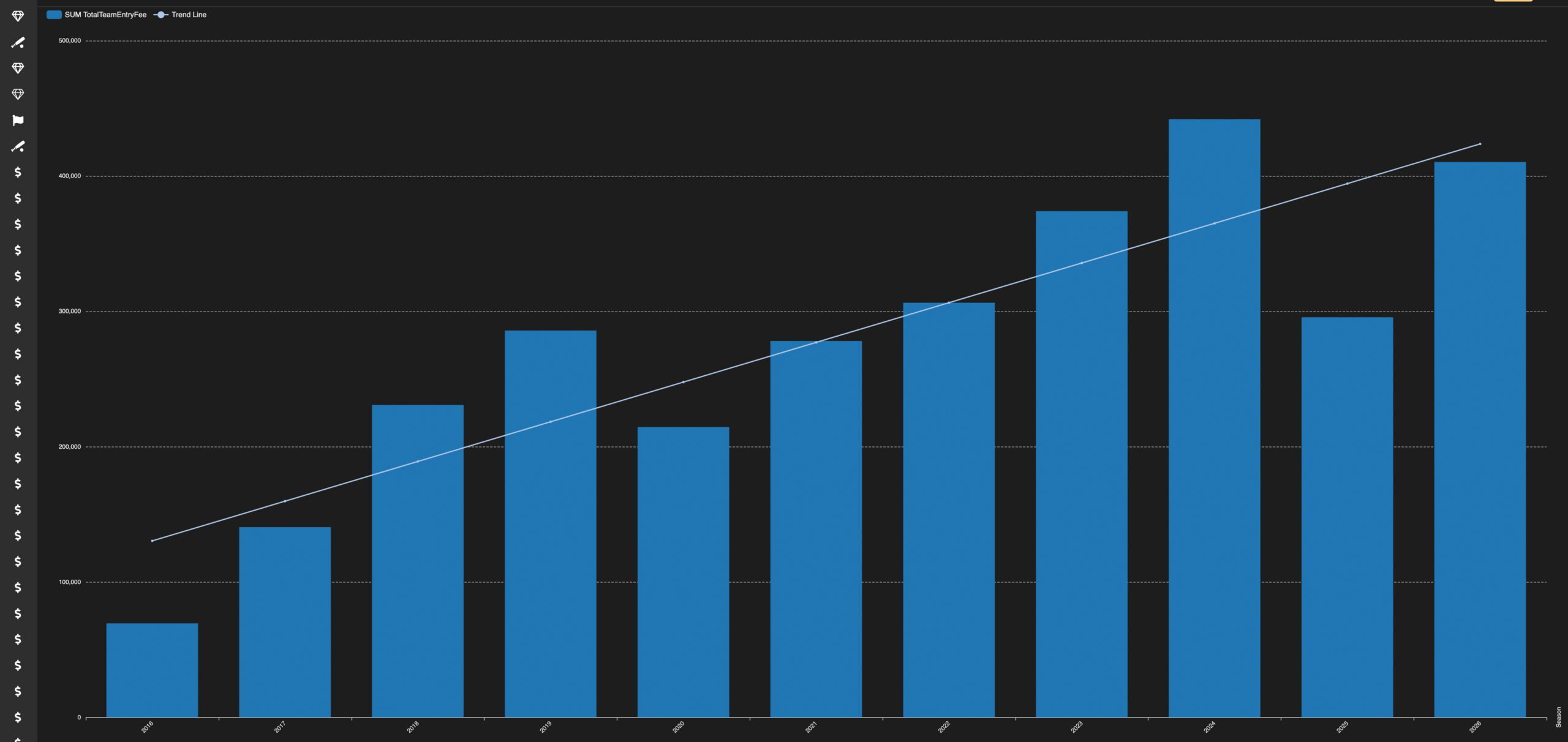
The displayed 2016–2026 series shows a pronounced overall upward trajectory in modeled annual team-entry-fee activity. The graphic begins near $70,000 in 2016, exceeds approximately $300,000 by 2022, approaches $400,000 in 2023, reaches an apparent high near $440,000 in 2024, declines in 2025 and rebounds above approximately $400,000 in 2026.
The fitted trend line remains positive despite annual volatility. The pattern suggests that Choctaw's tournament-related economic activity became materially larger during the later years shown.
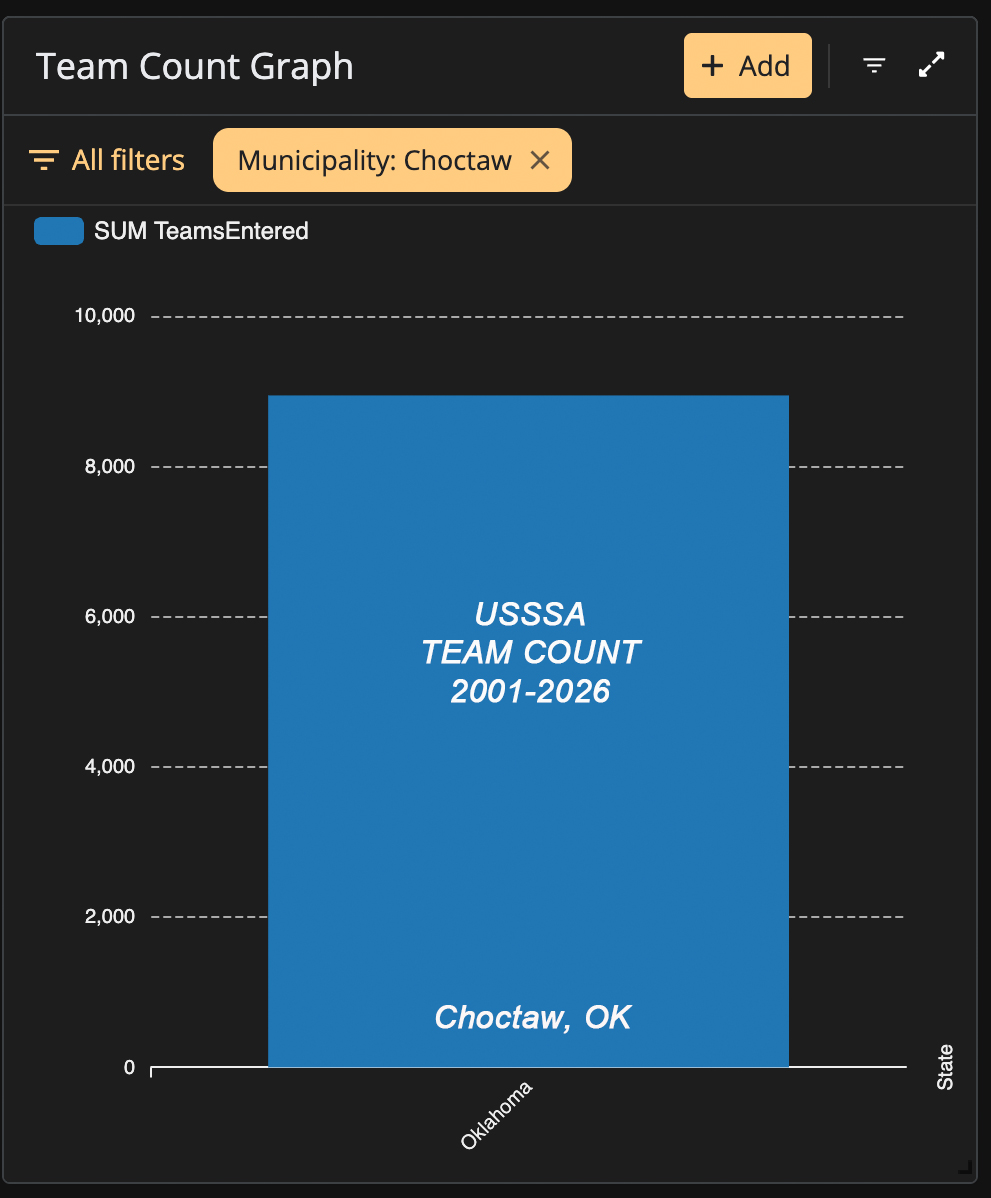
Cumulative team entries attributed to Choctaw in the research dataset.
What the data suggestsApproximately 9,000 team entries indicate sustained tournament use over the research period.
What it does not establishTeam entries do not necessarily represent 9,000 unique teams or organizations.
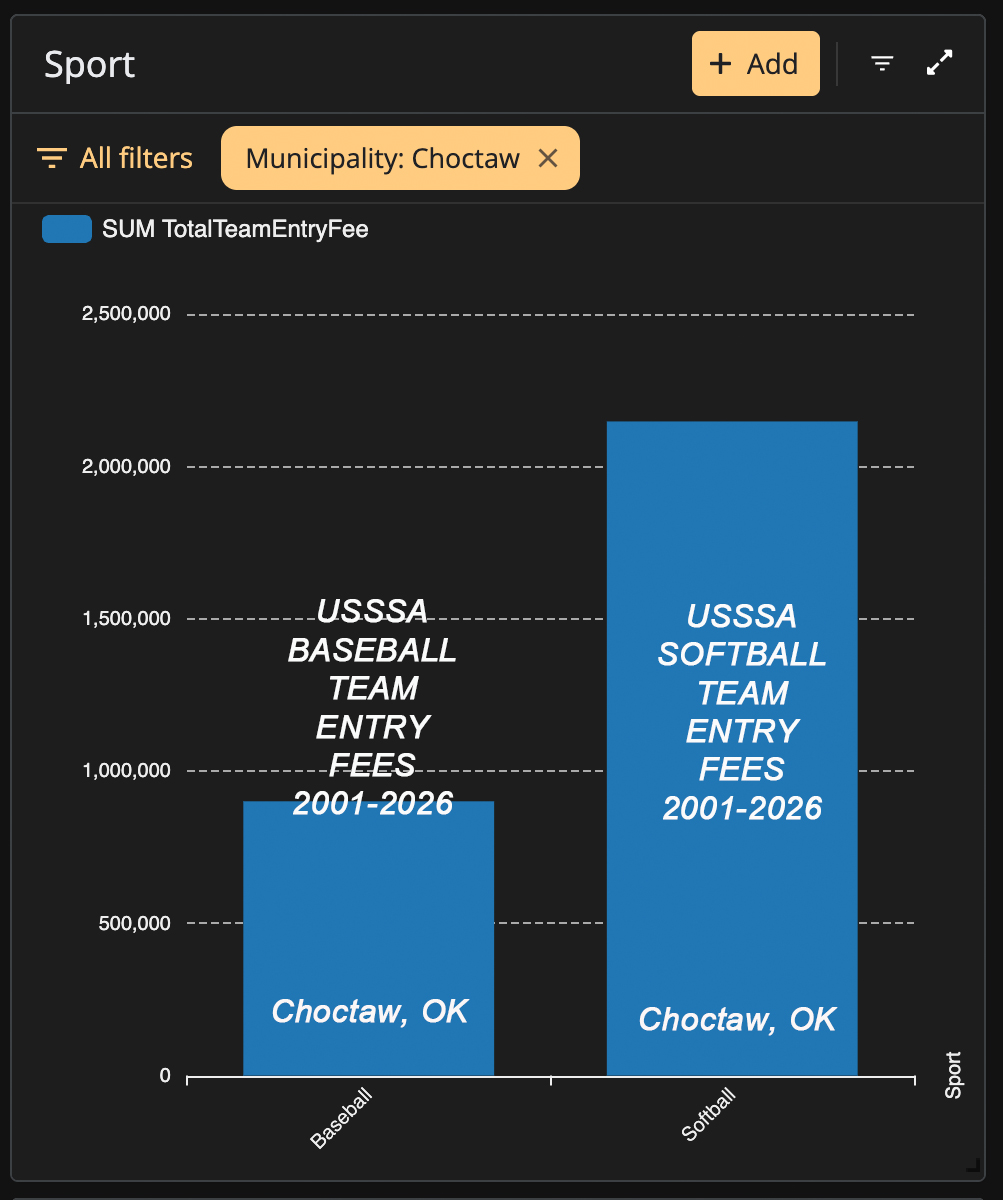
Team-entry-fee activity separated by sport.
What the data suggestsSoftball appears to represent approximately $2.1M, compared with roughly $0.9M for baseball.
Why it mattersBouse should be evaluated as a baseball-and-softball tournament facility rather than through baseball alone.
Tournament economics extend beyond the entry fee paid by a team. The research model separately examines team-entry activity, gate activity, concessions and umpire-related activity.
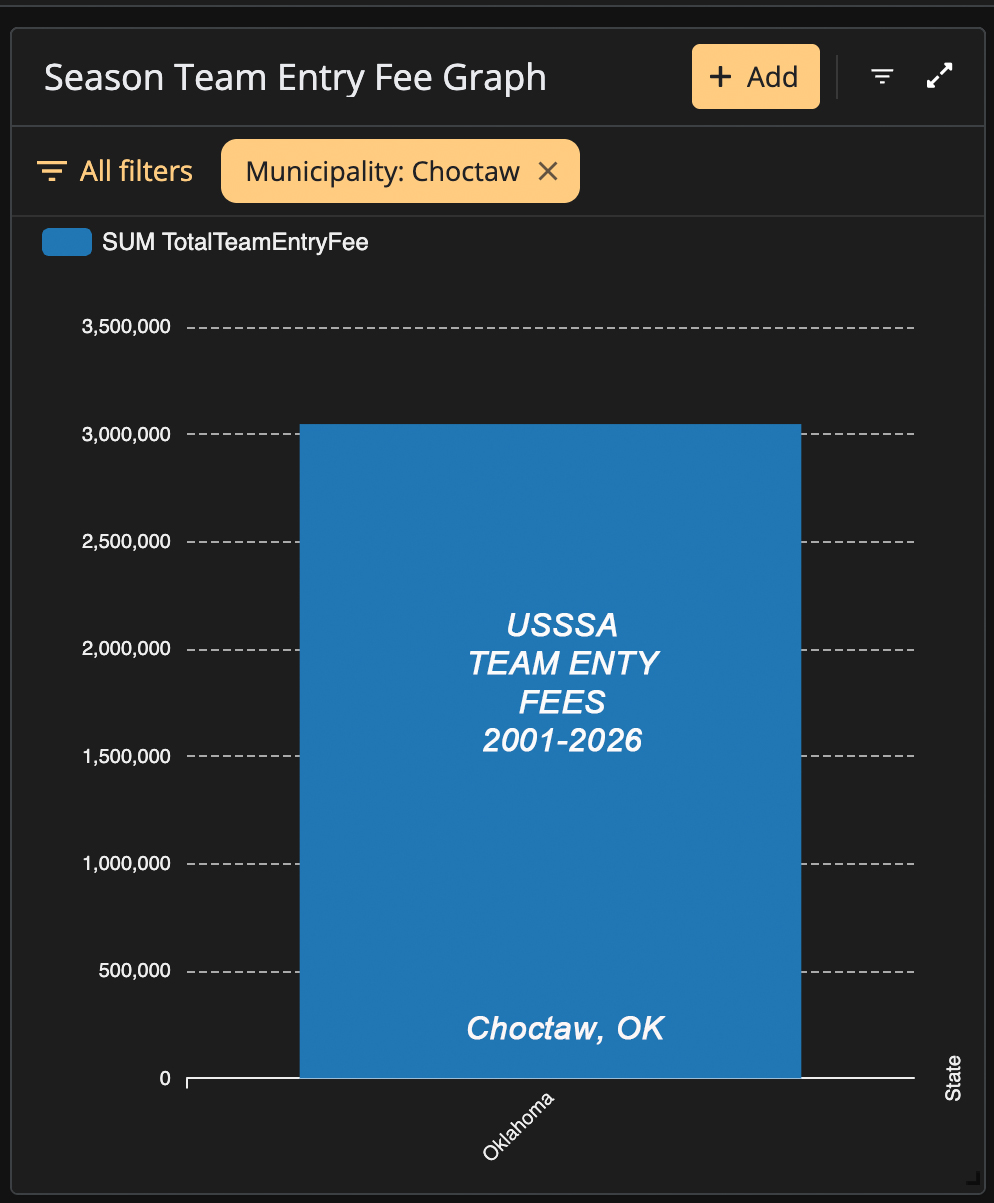
Approximately $3.0M in cumulative team-entry-fee activity.
Analytical meaningThis represents the participation-fee layer of the tournament model.
LimitationIt should not automatically be characterized as profit or revenue retained by one entity.

Approximately $2.3M in estimated gate activity.
Research questionWho collected, retained and distributed gate proceeds during the different operating periods?
LimitationThe graph alone does not identify who ultimately received the funds.
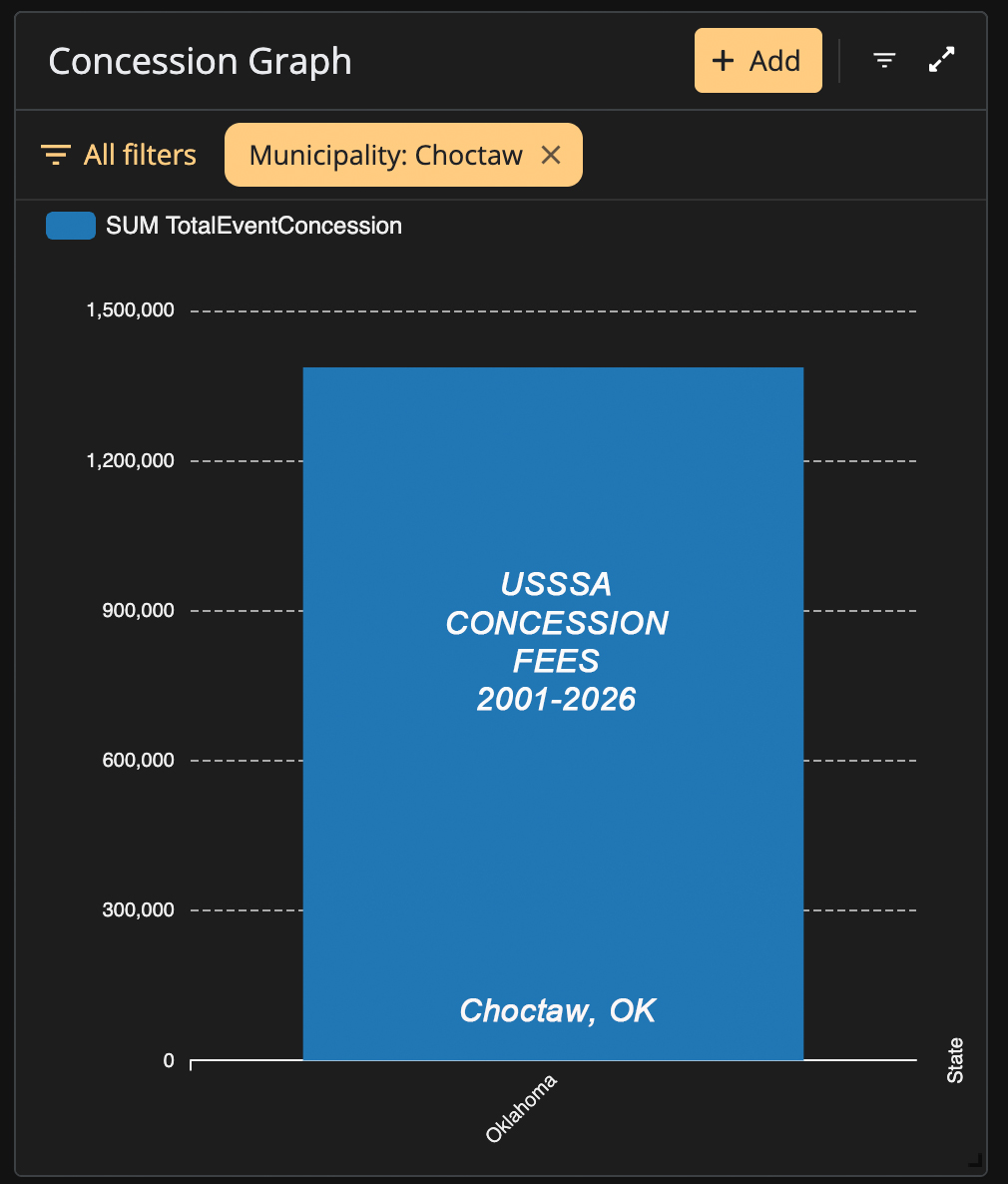
Approximately $1.4M in estimated concession activity.
Research questionWhat agreements governed concession operations and distribution of proceeds?
LimitationThe estimate is not proof that the City, operator or tournament director received the amount.
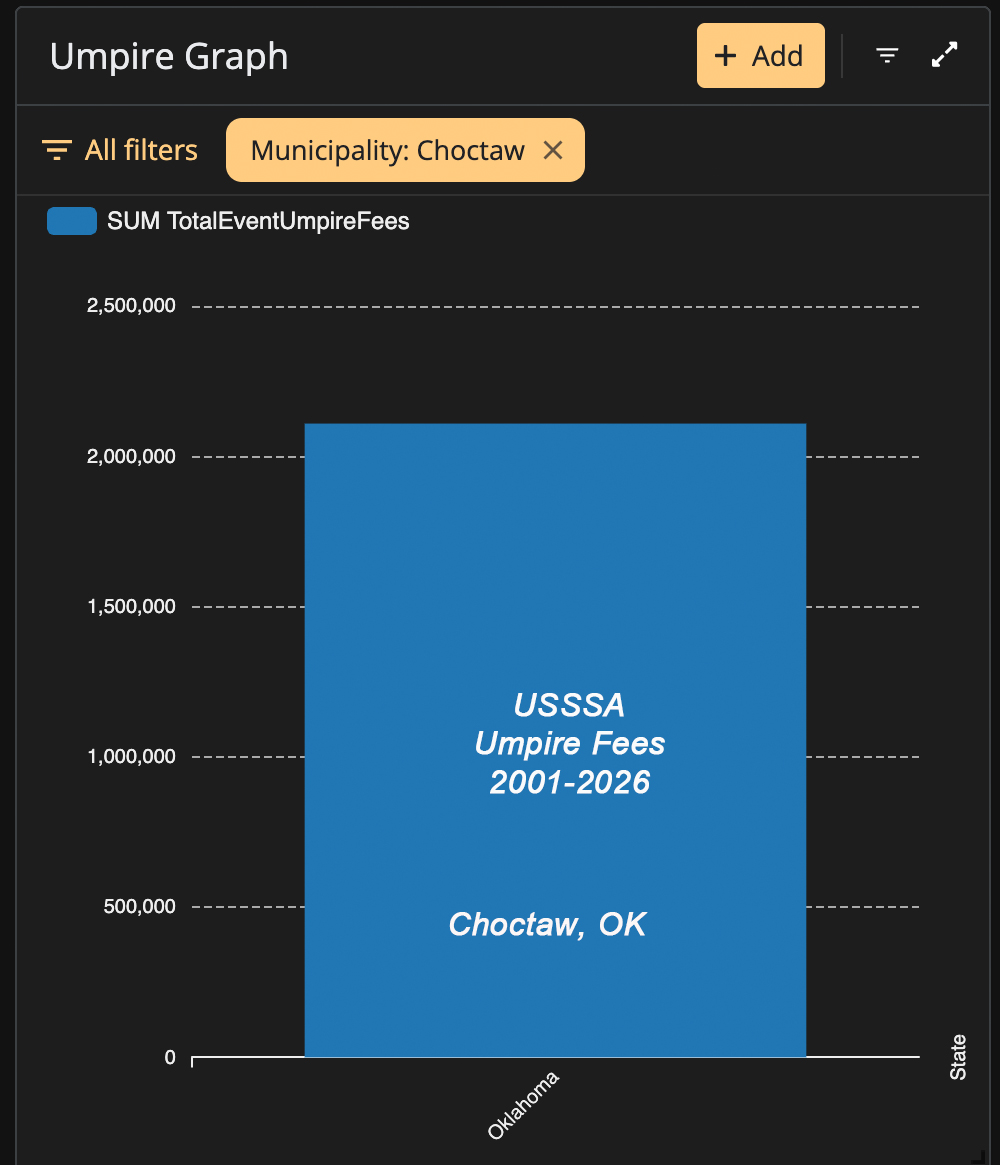
Approximately $2.1M in cumulative umpire-fee activity.
Why it mattersOfficiating represents a substantial operating component of tournament economics.
LimitationThis should not be described as USSSA, City, operator or director revenue without supporting financial records.
Event Income and Event Net describe different analytical measures within the Hidden Valley model and should be evaluated together without treating either figure as an audited organizational financial statement.
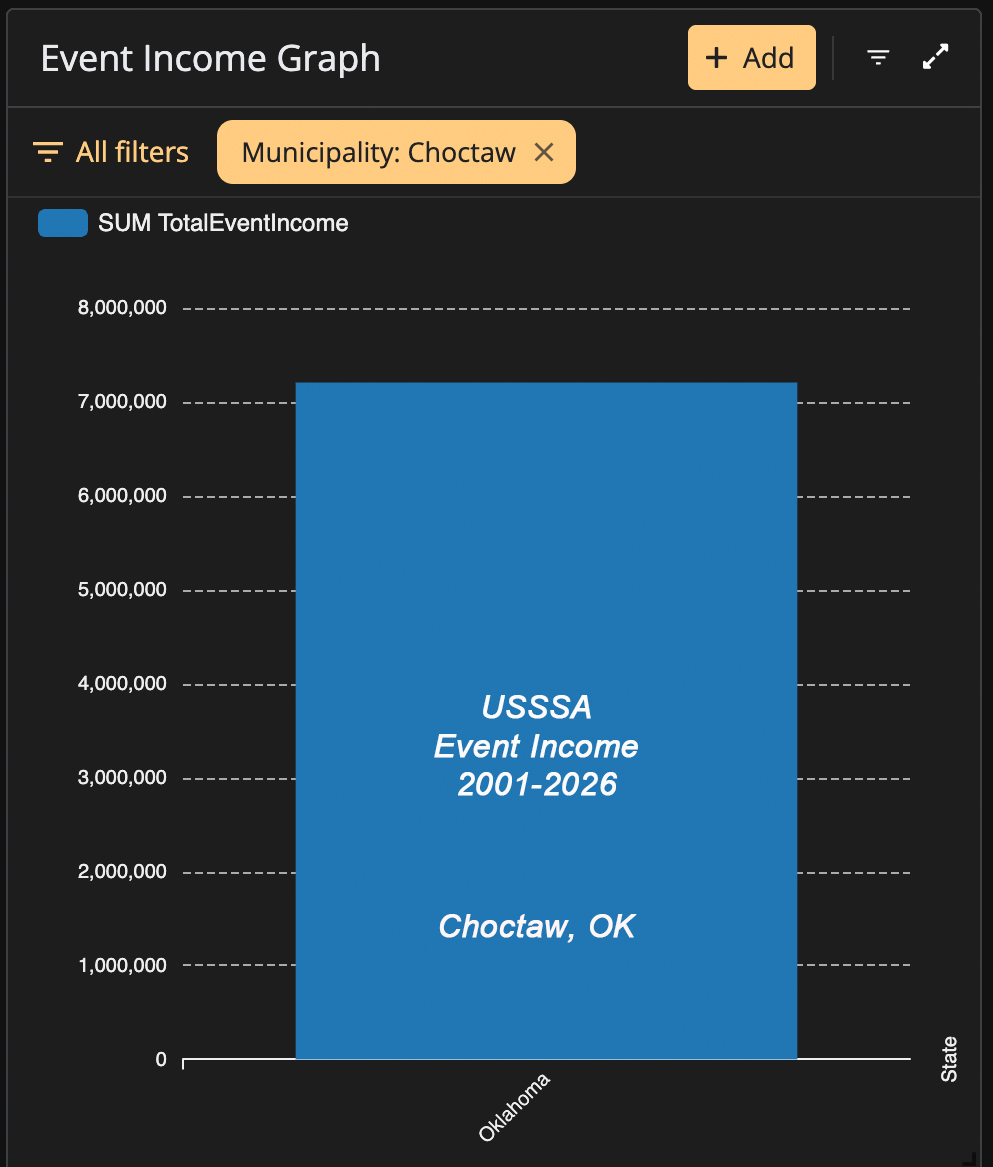
Approximately $7.2M in modeled cumulative event income.
This represents the broader event-income model and should be reconciled to the underlying methodology before being characterized as exact revenue.
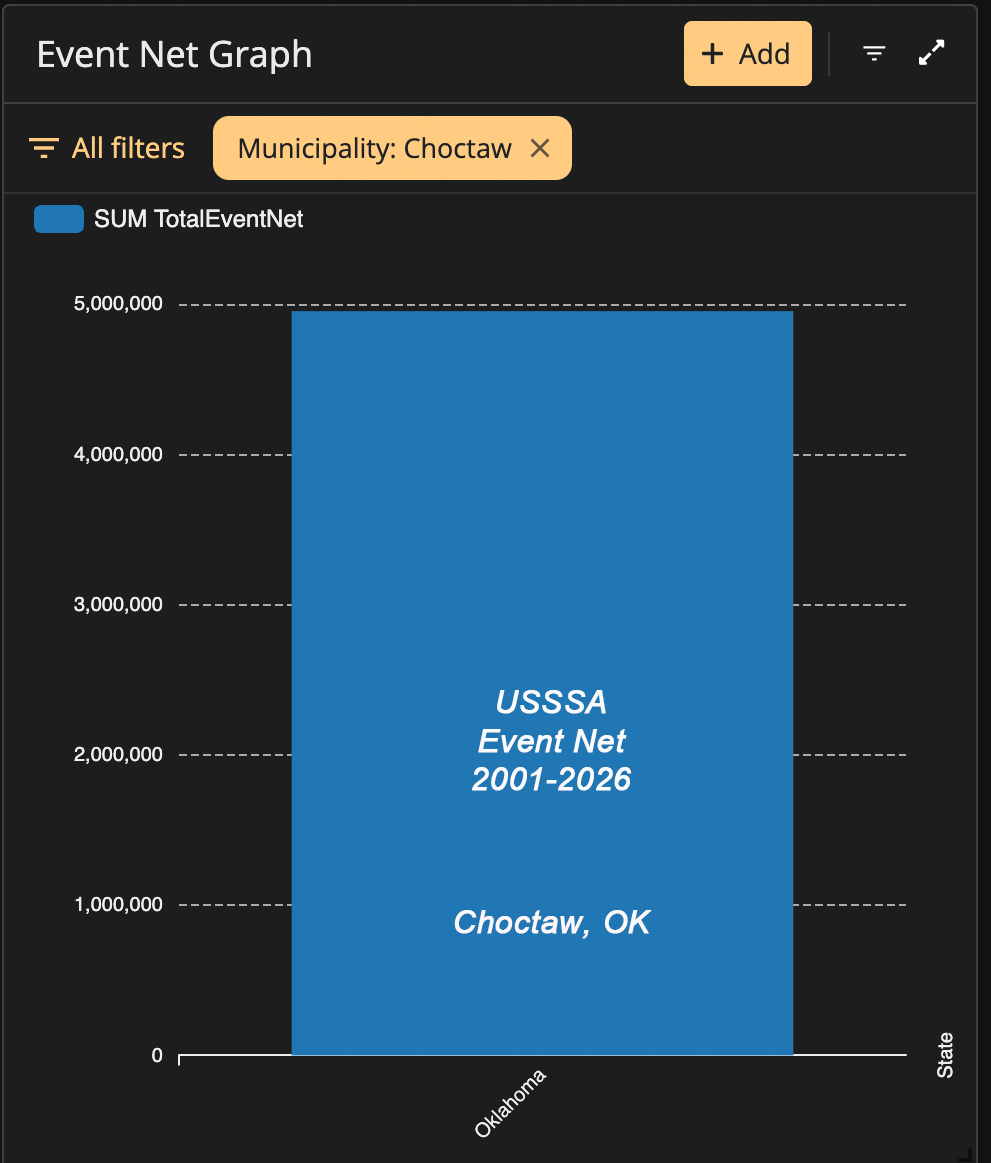
Approximately $4.9M in modeled net event activity.
Event Net is an analytical estimate based upon the research methodology. It should not be treated as audited net income or profit.
Tournament activity can create economic effects beyond the event operator or sports complex through visitor spending in the surrounding community.
The Hidden Valley economic-impact visualization places modeled cumulative community economic impact associated with Choctaw tournament activity at approximately $5.3 million.
Depending upon the underlying methodology, community impact may reflect estimated spending involving lodging, restaurants, fuel, retail activity and other visitor expenditures.
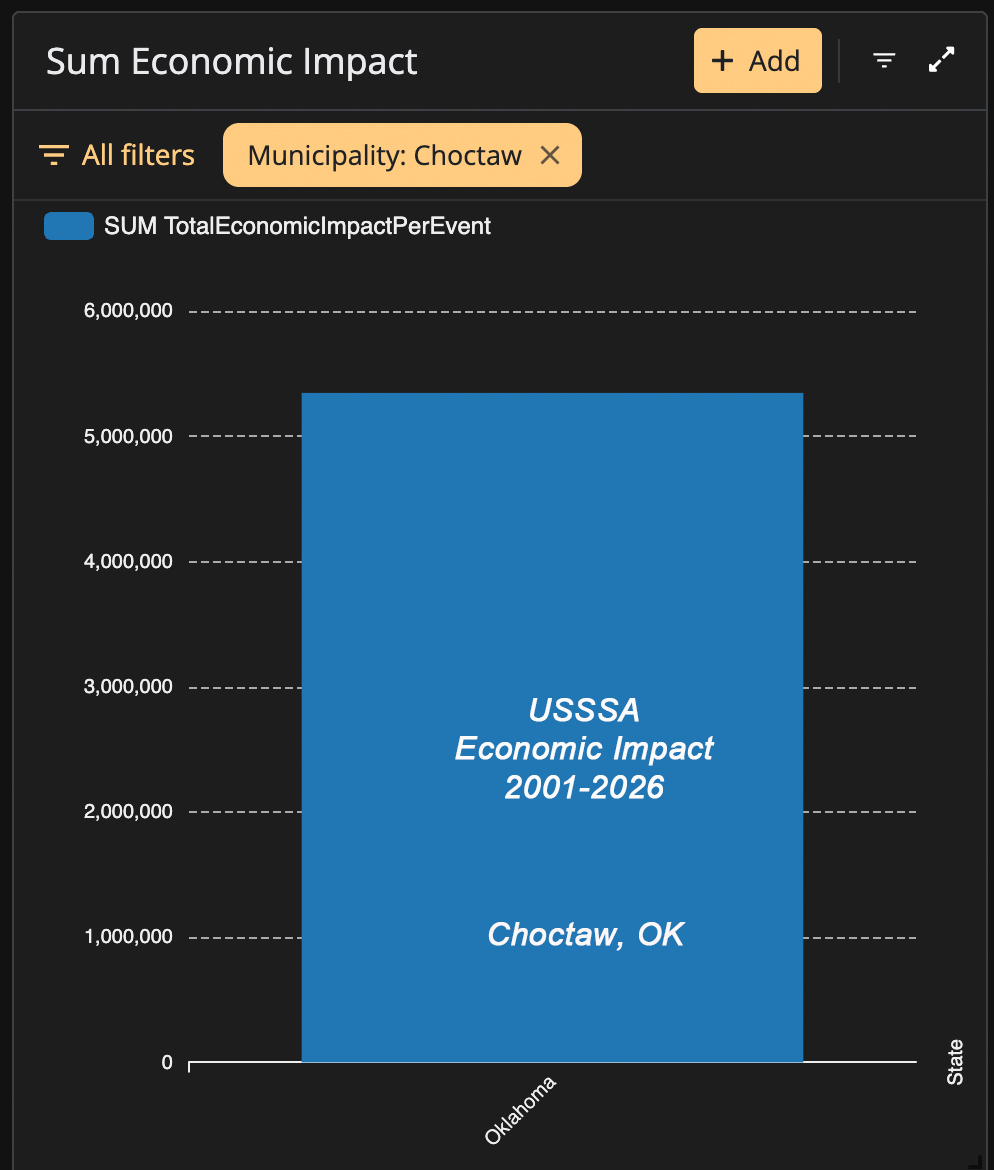
Approximately $5.3M in modeled community economic impact during the research period.
The Event Host visualization adds an organizational dimension to the economic analysis by grouping team-entry-fee activity according to the event-host or tournament-director field reflected in the underlying dataset.
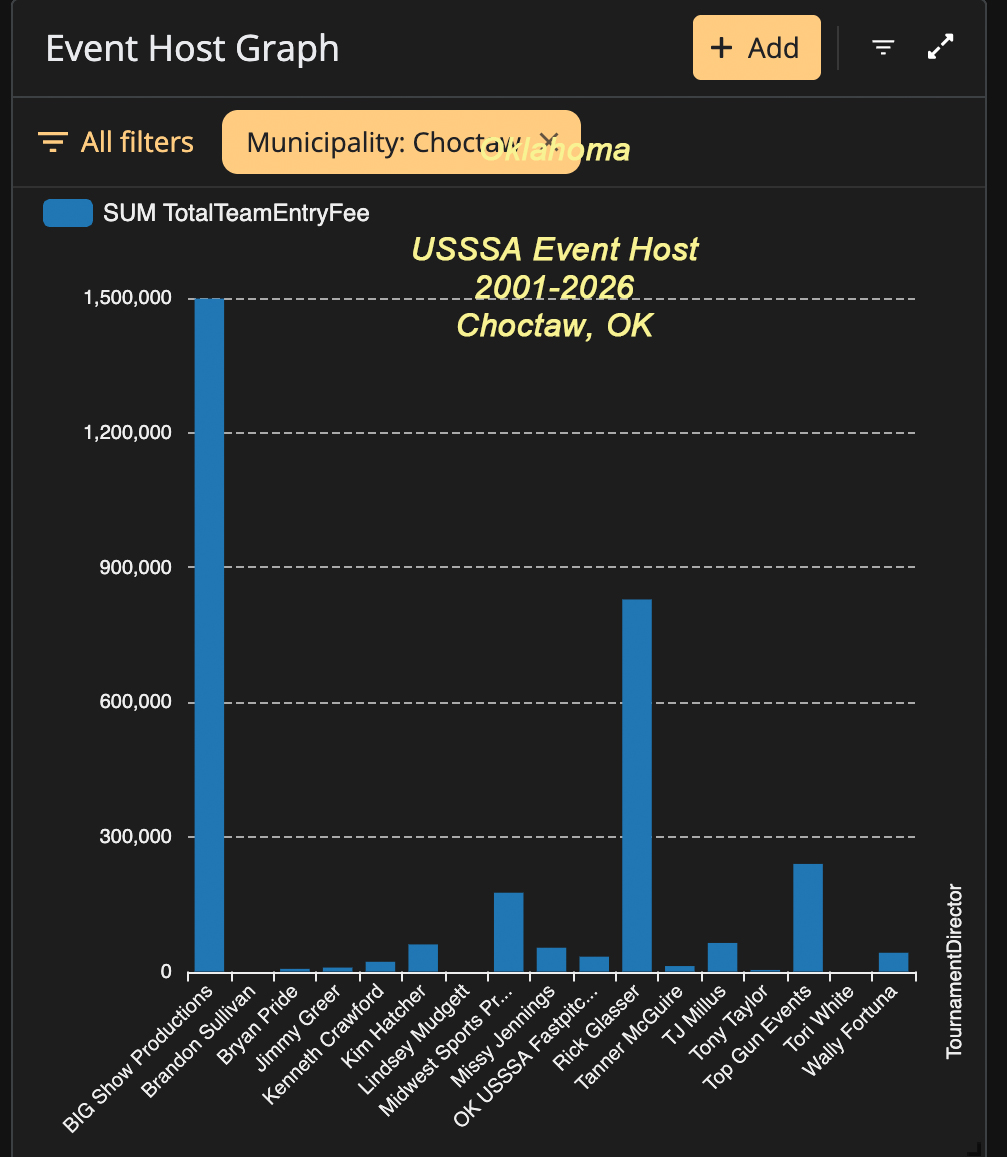
The visualization shows that tournament activity associated with Choctaw was not evenly distributed among all listed event hosts or directors.
Certain listed hosts appear associated with substantially more cumulative team-entry-fee activity than others. That concentration provides a research pathway for examining tournament allocation, facility access, sanctioning relationships and the organizations connected to repeated events.
Bouse Sports Complex matters within Hidden Valley because the research connects tournament activity to questions surrounding a publicly supported athletic facility, municipal governance and long-term stewardship.
These are research and governance questions. They are not allegations or findings of misconduct.
The strength of Hidden Valley depends on separating what the records establish from what the analytical model estimates and what questions remain unresolved.
Source documents, public records, tournament listings, contracts, government records or other preserved evidence.
Patterns, counts, associations and relationships visible within the underlying research dataset.
Calculations derived from fee structures, participation records and stated methodological assumptions.
Research conclusions drawn from relationships among records, data, timelines and other evidence.
An issue warranting additional records or independent investigation before a conclusion can be reached.
A determination made by a court, regulator, auditor, government agency or other competent authority.
The updated Choctaw evidence supports a clear research conclusion: Bouse Sports Complex should be evaluated as an economic and governmental asset as well as a recreational facility.
Across the 2001–2026 research window, the dataset reflects thousands of team entries and millions of dollars in modeled tournament and community economic activity.
That scale does not, standing alone, establish wrongdoing. It establishes materiality.
Materiality is why transparency, responsible governance, public return and stewardship deserve serious examination.
The Bouse Sports Complex study is one municipality-level component of Hidden Valley Oklahoma Research. The statewide project compares tournament activity, public facilities, municipalities, economic estimates and governance structures across Oklahoma.
BaseballHeaven.net and Hidden Valley Oklahoma Research are independent research, educational, commentary and public-interest initiatives. Unless expressly stated otherwise, neither is affiliated with, endorsed by, sponsored by or acting on behalf of the City of Choctaw, USSSA, any event host or director, sports governing body, nonprofit organization or other entity discussed in this research.
Financial and economic figures presented on this page may include analytical estimates derived from tournament records, fee schedules, participation information and stated research assumptions. Unless specifically identified as audited data, such estimates should not be characterized as verified revenue, profit, taxable income, tax liability or audited financial information.
Financial activity associated with an identified event host or tournament director represents activity attributed through the corresponding field in the research dataset. Such amounts do not establish that an individual personally received, retained or earned the associated amount.
The publication of a discrepancy, question, estimate, complaint, allegation, lawsuit, protest, public record or investigative lead is not proof that an individual or organization violated a law, regulation, policy, contract or ethical obligation.
Conclusions regarding unlawful conduct, fraud, misappropriation, tax liability, contract violations or other misconduct require appropriate supporting evidence and, where applicable, determination by a competent authority.
Hidden Valley is a continuing research initiative. Additional public records, corrections or reliable evidence may clarify, supplement or change earlier interpretations. Research materials may therefore be revised as new evidence becomes available.
Individuals, organizations and governmental entities discussed in this research are encouraged to provide relevant records, factual corrections, clarifications or substantive responses if they believe the published material is incomplete or inaccurate.
The purpose of this research is to document matters of public interest, preserve evidence, encourage transparency, improve governance, promote responsible stewardship of public resources and support informed discussion about youth sports and publicly supported athletic facilities.
Readers are encouraged to examine the underlying evidence, evaluate the methodology and reach their own conclusions.