For a few weeks in March 2025, I started recording something I called My Own Prison. I did not keep it going very long. At the time, I was simply trying to capture what was going through my mind. Looking back, those recordings preserved something I did not fully recognize while I was living it: the research had begun following me everywhere.
The title was not about a building, an organization, or a particular dispute. It was about my own thoughts. There were so many questions in my mind that I had trouble turning them off. One question led to another record. One record led to another facility. One facility led to another city, another memory, another experience, and another unanswered question.
I was researching youth sports, public facilities, municipal records, tournament activity, leases, finances, Little League, USSSA, the 1947 Instrument of Transfer in Shawnee, Buck Thomas in Moore, Bouse Sports Complex in Choctaw, Heartland Sports Turf, and the early ideas that were becoming Baseball Heaven.
But none of those subjects existed in isolation. They crossed paths with Brian, our memorial, my family, my faith, the places my boys had played, the places I had worked, and the places where my grandchildren were now beginning their own experiences in sports.
March 5, 2025 — The Words I Needed to Hear
On March 5, I was working on the book and continuing to research Shawnee. Lions Club Ballfields had led me into historical city minutes, the regional park, and the Instrument of Transfer. I was trying to understand the history through records rather than simply relying on what someone remembered or what I had been told.
That morning I also read from Psalms. One verse stopped me.
“Spare me, Lord, let me recover and be filled with happiness again before my death.”
Then I said something into the recorder that, in hindsight, probably explains why I had named the journal My Own Prison.
“One of the things I really miss, is being happy.”
I had become consumed with questions about integrity, transparency and accountability in youth sports. What bothered me was that I did not want to spend my time investigating why opportunities did not exist. I wanted to spend that time helping communities create those opportunities.
There is a difference between searching for answers and allowing the search for answers to consume the reason you started asking the questions in the first place.
The Research Kept Growing
By March 8, my attention had shifted heavily toward reconstructing historical USSSA tournament activity. Earlier work at Buck Thomas had caused me to begin manually tracking tournament information. Now I was exploring how technology and AI could help reconstruct a much larger historical record.
At the same time, I was thinking about Baseball Heaven. I did not want the research to exist merely to point out problems. I wanted it to help demonstrate how we could do better—how communities could create programs centered on kids, public trust, accountability and opportunity.
Questions
Why were community-based opportunities disappearing, and what did the historical record actually show?
Documentation
Minutes, contracts, financial records, tournament data, emails and recordings became the way I tried to separate fact from changing narratives.
Purpose
The goal was never supposed to be research for research's sake. The goal was finding a better path for kids and communities.
By March 11, another reality was becoming obvious: there was more research than one person could reasonably complete. I was thinking about people in other communities learning the same methodology so they could understand their own public records and youth-sports systems.
I remember saying it plainly: I was only one person.
March 11, 2025 — Back at Bouse
This is where the journal becomes more than research.
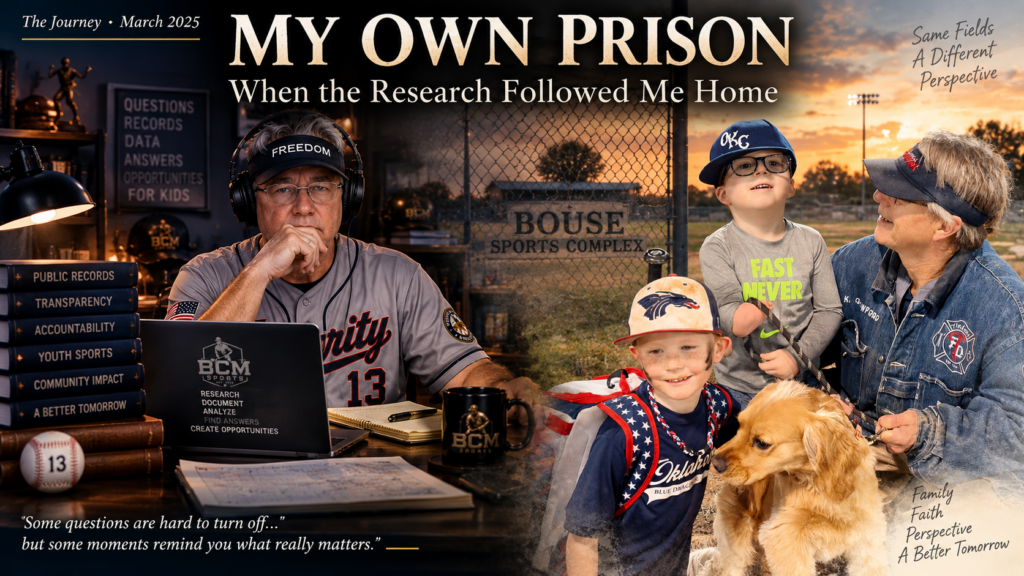
That evening, we went to Bouse Sports Complex in Choctaw to watch my grandson play T-ball. Years earlier, Bouse had been part of my own youth-sports journey. Now I was returning for an entirely different reason.
I was not there to operate the complex.
I was not there to negotiate a contract.
I was not there to study tournament finances.
I was there to be Papa.
My family was there. My grandsons were there. Nash was with me. There was a no-pets sign at the complex, so Nash and I watched from outside.
It should have been simple.
But familiar places carry memories.
Standing there, I recognized that I needed to put some of those memories behind me so I could enjoy watching my grandson play. I also admitted something else: knowing what I believed I had learned about these facilities and the youth-sports system continued to eat at me.
That is probably the best explanation of My Own Prison.
The research was no longer confined to a computer screen, a spreadsheet, a public-record request or a case-study folder. It was coming with me to the ballpark.
Researcher. Dad. Papa.
The photographs from that night mean more to me now because they show what the research cannot.
A database can count teams. A financial model can estimate dollars. Minutes can document votes. Contracts can establish obligations. Emails can preserve conversations.
But none of those things can measure the value of standing beside your grandchildren at a ballfield.
That was the conflict I was beginning to recognize.
I had spent years trying to understand youth sports because youth sports had been such an important part of our family's life. Brian was part of that history. Brad and Bryce were part of it. The Oklahoma Braves were part of it. The Brian Crawford Memorial was born from it.
Now another generation was beginning.
If I allowed every ballpark to become only a case study, every game to become a financial question, and every organization to become another research file, then somewhere along the way I risked losing the very thing I was trying to protect.
The Journal Stopped
I did not maintain My Own Prison for very long.
There was no formal final episode. No carefully written conclusion. No announcement that the project was over.
I simply stopped keeping up with it.
For a long time, that made the recordings feel unfinished. Today I see them differently.
Maybe they captured exactly what they needed to capture.
They preserved a few weeks when the research, the memorial, my faith, my family and my search for purpose were all colliding. They captured the point when I was beginning to understand that finding answers and carrying every unanswered question are not necessarily the same thing.
What I Hear Now
Listening back, I hear someone trying to connect every dot.
I hear someone who believed documentation mattered because memories change and narratives change.
I hear frustration.
I hear faith.
I hear a father still carrying Brian.
I hear pride when I talk about my children.
And I hear Papa beginning to understand that sometimes the most important thing happening at a ballpark has nothing to do with the research.
Some questions are hard to turn off.
But some moments remind you what really matters.