
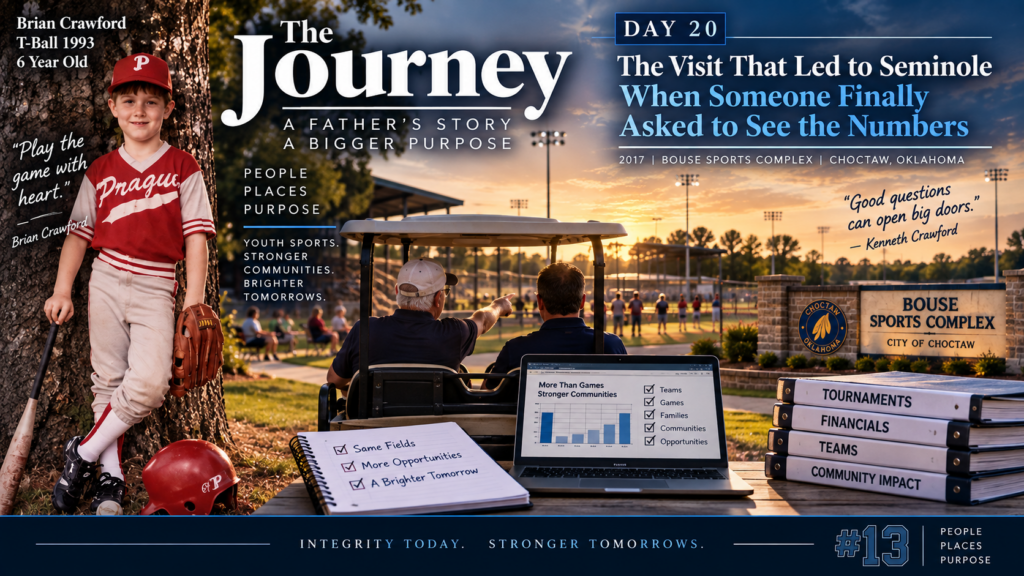
The Journey - Day 20
The Visit That Led to Seminole - When Someone Finally Asked to See the Numbers
Journey Marker: 2017 | Bouse Sports Complex, Choctaw - A Golf-Cart Ride, a Database, and a New Possibility
One of the most important conversations in this entire journey did not happen in a boardroom.
It happened during a softball tournament at Bouse Sports Complex.
Midwest Sports Productions was running a college-showcase event. The players were high-school girls hoping to be seen by college coaches, and the complex was busy.
During that event, a representative from the Seminole State College Education Foundation came to Choctaw.
We spent a couple of hours together.
We drove around the complex.
We talked.
And he asked questions.
That part matters to me, because by then I had spent years trying to explain what I believed sports could do for a community. I had talked about teams, tournaments, hotels, restaurants, families and economic activity.
This time, someone wanted to understand how it actually worked.
Firsthand Memory
My recollection is that Seminole State College and its Education Foundation were already considering an athletic-development project that included a baseball stadium for the college, a field that could serve Seminole High School, an indoor facility and a college soccer field.
I wasn't invited there to sell them anything.
They came to Bouse.
And I showed them what we were doing.
When the Database Mattered
By that point, I had built something behind the scenes that most people coming through the gates never saw.
A database.
Every day, I was entering financial information, deposits and operating activity.
I had built it because I wanted to know what was actually happening - not what I thought was happening.
If somebody asked me how many games we had played, I wanted an answer.
If somebody asked about revenue, I wanted an answer.
If somebody asked what the operation looked like financially that day, I wanted an answer.
During that visit, I was able to pull up the financial information through the current day and provide it almost immediately.
That made an impression.
In my oral history, I remembered that moment as the point when the people from Seminole began seeing the relationship between the sports complex, community activity and economic impact in a different way.
Looking back, I believe the database did something my words alone could not do.
It made the operation visible.
From the Historical Record
The later record helps place this period in the broader transition from Bouse to the Seminole project.
Brian's Memorial Was Still the Reason
Through all of this, I was still looking for a permanent home for Brian's memorial.
That part of the story can get lost when we talk about fields, contracts and financial models.
I wasn't trying to become a researcher.
I wasn't trying to build an economic-impact study.
I was a dad trying to turn something created in my son's memory into something permanent.
After the Bouse visit, the conversation with Seminole developed quickly.
My recollection is that the proposed project began changing from a relatively traditional college athletic project toward a larger sports-complex concept.
Later in my oral history, I described that Bouse golf-cart tour as an important moment in the evolution of that vision.
The discussions eventually reached Brian's memorial.
In my recorded recollection, the conversation moved toward a $500,000 memorial contribution connected with naming rights for what would become the Brian Crawford Memorial Sports Complex.
At the time, it felt like the opportunity we had been searching for.
Looking Back
Years later, when I wrote Integrity of the Game, I would describe youth sports as an economic system in which public facilities, nonprofit organizations, private operators, families and officials can all participate in the same activity while financial information remains fragmented.
But that wasn't what I was thinking about on the golf cart.
I was thinking about Brian.
I was thinking about whether this could finally be the place.
And I was learning something else that would stay with me:
Good records change conversations.
When somebody asks a question and you can show them the answer, the discussion becomes different.
That database began as a tool to help me run Bouse.
In hindsight, it became one of the bridges between the memorial work I had been doing and the research work that would define the next chapter of my life.
"I thought I was documenting a sports complex. Looking back, I was learning how powerful it is when somebody can actually see the numbers."
Question for the Reader
How often do promising community partnerships begin simply because one person is willing to ask questions - and another person has kept enough records to answer them?
Next on The Journey
The Seminole opportunity felt like the answer to a search that had lasted years.
But when that opportunity became public, my work at Bouse and the new project in Seminole were about to intersect in a way I had not expected.
Next on The Journey: When Two Opportunities Collided - Choctaw, Seminole, and the Question of Conflict.
The Journey is a continuing first-person series tracing the path from family and memorial work through hands-on youth-sports operations and, eventually, toward research and reform.