
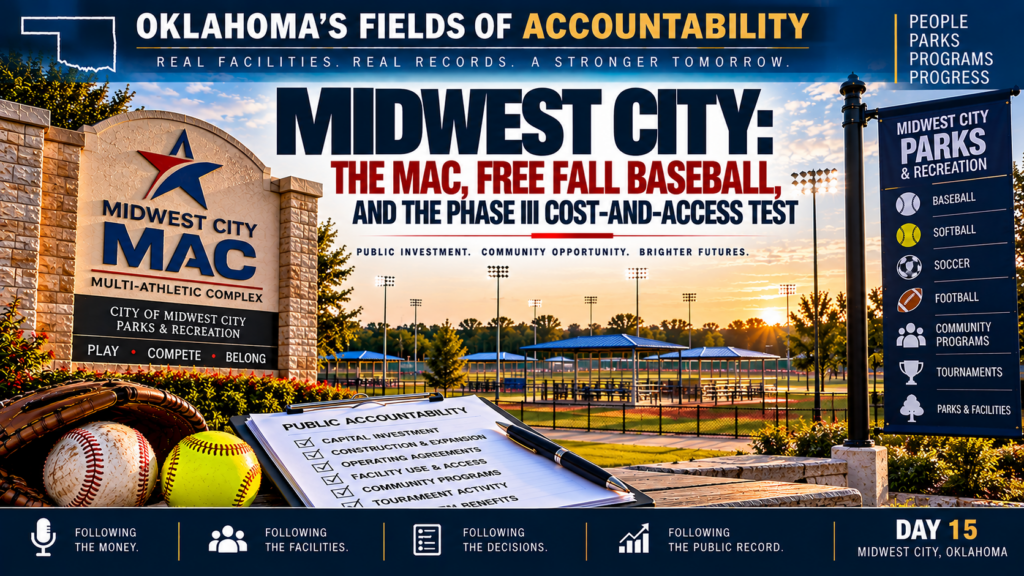
Oklahoma’s Fields of Accountability — Day 15
Midwest City: The MAC, Free Fall Baseball, and the Phase III Cost-and-Access Test
Research edition: October 21, 2026
Municipality / county: Midwest City, Oklahoma County, Oklahoma
Primary facility: Midwest City MAC (Multi-Athletic Complex), 9400 SE 29th Street
Public-asset jurisdiction: City of Midwest City; its elected City Council and Parks & Recreation administration
Public-decision review: 2018–2026, with the 2026 construction procurement receiving special attention
Hidden Valley / USSSA research window: 2001–2026 overall; the MAC itself is represented in 2023–2026
Series control: Day 15; a new municipality following Day 14 Sand Springs. Day 1 remains the separate Tulsa city/county jurisdictional case study.
Central question: Midwest City can point to a publicly owned, multi-sport venue, tournaments, and a 2026 youth baseball season advertised with no team or plate fees. As the City prepares to add three more fields, what can residents examine to verify actual construction costs, community field priorities, affordability, and measurable public benefit?
Research-status notice. This is a documentary review and an invitation to verify the record, not a claim of misconduct. Official City facility and recreation pages, a City-hosted construction bid posting, a City municipal report, an independent Hidden Valley activity inventory, and several secondary development accounts are available. Final executed Phase III construction awards, consolidated paid-to-date ledgers, audited facility-specific collections, and any tournament-user agreements have not been assembled for this installment. The absence of those records from this research is not proof that they do not exist, that the City failed to create them, or that any operator acted improperly. A formal Open Records Act request was emailed to City Clerk Sara Hancock on October 21, 2026, at 11:57 a.m., with the comprehensive Attachment A and copies of the prepared electronic form. A City acknowledgment, tracking number, production, or fee assessment has not yet been documented.
Executive findings
- A City-managed public asset rather than an assumed private lease. The City lists the MAC at 9400 SE 29th Street, directly invites tournament reservations through Parks & Recreation, describes three existing all-turf interchangeable fields, and states that construction of three additional Phase III fields begins in 2026. The City’s public recreation pages also identify community league programming at the MAC. No exclusive private-operator lease is established by these sources. [S1] [S2]
- A tangible 2026 affordability policy. The City advertised free team registration and no plate fees for its fall 2026 baseball league at the MAC and Reed Ballpark. It also described five age-group brackets, potential free practice slots at Doug Hunt, and minimum game targets. This documents published terms, not a verified count of children enrolled or an assertion that every family expense was eliminated. [S3]
- A publicly visible expansion process, but not yet a reconciled final construction cost. The MAC is part of the voter-approved 2018 Moving Forward general-obligation bond capital program. An earlier May 2018 presentation identified a $6.18 million proposed multi-purpose athletic facility, a planning figure rather than paid expenditures. News coverage reports a 2025 Council-approved $530,550 MAC design task order, part of a combined $613,550 arrangement that also included unrelated police/fire facility design. The City issued Phase III bid documents April 9, 2026, closing April 29, 2026. Those bid documents are primary procurement evidence, but do not alone establish the selected awardees or final payment totals. [S1] [S5] [S6] [S7]
- The research dataset supplies a conservative activity baseline. The exact-label, stand-alone “Midwest City MAC” records contain 25 identified events, 43 division-level rows, 380 team entries, $121,073 in calculated entry fees, 1,029 modeled minimum games and 2,058 modeled officiating assignments across 2023–2026. These are independent research calculations, not audited facility revenues or paid umpire positions. [R1] [R2]
- Do not assign multi-site tournament totals to the MAC. A separate associated population containing the MAC and other named venues has 1,419 team entries and $555,020 calculated entry fees. Its inclusion produces a broad $676,093 combined footprint, but the associated $555,020 cannot be attributed to one physical facility without schedules and settlements. [R1]
1. The governing line: who owns the asset, and who makes which decision?
The MAC is a Midwest City municipal parks facility. Its City-published description attributes construction to the Moving Forward 2018 general-obligation bond program and routes facility reservations to Parks & Recreation rather than identifying an exclusive independent operator. This is a different management model from a city leasing a ballpark to a single youth-sports organization. The existence of tournament partners does not, without signed agreements, establish who receives entry fees, gate charges or concessions. [S1] [S2]
The voters authorized the broader 2018 bond package; they did not approve each subsequent invoice. The City Council, acting collectively, approves budgets, contracts and applicable policy; an individual member’s public statement is not automatically a governing-body decision. The city manager, Parks & Recreation staff, procurement and finance personnel implement policy and manage reservations and payments within delegated authority. The 2025 design agreement is reported in contemporaneous news as Council-approved, but this edition has not independently checked the motion, second, recorded vote and signed task order in the official minutes. Therefore, no specific individual vote is assigned. [S5] [S6] [S8]
In a 2025 account of the design decision, Ward 2 Councilmember Pat Byrne was quoted praising tournament demand, while Assistant City Manager Vaughn Sullivan described operational demand and procurement experience. These are reported individual remarks and administrative explanations, not findings that either person controlled all field bookings or determined final construction costs. Likewise, this installment does not assign current officials retrospective responsibility for pre-election bond decisions. [S6]
2. A dated documentary chronology
| Date / period | Record-supported development | Decision classification | What the document does not establish |
|---|---|---|---|
| May–August 2018 | An advance municipal bond presentation proposed a $6.18 million multi-purpose athletic facility. City materials describe the $21.6 million Moving Forward parks-and-recreation bond program as voter-approved. | Planning proposal, followed by electoral authorization. | Final Phase I cash spending, a construction award, or that the entire $21.6 million belonged to the MAC. [S1] [S5] |
| January 2021–April 2022 | Phase I construction began in 2021; the first three turf fields opened in April 2022. Contemporary reporting described about $6 million in first-phase design and construction. | City capital implementation; the reported figure is an approximate contemporary cost description. | Audited paid-to-date capital totals or full lifecycle expense. [S4] |
| 2023 | Contemporary City reporting described growing tournament use and further parking/concession development; the Hidden Valley direct facility population begins in 2023. | Administrative programming and facility development; modeled tournament dataset. | That every event occurred solely at the MAC, or that tourism claims are a measured causal benefit. [S9] [R1] |
| 2025 | City municipal report documents youth leagues and tournament partnerships, including USSSA Baseball, Alliance Fastpitch and Special Olympics. August reporting describes $530,550 MAC design services within a $613,550 two-project agreement. | Published operational report; reported collective Council procurement action. | Audited MAC operating margin or verification of the exact Council vote without the official minutes and final contract. [S6] [S10] |
| April 9–29, 2026 | City posted its Phase III bid solicitation, project manuals and drawings; bid opening deadline April 29. | Documented public procurement solicitation. | Contract awards, accepted alternatives, change orders or actual payments. [S7] [S11] |
| Fall 2026 | City advertised no team fees and no plate fees for youth baseball, with MAC and Reed named as game locations. | Published administrative program rules. | Final attendance, participation mix, or elimination of other family costs. [S3] |
| 2026–2027 (planned) | City says Phase III construction begins in 2026; contractor portfolio describes a summer 2027 target and a $10–12 million project range. | City construction-plan statement; contractor-published estimate/range. | Verified executed contract price, final project expenditure, guaranteed date or completed new fields. [S1] [S12] |
3. Contracts, rentals, agreements and what the actual records show
The publicly visible City facility listing offers municipal reservation contact information, amenities and field rules. It does not display the executed tournament rental agreement, rate sheet, field-priority policy, event settlements, gate and concession allocations, or injury/insurance provisions. Nor does it prove that any particular outside organization has been granted exclusive control. Those underlying instruments are the proper next records to examine. [S1]
The City’s 2026 Phase III bid posting is a concrete primary document: it shows when bidding opened and closed and links the project manual, construction manager manual, drawings and addendum. The publicly indexed bid-tab document contains trade-package comparisons—including fields, paving and electrical packages—but a bid tab is not a notice of contract award, and summing each bidder’s offered price would double-count unselected alternatives. The final authorization, construction management arrangement, guaranteed maximum price if applicable, executed trade contracts, change orders and paid invoices must be traced separately. [S7] [S11]
The contractor Lippert Bros. describes Phase III as a $10–12 million current project with a summer 2027 target. Because that is a contractor portfolio description—not a signed City construction agreement examined here—it is presented as a prospective range, never as verified taxpayer spending. It must not be added to the earlier 2018 project-planning estimate, the 2025 design task order or the broad $21.6 million bond total to create a supposed all-in cost. [S12]
The City’s 2025 municipal report identifies sports partnerships and a municipal programming structure, but it does not by itself reveal the terms under which each event operator collects entry fees or rents fields. Likewise, public-facing league registration terms establish published pricing, not accounting entries. [S3] [S10]
4. Hidden Valley / USSSA: an exact-site measure, not a cash account
The September 20, 2026 Hidden Valley facility inventory identifies the exact label “Midwest City MAC.” The conservative facility-specific figures below include stand-alone event labels only. Event counts are de-duplicated tournament identifiers; division counts are dataset rows, not 43 proven unique age categories. Team entries are cumulative registrations, not the count of unique local clubs or athletes. [R1] [R2]
| Measure | Direct MAC, 2023–2026 | Interpretation |
|---|---|---|
| Seasons represented | 4 | 2023, 2024, 2025 and 2026; not the 2001–2026 entire statewide research window. |
| Event identifiers | 25 | Dataset-defined historical events; exact-label stand-alone population. |
| Division-level rows | 43 | Rows, not unique age divisions. |
| Team entries | 380 | Cumulative event registrations, not individual resident teams. |
| Calculated team-entry fees | $121,073 | Sum of team counts × public listed entry fees; not receipts. |
| Baseball / softball calculated entry fees | $89,297 / $31,776 | Dataset sport splits, not operator or City financial statements. |
| Modeled minimum games | 1,029 | Model-derived games, not verified field calendar actuals. |
| Modeled official assignments | 2,058 | Assignment-equivalents, not distinct officials or confirmed payroll. |
| Linked directors / organizations | 3 | Research associations, not identified City lessees. |
Direct annual activity (calculated, not collected):
| USSSA research season | Direct division-level event groups* | Team entries | Calculated entry fees | Minimum games | Modeled official assignments |
|---|---|---|---|---|---|
| 2023 | 5 | 85 | $38,690 | 270 | 540 |
| 2024 | 6 | 93 | $25,383 | 245 | 490 |
| 2025 | 5 | 80 | $23,222 | 201 | 402 |
| 2026 | 9 | 122 | $33,778 | 313 | 626 |
| Total | 25 | 380 | $121,073 | 1,029 | 2,058 |
*The annual inventory counts correspond to unique event counts for the exact facility label, not division-row totals; the 43 division rows are an additional aggregation. The 2026 season ends July 31, 2026 under the dataset’s USSSA-season convention. [R2]
Related multi-venue context—separate population, never reassigned to MAC:
| Measure | Associated multi-facility events only | Direct + associated descriptive footprint |
|---|---|---|
| Team entries | 1,419 | 1,799 |
| Calculated entry fees | $555,020 | $676,093 |
| Minimum games | 4,351 | 5,380 |
| Modeled officiating assignments | 8,640 | 10,698 |
The largest associated configuration is MAC + Reed Baseball Complex, listed at approximately $264,899 calculated fees; it names two distinct municipal facilities. The dataset does not show that the entire event, every team or all those fees belonged to the MAC. Nor should that multi-facility amount be counted again in a separate Reed study when constructing a statewide total. For county-level allocation, assign an event only to its independently verified primary facility county, rather than mechanically splitting across listed venues; unresolved primary hosts must remain flagged. [R1] [R2]
5. Financial accountability: do not mix four different kinds of dollars
| Financial reference | Amount | Evidence classification | Missing verification |
|---|---|---|---|
| Moving Forward 2018 bond program | $21.6 million | Broad voter-approved City program; not MAC-only. [S1] [S9] | Official ballot, issuance schedule and department-level allocation/paid totals. |
| 2018 MAC planning estimate | $6.18 million | Proposal-stage multi-purpose athletic facility allocation from 2018 briefing. [S5] | Final original capital budgets and construction pay applications. |
| MAC Phase III engineering/design task order | $530,550 | 2025 reported Council-authorized design-service amount; separate $83,000 police/fire scope in combined $613,550. [S6] | Executed task order, motion/second/vote, invoice ledger and revisions. |
| MAC Phase III contractor-published project range | $10–12 million | Outside-contractor portfolio description; not verified executed contract or payment. [S12] | Award action, GMP if any, final agreement, change orders, paid invoices. |
| Historical direct USSSA team-entry fee calculation | $121,073 | Independent 2023–2026 model; not City revenue. [R1] | Tournament settlements, operator filings and bank or City deposits if legally obtainable. |
A completed economic-impact evaluation also needs a defensible baseline: visiting team nights, hotel occupancy actually attributable to events, local spending versus displacement, municipal staffing, maintenance, turf replacement reserves and the value of local field hours. Tournament volume and gross spending assumptions alone do not prove net taxpayer benefit.
6. How Public Decisions Shape a Healthy Community-Based Program
Affordability. The City’s 2026 decision to advertise no team registration fees or plate fees for fall baseball is a concrete published affordability step. It needs follow-up on uniforms, travel, equipment, volunteer and insurance expenses, and the number of families actually reached. [S3]
Local league stability. The City identifies the MAC and Reed Ballpark as home sites for its community baseball league and advertises weekday game blocks. Stable seasonal access is a potential structural benefit; actual priority during competing tournament weekends requires field calendars and cancellation records. [S2] [S3]
Volunteers. Providing a predictable league schedule and free team entry can support volunteer coaching, but the available public pages do not quantify coaching hours, background-check procedures, training costs or volunteer turnover. Those are reasonable program-health indicators, not established deficiencies.
Equitable access. The MAC advertises ADA-accessible spectator areas and interchangeable fields, while the city offers 4U–12U baseball brackets. Equity also requires examining disability accommodations for players, registration caps, waiting lists, resident/nonresident priority, girls’ and softball access, and transportation barriers. [S1] [S3]
Transparency. City facility pages and the April 2026 public bid package make the basic asset and procurement visible. The next accountability layer is publishing adopted field-use rates, contract parties, general priority rules, annual utilization and budget-versus-paid project reporting. [S1] [S7]
Reinvestment. Expansion from three fields toward six may reduce overflow bookings and open practice slots, but turf, lighting and infrastructure have future replacement and maintenance costs. Capital approval must be evaluated alongside reserves and life-cycle budgets, rather than assumed to be costless once construction is finished. [S1] [S12]
Competition. The City’s 2025 report identifies USSSA Baseball, Alliance Fastpitch and Special Olympics partnerships, demonstrating more than one event category. Scheduling balance—and whether independent organizers face published, comparable terms—still requires application forms, booking logs and signed agreements. [S10]
Player development. The 2026 published baseball program spans developmental T-ball through 11U/12U, with stated seven-game minimums for younger divisions and 14-game minimums for older divisions. Announced minimums are program promises to verify against completed schedules, not evidence of athlete progress by themselves. [S3]
Long-term sustainability. Public ownership, municipally managed reservations, a youth league and modular fields are useful ingredients. Actual sustainability depends on demonstrated access, maintenance, risk allocation, event revenue reconciliation, staffing, accessible scholarships where needed, and financial transparency before and after Phase III. [S1] [S2] [S10]
Decision-level distinction: the 2018 bond was a voter authorization; MAC policies on published league fees and bookings are municipal administrative program decisions unless a contrary adopted Council rule is located; the 2025 design arrangement is a reported collective Council action requiring a verified roll-call source; the 2026 bid posting is procurement activity, not an award; volunteer supply, travel-team demand, rainouts and long-term turf wear are structural conditions. These categories should not be collapsed into an allegation against a particular elected official.
7. Evidence categories, conclusions and unanswered questions
Documented public facts: Midwest City identifies the MAC as a voter-supported municipal facility with three current turf fields and a Phase III three-field build; the City publicly advertised free team and plate fees in fall 2026; and the City publicly issued an April 2026 Phase III solicitation. [S1] [S3] [S7]
Independent calculations: 25 direct tournament event identifiers, 43 division rows, 380 team entries, $121,073 calculated entry fees, 1,029 minimum games and 2,058 official assignments across four represented seasons. These do not establish actual receipts or the number of unique people. [R1] [R2]
Reported, not independently reconciled: 2025 design appropriation of $530,550 for the MAC; contractor’s prospective $10–12 million Phase III project range and target completion; media-reported statements by Councilmember Byrne and administrators. The legal instruments, exact vote, contract scope and approved paid totals still need official corroboration. [S6] [S12]
Allegations: None are made in this installment. The materials examined do not support asserting fraud, corruption, illegality, private enrichment or an elected official’s failure.
Provisional conclusion: Midwest City offers an especially useful comparative case because it publishes a concrete 2026 affordable community-league program while simultaneously expanding public facilities for tournament and other recreation demand. The unresolved public-interest issue is measurement: do actual field hours, family costs, procurement decisions and project payments substantiate the intended balance between local play and regional events?
8. Records Still Needed — Formal Request Sent October 21, 2026
- 2018 voter materials, bond issuance and annual project accounting: original ballot and certified outcome; source-and-use schedule; initial MAC capital authorizations; Phase I/II construction contracts, design fees, retainage, change orders, paid invoices and asset capitalization.
- August 2025 City Council record: official agenda and minutes; motion, second and roll-call if recorded; executed C.H. Guernsey master agreement and MAC-only $530,550 task order; all subsequent amendments.
- 2026 Phase III award file: procurement question-and-answer logs, bid tabs and evaluation/scoring, selected bidders, award minutes, construction manager/GMP documents if applicable, signed trade contracts, alternates, bonds, notices to proceed, change orders and paid-to-date invoices.
- 2023–2026 MAC reservation/use agreements: standard and negotiated rate sheets; applications; permits; sports-organization agreements; local-league priority and cancelled/rescheduled events; parking, access and tournament operational terms.
- Actual MAC financial records: annual rental receipts and deposits, concessions or vendor revenue, gate settlement arrangements if any, labor, utilities, cleaning, security, insurance, repairs, turf maintenance and depreciation/replacement reserve planning.
- 2026 free baseball season actuals: teams enrolled, age divisions, scholarships/fee waivers if any, final games completed, resident/nonresident splits only in aggregate, waitlists, field calendars and cancellations; no private child-level data required.
- Multi-site reconciliation: for MAC + Reed and other combinations, identify the primary event host/facility, actual assigned fields and dates, split of games and teams, event settlement statements and any City payments. Retain event-ID deduplication.
- Outcome testing: measured hotel-night or local visitor data tied to specific events, comparison periods, maintenance and staffing net costs, accessibility feedback and published annual community-benefit criteria.
9. Oklahoma Open Records Act Request — Submission & Response Tracker
Status as of October 21, 2026: Formal request emailed; City acknowledgment pending. The supplied sent-email record shows transmission to City Clerk Sara Hancock at 11:57 a.m. on October 21, 2026, with three attachments. This documents the sender's email transmission, not confirmed receipt, acceptance, or processing by the City. The electronic form was prepared and included as an attachment; the available evidence does not establish that the form's separate Submit button was used.
| Tracking item | Documented status |
|---|---|
| Requesting party | Kenneth R. Crawford, Brian Crawford Memorial / BCMSPORTS |
| City records custodian | Sara Hancock, City Clerk — shancock@midwestcityok.org |
| Submission | October 21, 2026, 11:57 a.m. — email sent to City Clerk with comprehensive Attachment A |
| Requested coverage | January 1, 2001–October 21, 2026, where records exist; MAC-specific capital review principally 2018–2026 |
| Facility scope | Midwest City MAC, Reed Ballpark, Doug Hunt Park, and other applicable City baseball/softball facilities |
| Requested format / fee control | Electronic records; advance written approval required before charges exceed $25 |
| City acknowledgment / tracking number | Not yet documented |
| Records produced / City fees / final disposition | Not yet documented |
Records requested. The October 21 Attachment A details nine categories: (A) facility ownership and operating authority; (B) reservations, tournaments and league access; (C) collections and revenue flows; (D) operating costs and sustainability; (E) 2018 bond and MAC Phases I/II; (F) MAC Phase III design, bids, awards and payments; (G) City Council and administrative decisions; (H) 2026 free baseball program and public benefit; and (I) production, exemptions and cost controls.
Submission documentation. The sent-email PDF records the recipient, date, request text and three attachments: a screenshot of the prepared electronic form, a PDF copy of the prepared electronic form, and the four-page comprehensive Attachment A. The form's text area could not accommodate the full request, so the complete request was transmitted by email. The full supporting documents are retained in the research archive; no public download URL has yet been supplied for these local files.
Public follow-up log: October 21, 2026 — request sent by email; awaiting acknowledgment. Subsequent entries will distinguish City statements, documents received, verified financial findings, costs, redactions and unresolved issues. No response or refusal is inferred from the current absence of an acknowledgment.
Official submission resources: City open-records information | Electronic request form.
10. Right of Response
The City of Midwest City (City Council, City Clerk, Parks & Recreation, Engineering, Finance and procurement), current and former MAC recreation staff, C.H. Guernsey & Co., Lippert Bros., community baseball and softball participants, tournament organizations, coaches, volunteers and families are invited to submit specific corrective documents, signed agreements, financial schedules, fee rules or measurable participation evidence. A response will be attributed and incorporated after verification; silence is not interpreted as an admission, and no City reply is implied by the October 21 request email. The City's records contact page lists City Clerk Sara Hancock, shancock@midwestcityok.org, and its public requests process. [S13]
11. Sources and methods — verifiable source register
Official City of Midwest City evidence
- [S1] Midwest City MAC official facility listing — location, voter-funded facility, three existing turf fields, Phase III plan, amenities and reservations.
- [S2] City Parks & Recreation Department — municipal recreation services, baseball league and multi-sport programming links.
- [S3] Midwest City Baseball League — fall 2026 program — no team/plate fees; practice arrangements; age brackets; schedules and published minimum games.
- [S5] May 14, 2018 special meeting and Moving Forward project presentation (PDF) — proposal-stage approximately $6.18 million athletic complex amount; not final spending.
- [S7] City MAC Phase III bid posting, April 9–29, 2026 — solicitation, manuals, drawings and addendum.
- [S8] City Council government and records responsibilities — council-manager form, budgeting, motions and official minutes access.
- [S10] City of Midwest City 2025 Municipal Report (PDF) — Parks & Recreation sports-facility and event partnership reporting, including MAC/Reed.
- [S11] City-hosted 2026 MAC Phase III bid-tab compilation — bids by trade and alternatives; not final award.
- [S13] City Media Contacts / Open Records Requests — official process and City Clerk contact.
Public reporting and developer material (different evidence levels)
- [S4] Central Oklahoma Weeklies, MAC April 22, 2022 grand opening — first-phase completion and approx. $6 million contemporary description.
- [S6] Central Oklahoma Weeklies, August 12, 2025, Phase III design approval reporting — $530,550 MAC design and separate $83,000 training-center design; official agreement/roll-call still requested.
- [S9] The Journal Record / Oklahoman, May 10, 2023 — historical bond-program context, MAC/parking/Reed descriptions; reported rather than audited expenses.
- [S12] Lippert Bros., Midwest City MAC Phase III contractor project page — stated $10–12 million project range and summer 2027 target, neither independently reconciled to City contracts.
Independent research dataset (not governmental finance documents)
- [R1] Baseball Heaven — Midwest City MAC direct, associated and combined facility profile — published facility research, including allocation cautions.
- [R2] Hidden Valley — HVIOG_9-20-2026_Master_Sports_Facilities_Inventory.csv, exact-label “Midwest City MAC,” and HVIOG_9-20-2026_Sports_Facilities_Inventory.xlsx, sheet “Facility by Year”; from AIUSSSA - HVIOG 9-20-2026.csv. Internal research archive baseline, September 20, 2026. The 25 event identifiers / 43 division rows distinguish events from divisions. Use with reconciliation controls; not audited receipts.
Editorial methodology: Facts come from cited municipal material where possible; newspaper quotations are attributed as reporting; a contractor's anticipated value is not a City payment; dataset models are separated from City accounts; and missing documents prompt testable requests, never automatic accusations. For multi-facility county assignments, use the verified primary facility's county, not a proportional guess.
Following the money. Following the facilities. Following the decisions. Following the public record.