
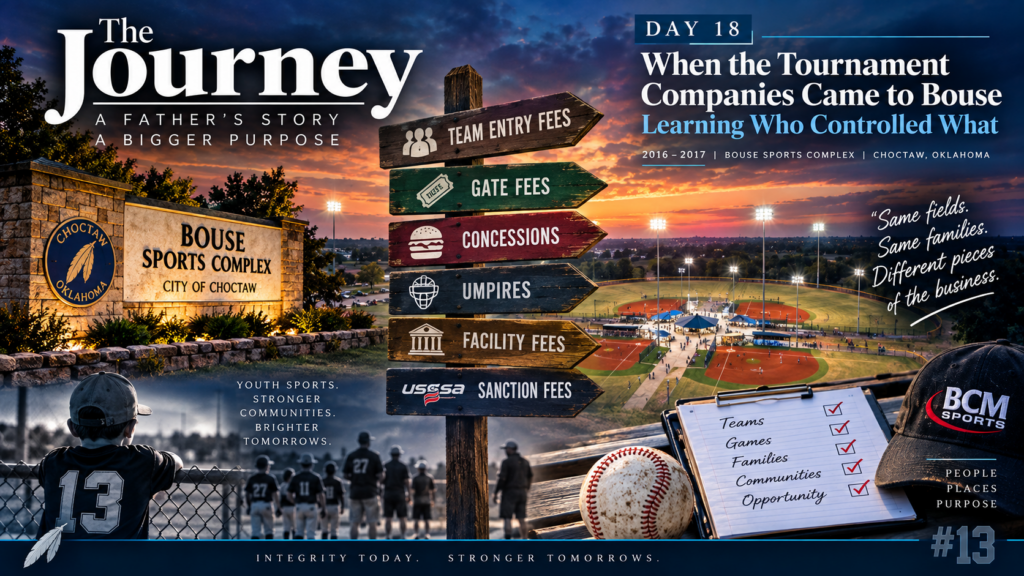
The Journey - Day 18
When the Tournament Companies Came to Bouse - Learning Who Controlled What
Journey Marker: 2016-2017 | Bouse Sports Complex, Choctaw - One Facility, Different Pieces of the Business
By the time we had teams coming through the gates and Eddie Woods had the umpire program taking shape, I was beginning to understand something I had never really seen as a tournament director.
A sports complex could be full of people, full of games and full of money changing hands - and no single person or organization necessarily controlled all of it.
That lesson started with our agreement itself.
My recollection has always been simple: BCM Sports had the fields. We did not have the concessions.
I had moved from renting a complex for one weekend to operating the field side of Bouse Sports Complex, but one piece of the business was already outside our control.
At first, I didn't look at that as a research question.
It was just the arrangement.
Then the tournaments started teaching me the rest.
Two Tournament Worlds on the Same Fields
Firsthand Memory
The Choctaw-area league culture I was working with had historically used a January 1 age cutoff. USSSA baseball used a different age structure.
That created a practical problem.
I wanted activity at Bouse. I needed games on those fields. But I also had to work within the tournament market that already existed.
My recollection is that BCM Sports handled the January 1 tournaments, while Rick Glasser and Shootout Baseball handled the USSSA baseball tournaments.
On those Shootout weekends, Rick collected the team entry fees.
I collected the gate, paid the umpires and then satisfied the game-fee obligation connected to the facility.
Nobody handed me a textbook explaining what I was seeing.
I was learning it weekend by weekend.
The same team could pay one organization to enter the tournament.
The family could pay another stream at the gate.
Someone else could operate concessions.
Umpires had to be paid.
The City had its facility-related charges.
USSSA had its sanctioning structure.
All of it could happen during the same tournament.
From the Historical Record
Later reconstruction of the Bouse operating model confirms that outside tournament providers became part of the facility's operating network while BCM Sports remained the municipal field and program operator.
It Didn't Always Work the Same Way
This is also where I have to be careful not to simplify the past.
Not every outside tournament arrangement worked exactly the same.
My oral-history recollection is that some Midwest Sports Productions softball events operated differently.
As I remember it, MSP could handle the gate and officials and pay BCM what I remember as a sublease-type amount, while BCM then satisfied its underlying obligation to the City.
That recollection is useful evidence.
But it should not be substituted for contracts, settlement sheets or banking records where those records exist.
That's an important distinction.
What I remember explains how I experienced the system.
Documentation determines what we can establish as fact.
What I Didn't Understand Yet
I wasn't standing at Bouse in 2016 thinking about revenue fragmentation.
That term came much later.
I was thinking:
Did the gate cover the umpires?
Did we have enough teams?
Did I owe the City game fees?
Could we make next weekend work?
Could we put money back into Brian's memorial instead of losing money operating the facility?
It wasn't until after my later years at Seminole State that I began going back through the public data and reconstructing what these tournament systems actually looked like financially.
In my own recorded history, I acknowledged that much of what I eventually learned about tournament-entry-fee activity came after I had lived through Bouse.
Looking Back
Today, I can see why Bouse became so important to everything that followed.
Later research separated the pieces I had once experienced simply as "running tournaments":
Team entry fees.
Gate receipts.
Concessions.
Municipal usage payments.
Umpire compensation.
Sanction fees.
And the broader spending families brought into a community.
The question eventually became less about how much money a tournament generated and more about who controlled each stream, who carried each expense and who carried the risk.
That wasn't Integrity of the Game yet.
It was just me trying to keep baseball games going in Choctaw.
But the questions had started.
"Same fields. Same teams. Same families. Different people controlled different pieces of the money."
Question for the Reader
When an event takes place on a taxpayer-owned sports complex, what should families and the public reasonably be able to understand about who controls the entry fees, gate, concessions, officials and facility payments?
Next on The Journey
Learning who controlled the different pieces was one thing.
Then the cost of operating those fields began to change.
What I remember starting at one rate eventually became something very different - and the numbers started changing the relationship.
Next on The Journey: When the Math Changed - From $5 a Game to $15 a Game.
The Journey is a continuing first-person series tracing the path from family and memorial work through hands-on youth-sports operations and, eventually, toward research and reform.