OK Kids Baseball Association
Oklahoma Youth Sports Community Opportunity
A living institutional research profile examining Oklahoma's community-based baseball model through the documented Lincoln County record, public-facility use, player development, umpire workforce demand, local economics and the conditions that may help community programs coexist with travel and tournament sports.
What This Research Can — and Cannot — Establish About OK Kids
The existing source is a detailed Lincoln County OK Kids baseball case study. It documents how community baseball operated across the researched games and facilities. It should not silently be treated as a complete statewide organizational history or as evidence about softball where the current dataset does not establish that scope.
Documented Community Model
The Lincoln County record centers recurring league play, local/community identity, public facilities, player development, families, volunteers and officials. That documented operating pattern is the principal evidence base for this profile.
Statewide Organization — Further Research Needed
The current source does not fully establish OK Kids' statewide legal structure, governance history, statewide participation totals, all local-association relationships or the organization's present softball scope. Those remain research tasks rather than assumptions.
Lincoln County Case Study: Community League, Umpire Workforce & Rural Economic Research
A comprehensive analysis of 1,385 Lincoln County OK Kids Baseball game records examining community-based rural baseball, municipal-facility use, umpire workforce demand, officials compensation, game-day economics and local economic impact.
This Lincoln County dataset now serves both the existing Integrity of the Game vs. Economic Impact (Politics); The Oklahoma Business Plan research and the Better Together institutional profile. Lincoln County demonstrates that substantial economic activity can exist within a youth-sports system while the operating structure remains centered on local communities, recurring league play, public facilities, player development, families, volunteers and officials.
The Central Research Question
How does economic activity interact with a community-based baseball model, and what conditions allow community recreation and other youth-sports models to coexist?
Key Findings
Methodology: Gate, concession, attendance, player-count, event-net and economic-impact figures are modeled research estimates and should not be interpreted as audited organizational financial statements.
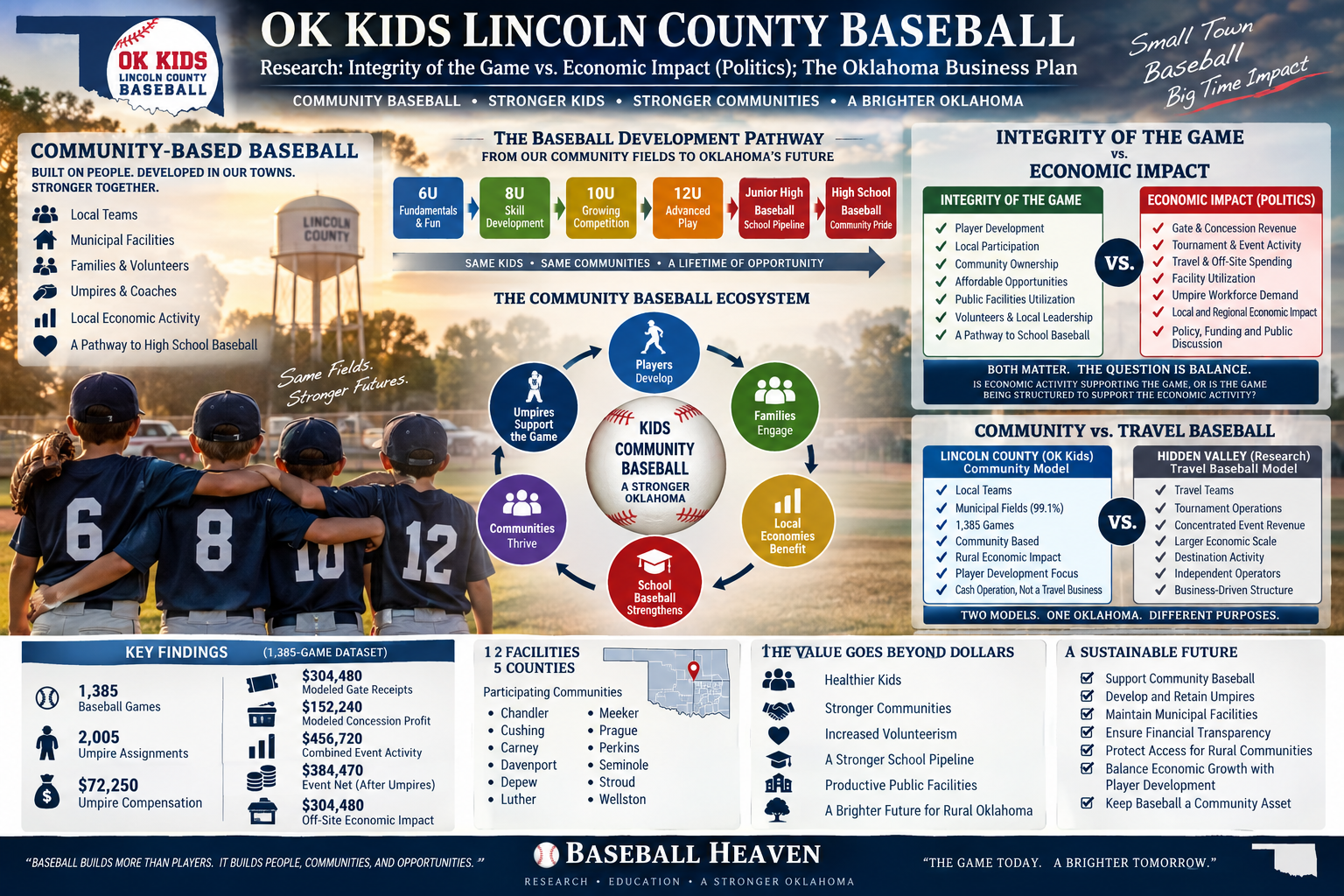
Same Kids. Same Communities. A Pathway to School Baseball.
The community-based structure can allow children to develop alongside classmates and future school teammates while giving rural communities a recurring baseball identity.
Fundamentals
Skill Development
Growing Competition
Advanced Play
School Pipeline
Community Pride
Community Identity
Teams are tied to communities and geographic areas rather than existing solely to enter destination tournaments.
Develop the Players You Have
Rural communities cannot always replace players through broad regional recruiting. Their long-term success depends on developing local children.
Community Capital
Coaches, parents, boards, concession workers, field volunteers, schedulers and officials contribute value not fully captured by the cash model.
The Umpire Is the Common Denominator
Community baseball and competitive travel baseball may operate under different economic structures, but they ultimately draw from a shared human-resource pool.
2,005 Assignments from 1,385 Games
The 10U and 12U divisions account for 620 games but require 1,240 umpire assignments—approximately 61.8% of the documented workload.
Documented Assignment Rates: $25–$50
Total umpire expense equals $72,250, with a weighted average of approximately $36.03 per assignment. The 10U and 12U divisions account for approximately 69.4% of total umpire expense.
From “Umpire Shortage” to Workforce Development
A sustainable Oklahoma strategy should focus on creating, training, compensating, retaining, scheduling and advancing officials—not simply competing over the existing supply.
Economic Activity Supporting Baseball
Modeled Game-Day Economy
- $304,480 modeled gate receipts
- $152,240 modeled concession profit
- $456,720 combined modeled gate + concession activity
- $72,250 umpire expense
- $384,470 modeled event net after umpire expense
Distributed Rural Economic Impact
- $304,480 modeled off-site economic impact
- Economic activity rotates among participating communities
- Fuel, food, beverages and incidental spending
- Off-site impact remains separate from association revenue
- Repetition across hundreds of games creates scale
Cash Activity Alone Does Not Define the Organizational Model
The more meaningful questions are who controls the money, how it is accounted for, how it is distributed, what it supports, who benefits, and whether the financial structure sustains the game and the communities that make it possible.
12 Facilities • 5 Counties • 99.1% Municipal Utilization
Games by County
| County | Games |
|---|---|
| Lincoln County | 963 |
| Seminole County | 221 |
| Payne County | 120 |
| Creek County | 43 |
| Oklahoma County | 38 |
Participating Facilities / Associations
- Prague Youth Baseball Association — 296 games
- Chandler Youth Baseball Association — 213
- Stroud Youth Baseball Association — 209
- Meeker Youth Baseball Association — 155
- Wellston Youth Baseball Association — 140
- Cushing Youth Baseball Association — 115
- Davenport Youth Baseball Association — 108
- Carney — 51 • Depew — 43 • Luther — 38
- Brian Crawford Memorial Sports Complex — 12 • Perkins — 5
Facility finding: 1,373 of 1,385 documented games were conducted at facilities classified as municipally owned. The remaining 12 were associated with the Brian Crawford Memorial Sports Complex, identified in the research dataset as owned by Seminole State College.
Community Baseball and Competitive Travel Baseball
Lincoln County OK Kids Community Model
- Local teams and geographic identity
- Recurring community league schedule
- Predominantly municipal fields
- Distributed rural economic activity
- Player-development focus
- Junior-high / high-school pipeline
- Community-based cash economy
Hidden Valley Research: Travel Baseball Model
- Independently assembled travel teams
- Tournament-centered schedules
- Destination facility activity
- Concentrated event revenue
- Larger commercial scale
- Independent operator structure
- Broader competitive marketplace
Integrity of the Game vs. Economic Impact
The two structures can serve different purposes. The research question is how community recreation, competitive travel opportunities, public facilities and the shared officials workforce can coexist without assuming that one model must displace the other. Lincoln County provides a documented community-based benchmark.
Documented Strengths, Structural Limits & Competing Explanations
Evidence of Community Capacity
- 1,385 documented games create a recurring local-play sample.
- 1,373 games were classified at municipally owned facilities.
- The record spans 12 facilities/associations and five counties.
- The dataset documents a substantial officials workload and compensation stream.
- Teams and facilities remain connected to identifiable communities.
Limits of the Current Record
- Lincoln County does not automatically represent every OK Kids association statewide.
- Modeled gate, concession and economic-impact figures are estimates, not audited financial statements.
- The dataset does not establish why participation may rise or fall over time.
- The current source does not establish the complete statewide softball model.
- Travel/tournament growth should not be treated as a proven cause of community-program change without additional evidence.
Questions for the Next Research Stage
Statewide Governance
What is the current statewide organizational, governance and local-association structure, and how has it changed historically?
Participation Trend
What do statewide registration and team counts show over time, and what competing explanations best account for change?
Baseball & Softball Scope
What sports and divisions does the organization currently administer statewide? The Lincoln County dataset itself is a baseball study.
Affordability
What are actual family, association and municipal costs, and how do they vary across communities?
Facility Access
How are public fields allocated among community leagues, schools, tournaments and other users?
Collaboration
Where could OK Kids, municipalities, schools, officials and tournament organizations complement rather than duplicate one another?
What Would a Sustainable Community-Based Ecosystem Require?
Community Access
Examine affordability, recurring local play and access to public facilities while recognizing that families may also choose travel and tournament opportunities.
Shared Officials Workforce
Test whether community baseball can serve as one entry point for recruiting, training, mentoring and advancing officials who later work across multiple levels of competition.
Public-Asset Stewardship
Examine how public facilities, local associations, finances, scheduling and maintenance can be documented in ways that support community trust and sustainable use.
Closing Perspective
The Lincoln County record documents substantial economic activity within a community-based baseball structure. Better Together uses that evidence to ask how economic activity, player development, public assets and community access can reinforce one another rather than treating economic impact as the only measure of success.
Existing Lincoln County Research Record
The 60-section Executive Summary remains the underlying Lincoln County research record. Better Together adds an institutional framework around that evidence without replacing or rewriting the documented dataset.
Research disclaimer: This material is intended for research, educational, public-policy, youth-sports reform and workforce-development purposes. Modeled financial values are estimates. Nothing in this research, standing alone, establishes financial misconduct, tax violations, improper cash handling, unlawful conduct or wrongdoing by participating organizations, municipalities, facilities, volunteers, coaches or officials.