
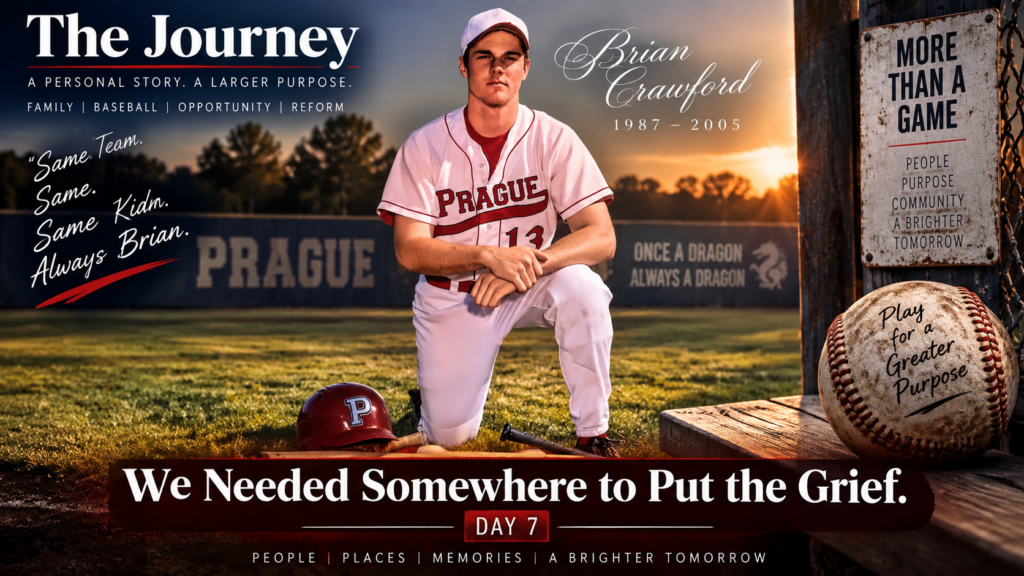
The Journey · Day 7
We Needed Somewhere to Put the Grief
Journey Marker: 2005–2006 | From Loss to the First Brian Crawford Memorial Tournament
After Brian died, I did not have a plan.
I did not have a nonprofit strategy.
I did not have a vision for a sports complex.
I had a family trying to survive something we never imagined would happen to us.
We buried Brian in his baseball uniform. The memorial service filled the school, and I remember being told there were people standing outside because so many came. The fire department brought an engine and led the procession to the cemetery.
Those are memories that never really leave you.
My brothers at the fire department also helped establish what became the Brian Crawford Memorial Fund. I remember Justin Dilworth and Todd Evers being instrumental in getting the account started, along with the larger support of the fire-department brotherhood.
At the time, none of us knew where that would lead.
We were just responding to grief.
One Door Closed
The high-school baseball booster club wanted to have the baseball field named for Brian.
They asked us first.
Of course we said yes.
My recollection is that the request went before the school board and was turned down because the district did not name its facilities or fields for individuals.
I can say today that I understand an institution having policies.
At the time, I didn't understand it that way.
It hurt.
Our son had just died. People were trying to honor him. When that particular idea ended, it felt like another door had closed.
But something else began taking shape.
I already knew how to run baseball tournaments.
The Oklahoma Braves had used tournaments as fundraisers. I knew about teams, brackets, fields, officials and entry fees. Those years of trying to help families afford baseball had taught me something I never expected to need for this purpose.
Somewhere in that period, a thought settled into my heart:
What if we built something in Brian's name?
I didn't know where.
I didn't know how.
I certainly didn't know it would take seventeen years.
But the seed was there.
The First Tournament
In 2006, we held the first annual Brian Crawford Memorial Baseball Tournament at the Lions Club Ball Fields in Shawnee.
The historical archive now confirms that this was not just something I remembered years later. Surviving tournament records identify the 1st Annual Brian Crawford Memorial Tournament and preserve brackets across age divisions from 6U through 14U.
But my memory of that first tournament isn't neat and organized like an archive.
I remember the rain.
The original weekend was washed out.
I remember sitting there with about $4,000 worth of trophies and a tournament that couldn't be played.
So we moved it to the following weekend.
And we played.
And we got the first one finished.
That may sound like a small thing.
It wasn't to us.
People came to a baseball field carrying Brian's name.
Kids played.
Families gathered.
Friends helped.
For a little while, our grief had somewhere to go.
The tournament returned to Shawnee for the next two years before eventually moving to larger facilities as it grew. My later recollection and the separate memorial-history record both place the first three annual tournaments at the Lions Club Ball Fields.
At that moment, though, I wasn't thinking about year two.
I was trying to get through year one.
Looking Back
Integrity of the Game later described those early fundraiser tournaments as part of a much longer preparation.
Fields had to be scheduled. Teams had to be coordinated. Entry fees had to be collected. Officials had to be paid. Even a small tournament required records simply to function.
The book makes a distinction I did not have words for back then: transparency reduced friction, while ambiguity created confusion.
That is the researcher's interpretation years later.
The father's memory is much simpler.
My son was gone.
People wanted to help us remember him.
And I knew how to run a baseball tournament.
So that is what we did.
I could not have known that those weekends would eventually take us from Shawnee to Norman, Chickasha, Choctaw and, much later, to a sports complex bearing Brian's name.
There was no master plan.
There was just the next step.
“I thought I was building a memorial. Looking back, I was also giving the grief a purpose.”
Question for the Reader
When a family experiences a loss that cannot be fixed, what role can a community play in helping that family turn remembrance into something that continues giving to others?
Not every memorial has to become an organization.
Not every loss has to become a mission.
Sometimes remembering is enough.
For us, though, remembering Brian was beginning to move.
Next on The Journey
The first tournament was complete.
Then came the second.
Then the third.
And with every tournament, I learned a little more about facilities, money, volunteers—and what happens when different people control different pieces of the same youth-sports event.
Next: when the memorial tournament began to grow beyond Shawnee—and I started seeing the business side of youth baseball differently.
The Journey is a continuing first-person series tracing the path from family, baseball and memorial work to research, public accountability and youth sports reform.