
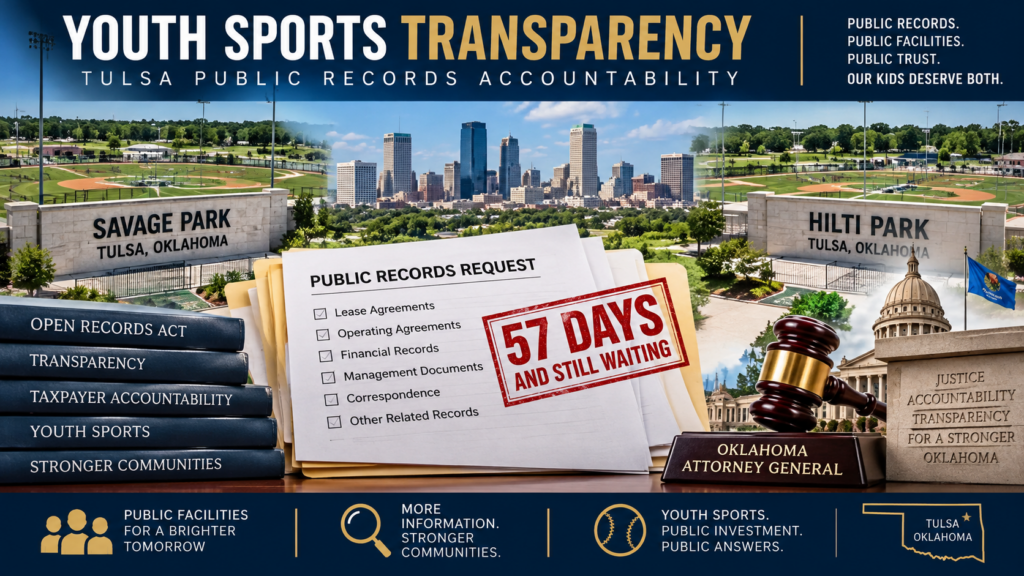
Tulsa's Youth Sports Facilities: The Continuing Wait for the Public Record
Savage Park, Hilti Park, and the history of City of Tulsa Open Records Request ORR2026-2950 and the Oklahoma Attorney General complaint.
Updated October 15, 2026 | Kenneth R. Crawford | Independent Youth Sports ResearchWho controls the fields? Who determines access, schedules tournaments, collects concession and gate receipts, and pays for maintenance? What do Tulsa taxpayers receive in return? These are the questions behind a public-records request concerning two City-owned youth sports complexes.
Why these parks matter
Savage Park is described in the independent facility research as a 13-field complex at 17800 E. 21st St., with a reported 2021 transition involving Tulsa Parks, the Tulsa Girls Softball Federation and Tulsa Little League. Hilti Park is described as a 15-field complex at 12148 E. 51st St.; supporting research refers to management by The Diamonds at LaFortune. These descriptions provide historical context, not verified terms of the executed City agreements.
Separate Tulsa County LaFortune Park litigation and youth sports governance issues are part of the broader research setting, but they do not prove wrongdoing in the City's response to this request. The immediate issue is access to identifiable public records.
Documented chronology
ORR2026-2950 was filed through the City of Tulsa JustFOIA portal, covering six categories of records about Savage and Hilti. The original seven-page portal record is preserved.
Based on a review of his mobile call history, the requester believes he called (918) 596-7513. He recalls a City representative saying the request was still being reviewed. The precise date, call duration and representative's identity are unverified.
The updated six-page portal capture still said “In Progress” and “No documents have been added.” This proves what the visible portal showed, not whether City personnel were working internally.
An automated Smartsheet confirmation thanked the requester for submitting the Public Access Counselor complaint to the Oklahoma Attorney General. It listed the original City request, updated portal record and complaint packet as attachments. No investigative outcome was reported.
A message to opengov@oag.ok.gov requested confirmation of assignment, City contact, an anticipated review timeline and any needed documentation. The October 15 sent email expressly refers to this October 12 follow-up, but the separate October 12 sent message has not been supplied here for independent inspection.
The requester reports that no responsive records or substantive AG update have been received. The October 9 portal capture remains the latest supplied documentary status evidence.
A saved copy of an email from Kenneth R. Crawford to opengov@oag.ok.gov, with the requester copied, documents a second follow-up regarding ORR2026-2950. The email asks whether the October 9 complaint was accepted for initial review; whether an initial review determination has been made; whether Tulsa was formally notified or asked for a written explanation; what review timeline applies; and whether further documents are needed. The requester states that no substantive response had been received as of the email's sending. The message is not evidence that the AG office received, read, or acted on it.
October 15 update — Following the established accountability process
Transparency also applies to the researcher's own conduct. Rather than treating an outstanding request as evidence of intentional wrongdoing, the researcher has documented the original filing, attempted direct follow-up with Tulsa, submitted the prescribed Attorney General Public Access Counselor complaint on October 9, and sent a second follow-up email on October 15 at 9:01 a.m., as documented by the saved email record.
The documented October 15 follow-up seeks five procedural clarifications: whether the complaint was accepted for initial review; whether further review is warranted; whether the City was notified or asked for a written explanation; what statutory or anticipated timelines apply; and whether further supporting documents are needed. These questions do not prejudge the City’s explanation or the Attorney General’s eventual advisement.
Evidence standard: The October 9 submission is documented by an automated Smartsheet confirmation with an attachment list. The October 15 second follow-up is supported by a saved sent-email copy with its time and full text. The separate October 12 email is referenced in the October 15 message but has not been independently inspected here. No unverified third-party account concerning the existence or expiration of a City lease is treated as an established finding.
Documentary update — What the October 15 evidence establishes
The October 9 Smartsheet confirmation is an automated acknowledgment of a submitted Public Access Counselor complaint. It identifies the City of Tulsa as the public body, August 17 as the original request date, and lists three uploaded files: the original City request detail PDF, the complaint packet, and the updated City request detail PDF. It does not confirm acceptance for investigation or an outcome.
The October 15 saved email is a direct record of the requester's second follow-up. It expressly states that he is not asking for preferential treatment and seeks a written procedural update for his research archive. This is evidence of the requester's documented effort to use the established complaint process, not proof that the City has violated the law or that the Attorney General has made any finding.
What the City was asked to produce
1. Leases and operating agreements
Leases, amendments, user agreements, management, facility-use and concession agreements, renewals, assignments and terminations for Savage and Hilti, principally January 2018–August 2026. The request identifies Tulsa Girls Fastpitch Association, Tulsa Girls Softball Association, Tulsa Little League and related names as possible parties where applicable, without assuming particular agreements exist.
2. Operator selection and transition, 2019–2022
RFPs, RFQs, proposals, evaluations, scoring, recommendations, council and parks board materials, approvals, termination notices and resulting contracts.
3. Financial terms and revenue rights
Rent, use fees, concessions, admission and tournament revenue, sponsorship rights, revenue sharing, utilities, maintenance and capital-improvement obligations, supported by actual existing agreements and payment records.
4. City expenditures, 2018–2026
Purchase orders, invoices, contracts, payment records, project authorizations, major repairs, capital improvements and grant-funded work.
5. Four-park operating structure, 2019–2022
Plans, solicitations, decisions and agreements relating to Savage Park, Hilti Park, Patrick Park and Bales Park and their proposed or selected user groups.
6. Operator-transition communications, 2020–2022
Specified City Parks and Recreation emails and written communications concerning operator selection, renewal, termination and transition. The original request names Parks, Legal, Finance and Procurement as possible custodians and expressly offers to clarify or narrow search terms.
What the historical facility data shows
The independent Hidden Valley — Integrity of the Game reports reconstruct public USSSA event activity. Their calculated team entry fees are teams × publicly posted entry fee, not verified collections, profit, City revenue or director compensation. The two facility reports include different available historical seasons.
| Research measure | Savage Park | Hilti Park |
|---|---|---|
| Direct calculated team entry fees | $2,731,173 | $846,336 |
| Direct event-associated teams | 10,877 | 4,187 |
| Direct minimum games | 34,305 | 8,435 |
| Direct minimum umpire assignments | 65,815 | 15,581 |
| Additional multi-facility associated calculated fees | $89,243 | $175,447 |
| Combined direct + associated activity | $2,820,416 | $1,021,783 |
| Direct sport profile | Predominantly softball | Baseball |
Savage's direct report assigns $2,726,753 in calculated fees to softball and $4,420 to baseball; Hilti's direct report identifies $846,336 for baseball. Association is not allocation: multi-facility event totals cannot be assigned exclusively to one location, and historical director listings do not prove individual receipt of money. These figures are research estimates, not audited financial findings. Executed agreements and payment records are necessary to identify real contractual revenue rights and City expenditures.
Why the Attorney General was contacted
The Public Access Counselor Unit advised use of the complaint procedure created following HB 2163. On October 9 the requester filed a signed complaint asking for review under the Oklahoma Open Records Act, including 51 O.S. § 24A.40, of whether access had been prompt and reasonable. The submitted packet documented the original request, the October 9 portal snapshot, the telephone recollection and willingness to clarify the email search.
The automated confirmation is evidence that the complaint was submitted. It does not show that an investigator has been assigned, the City contacted, a violation found or a remedy ordered. The requester's separate LaFortune research is context only; this complaint concerns the City of Tulsa's handling of ORR2026-2950.
Established facts versus open questions
| Supported by records or attributed account | Still unknown |
|---|---|
| Request filed August 17. | City's explanation for the processing timeline. |
| October 9 portal: In Progress, no posted documents. | Extent of internal search and review. |
| Requester recalls September status call. | Exact call details and official's identity. |
| AG complaint submission acknowledged October 9. | Assignment, investigation and outcome. |
| Independent historical event calculations exist. | Actual collections, revenue allocations and municipal receipts. |
| Request seeks leases and operating documents. | Actual current and historic contract terms and parties. |
Questions that the public records should help answer
- Which organizations were authorized to operate, schedule or manage each complex, and for which dates?
- What formal process selected or renewed each operator?
- Who held gate, concession, tournament, sponsorship and other revenue rights?
- What insurance, reporting, maintenance, public access and capital-improvement requirements applied?
- What City expenditures supported each park?
- Can identifiable executed agreements be produced before a broader email search is complete?
- What clarification, processing explanation or fee estimate, if any, will Tulsa provide?
Facility reports and public reference links
Research page · Full facility report (PDF) · Facility summary (PDF)
Research page · Full facility report (PDF) · Facility summary (PDF)
City of Tulsa public records portal · Oklahoma AG Public Access Counselor complaint information
Document inventory reviewed for this article: August 17 seven-page JustFOIA capture (the newly supplied copy is an August 17 snapshot, not a new October 15 status check); October 9 six-page JustFOIA capture preserved in the complaint packet; October 9 15-page complaint packet; October 9 automated Smartsheet complaint confirmation with three listed attachments; October 15 9:01 a.m. sent-email record; Savage Park seven-page full report and four-page summary; Hilti Park seven-page full report and six-page summary. The City request captures, complaint packet, confirmation and follow-up email have not been given public hosting URLs in the material supplied for this article. Upload redacted public copies before adding download links; do not publish private residential contact details or tracking tokens from portal URLs.
Next steps and continuing public record
This article is an ongoing archive, not a final judgment. Future updates should document any acknowledgment or substantive response to the October 15 email, obtain the separate October 12 email if needed, and record the date and substance of each City response, any fee or clarification request, partial production, AG acknowledgment, advisory determination or appeal. Documents should be linked to their exact source, and corrections dated rather than silently replacing earlier history.
The requester welcomes accurate responses, documents and corrections from the City of Tulsa, relevant facility operators and the Attorney General's Office. The goal is a record that families, local officials and researchers can evaluate for themselves.
The question is not whether a delay proves misconduct. It is whether the public can see the agreements governing its own fields.