Little League International — Better Together
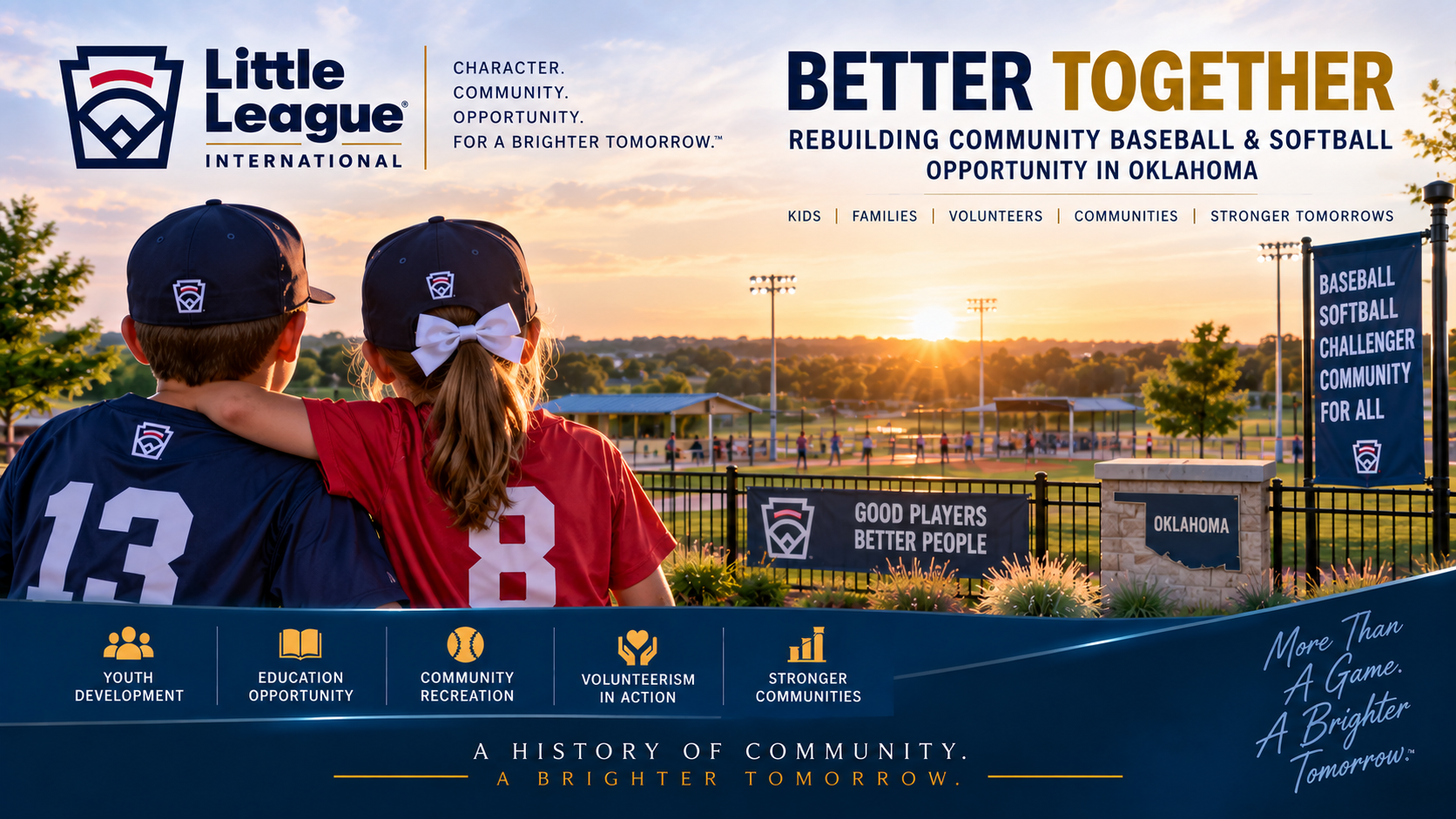
Rebuilding Community Baseball & Softball Opportunity in Oklahoma
A living institutional research profile examining Little League's community model, Oklahoma history and participation, facilities, governance, volunteer capacity and the conditions that could support sustainable growth alongside tournament and travel sports.
What if the goal is not to defend the past—but to understand what Oklahoma needs next?
Little League has a long Oklahoma history, a recognizable community-based model and current baseball and softball participation. The research question is why that footprint is limited in many communities and what conditions could allow sustainable expansion.
The history of disagreement is part of the record—not a reason to predetermine the conclusion.
Kenneth R. Crawford previously served within Oklahoma Little League district administration and has raised governance, eligibility, facility, participation and administrative concerns with Oklahoma leadership, the Southwest Region and Little League International. Some interactions involved disagreements and unresolved disputes.
One protocol for the entire Little League record.
Local league actions, district administration, Southwest Region decisions and Little League International policies are not treated as interchangeable.
What Little League is designed to do.
Community Chartering
Locally governed baseball and softball tied to communities and league boundaries.
Volunteer Infrastructure
Boards, coaches, umpires and local leadership provide much of the operating capacity.
Player Pathways
Baseball, softball, Challenger and teenage opportunities can connect local play to tournament progression.
Facility Support
Little League guidance addresses capital fundraising, grant resources and public-field relationships.
Affordability Tools
Local financial guidance and assistance mechanisms can help reduce participation barriers.
Regional Support
The Southwest Region provides tournament, training, operational and volunteer-support infrastructure for Oklahoma and neighboring states.
A long history deserves a long view.
Oklahoma has decades of Little League history, state champions, local leagues, volunteers and facilities. Better Together should examine how that footprint changed over time rather than beginning with the assumption that one modern controversy explains the statewide condition.
Historical Footprint
State-championship and league history can help identify where community programs existed, persisted, consolidated or disappeared.
Current Participation
Tulsa National represented Oklahoma in the 2026 Southwest Region baseball and softball tournaments, demonstrating continuing participation in both sports.
Multiple Pathways
Baseball, softball, Challenger and teenage programs provide a broader institutional model than a single tournament division.
Who controls the field can shape what kind of program can exist.
Community recreation requires recurring access to fields, practice space, maintenance, scheduling and volunteers. Tournament and travel sports may seek many of the same public assets. Better Together asks how municipalities can accommodate both without assuming that one model must eliminate the other.
Explore Field Control ResearchResponsibility should be assigned to the level where the decision actually occurred.
The research should distinguish local eligibility, league operations and board decisions from district administration, regional review and Williamsport policy or oversight. “Little League” should not be used as a catch-all attribution when the record identifies a more specific decision-maker.
Document what changed. Do not invent why.
Blaine Whitmire appointed Southwest Region Director
Little League International publicly announced Whitmire's appointment, effective March 28, 2022.
A — Documented FactHouston District Administrators meeting
Kenneth Crawford recalls a conversation with Elizabeth DiLullo Brown concerning the Oklahoma youth-sports environment, USSSA litigation and an anticipated Little League capital-funding initiative. Unless corroborating records are located, this remains first-person recollection.
D — First-Person RecollectionWhitmire no longer a Little League International employee
A communication attributed to Senior Director of Regional Operations Corey Wright informed Southwest Region District Administrators that Whitmire was no longer an employee and directed matters through Assistant Region Director Brant Durden during the transition.
A — Documented FactA governance-learning case—not the identity of the entire profile.
The 2026 Tulsa National eligibility disputes belong in the research because Little League's own public tournament pages and official statements provide an authoritative record that can be compared with local, district and regional documentation.
Test the statewide ecosystem—not a single explanation.
Historical Footprint
What do league, charter, championship and participation records show over time?
Baseball & Softball
Where do the sports follow similar or different participation, facility and volunteer patterns?
Public Facilities
How do ownership, scheduling, leases and tournament demand affect recurring community play?
Affordability
What are actual family and league costs, and where can assistance reduce barriers?
Volunteer Workforce
What conditions recruit and retain boards, coaches and umpires?
Governance
How should responsibility be distinguished among local, district, region and Williamsport?
Growth Tools
Which affiliation, grant, capital, Challenger and training resources are being used in Oklahoma?
Competing Models
What does tournament/travel growth explain—and what other explanations must be considered?
Little League cannot rebuild community opportunity alone—and Oklahoma cannot do it without local institutions.
The record should be open to correction, challenge and successful counterexamples.
Little League International, Southwest Region personnel, Oklahoma District leadership, local leagues and other stakeholders are invited to identify errors, supply missing records, challenge interpretations and document successful Oklahoma models the research may have overlooked.
Start with the concise brief. Then test the underlying record.
Oklahoma Executive Brief
A concise six-page summary of the institutional model, evidence standard, Oklahoma research questions, collaboration opportunities and recommended outreach posture.
View Executive Brief →Related Baseball Heaven Research
Existing Little League history, facility research, organizational analysis and comparative work remain evidence sources for this living profile.
Research Summary →A community-based model with a century of history. A state where its footprint has changed. A research question about what comes next.
The goal is not to decide whether Little League or another model “wins.” It is to understand what each model is best equipped to do and what Oklahoma must build around them so children and communities have meaningful choices.
Return to Better Together →